
Yes, electric vehicles can genuinely tow — modern EV trucks and SUVs now match or exceed comparable gas vehicles in raw towing capacity, with electric trucks like the 2026 Chevrolet Silverado EV and GMC Sierra EV rated up to 12,500 lbs — but towing cuts real-world range by 30-60%, which is the actual limitation, not the vehicle’s ability to pull weight. EVs also offer genuine towing advantages gas vehicles can’t match: instant torque from a standstill, superior stability from a low-mounted battery pack, and smoother acceleration under load.
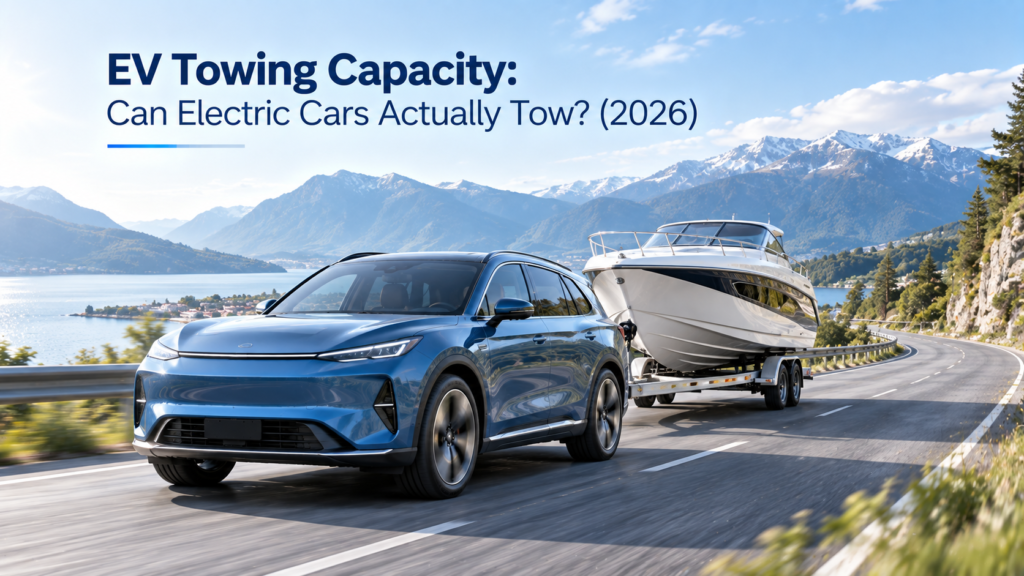
This guide covers how much EV towing actually reduces range, which vehicles offer the strongest capacity, and how to plan a towing trip that accounts for an EV’s specific limitations.
Can Electric Vehicles Actually Tow Heavy Loads?
Yes, unambiguously — towing capability itself is not the limiting factor for modern EVs. Electric SUVs currently offer towing capacities up to 10,000 lbs, while electric trucks reach 12,000-14,000 lbs, putting them on comparable footing with equivalent gas-powered vehicles in the same class. EVs bring specific mechanical advantages to towing that gas vehicles don’t have: instant torque delivery means no lag when pulling away from a stop with a loaded trailer, and the battery pack’s low, centered weight distribution improves stability compared to a gas truck’s higher center of gravity — a genuinely relevant safety factor when hauling a heavy trailer.
The Real Limitation: Range, Not Power
Towing reduces an EV’s real-world range by roughly 30-60%, and this — not raw pulling power — is the actual constraint on long-distance EV towing in 2026. A truck rated for 300 miles unloaded might realistically deliver only 120-180 miles with a trailer attached. This is a fundamentally different problem than gas-vehicle towing, where a driver just accepts worse fuel economy and refuels in five minutes — an EV towing at reduced range needs meaningfully more frequent charging stops, and not every charging station is designed with trailer access in mind.
Range impact scales with several factors:
| Factor | Effect on Range |
|---|---|
| Trailer weight (light to moderate) | 20-35% reduction |
| Trailer weight (near maximum capacity) | 45-60% reduction |
| Highway speed (65-70 mph) | Amplifies reduction further |
| Cold weather + towing combined | Can compound to 50%+ reduction |
| Commercial vans, half load | ~7-11% real-world range dip |
| Commercial vans, full load + towing | Up to 31% reduction |
2026 EV Towing Capacity by Model
Several 2026 electric trucks now offer towing capacity that genuinely competes with traditional gas trucks in the same segment:
| Model | Max Towing Capacity | Max Range (Unloaded) | Estimated Towing Range |
|---|---|---|---|
| 2026 Chevrolet Silverado EV | 12,500 lbs | Up to 493 miles | ~200+ miles |
| 2026 GMC Sierra EV | 12,500 lbs | Up to 478 miles | ~190-240 miles |
| Rivian R1T | 11,000 lbs (at max capacity) | Varies by configuration | ~50% of unloaded range |
| Ram 1500 Ramcharger (range-extended) | 14,000 lbs | 145 mi EV-only / 690 mi total | Eliminates towing range anxiety via onboard generator |
The Ramcharger’s approach is worth noting specifically — by pairing an EV drivetrain with a small onboard generator that recharges the battery on the move, it sidesteps the towing range problem entirely, offering a genuinely different solution than a pure battery-electric truck for owners who tow frequently over long distances.
How to Plan a Towing Trip With an EV
Trips under roughly 200 miles with towing are realistic today along routes with reliable DC fast charging infrastructure; trips into remote areas without charging access remain genuinely impractical.
- Plan your route around charging stations, not just distance — verify that stations along your route can actually accommodate a vehicle with a trailer attached, since not all charging bays are designed for this
- Budget for more frequent, shorter charging stops than you would for an unloaded trip, since towing range drops mean you’ll need to charge sooner and more often
- Check your specific vehicle’s published towing range estimates if available — Rivian, for example, publishes that its R1T can expect roughly a 50% range reduction at maximum towing capacity, giving owners a concrete planning number rather than guesswork
- Use a trailer with its own braking system for heavier loads — this improves both safety and how effectively the tow vehicle’s systems can manage the additional weight
- Account for reduced regenerative braking effectiveness when towing heavier loads, since regen braking recaptures less energy proportionally under heavier towing weight
Does Cold Weather Make EV Towing Worse?
Yes — cold weather and towing compound each other, since both independently reduce EV range, and combining them can push total range reduction well past 50% in worst-case conditions. This is worth specific attention when planning a winter towing trip, since the range estimate that felt comfortable in mild weather can become genuinely tight once temperatures drop and a trailer is attached simultaneously.
Does Towing Stress the Battery and Cooling System More?
Yes — towing increases heat generation in both the motor and battery pack, making a properly functioning cooling system more important than during normal unloaded driving. Confirming your EV’s cooling system is in good working order before a demanding tow, particularly in hot climates or on long uphill grades, is a reasonable precaution rather than an unnecessary one. This connects to the same thermal management principles covered in our EV Battery Preconditioning guide, where heat management directly affects both performance and long-term battery health.
Is EV Towing Practical for Regular, Heavy-Duty Use?
For most owners — weekend recreation, regional trailer trips, and local equipment hauling — modern EV trucks handle towing comfortably within realistic range expectations. For owners planning to tow at or near maximum capacity across long distances on a regular, weekly basis, the range and charging-stop overhead genuinely make current battery-electric trucks a less practical choice than a diesel equivalent or a range-extended option like the Ramcharger. The honest assessment from truck-focused reviewers is consistent: the limitation with EV towing in 2026 is range, not capability — the trucks can genuinely pull the weight, but planning around reduced range and charging infrastructure remains a real, ongoing consideration.
Common Myths About EV Towing
“EVs don’t have enough power to tow heavy trailers.” Not accurate. Modern electric trucks match or exceed comparable gas trucks in raw towing capacity — the top 2026 models pull up to 12,500 lbs, putting them firmly in serious towing territory rather than a compromised “good enough for an EV” figure.
“Towing range loss is roughly the same as just driving normally with a heavier car.” Towing has a disproportionately larger impact than simply adding weight — the aerodynamic drag from a trailer, combined with the extra load, compounds to a 30-60% range reduction, far beyond what added weight alone would cause.
“You can’t safely brake with a heavy trailer on an EV.” Regenerative braking effectiveness is reduced when towing heavier loads, but this doesn’t mean unsafe braking — using a trailer equipped with its own braking system, as recommended for any heavier tow regardless of vehicle type, addresses this directly.
“EV towing is only practical for short local trips.” This is true for towing near maximum capacity into remote areas without charging access, but trips under roughly 200 miles along routes with reliable DC fast charging infrastructure are genuinely practical today, not just theoretical.
Does This Apply to EVs in Malaysia?
Towing isn’t a common use case for the compact and mid-size EVs currently dominant in the Malaysian market — most locally available models like the BYD Atto 3 or Proton eMas 7 aren’t marketed or rated as towing vehicles the way North American electric trucks are. For Malaysian EV owners with occasional towing needs (a small trailer or boat, for instance), checking your specific model’s owner’s manual for any rated towing capacity is essential, since unlike the dedicated electric trucks covered in this guide, many mainstream passenger EVs aren’t designed or rated for towing at all.
What Buyers Should Check Before Assuming Towing Capability
Before assuming any EV can tow, confirming the manufacturer’s rated capacity in the owner’s manual or on the door-jamb sticker is essential — towing figures vary significantly even within the same model line depending on trim, motor configuration, and whether a specific tow package was included. Manufacturers also often distinguish between a maximum theoretical capacity and a more conservative recommended capacity for regular use, so it’s worth checking both figures rather than assuming the headline number applies to every real-world scenario. Independent towing specification databases, updated regularly as new model years and trims are released, can also help verify a specific configuration’s actual rated capacity against manufacturer claims.
Final Thoughts
Electric vehicles can absolutely tow, and modern EV trucks now match traditional gas trucks in raw towing capacity — the genuine limitation in 2026 is the 30-60% range reduction that comes with pulling a loaded trailer, not any deficiency in pulling power. For weekend trips, regional hauls, and towing within a few hundred miles of reliable DC fast charging, EV towing is a practical, often smoother experience thanks to instant torque and superior stability from the low battery placement. For frequent, long-distance, near-maximum-capacity towing, the charging-stop overhead remains a genuine practical trade-off worth weighing against a traditional gas or range-extended alternative.
Frequently Asked Questions
How much does towing reduce an EV’s range?
Typically 30-60%, depending on trailer weight, speed, and weather conditions — a truck rated for 300 miles unloaded might realistically achieve only 120-180 miles while towing.
What’s the maximum towing capacity of an electric truck in 2026?
Top electric trucks like the 2026 Chevrolet Silverado EV and GMC Sierra EV are rated up to 12,500 lbs, while the range-extended Ram 1500 Ramcharger reaches 14,000 lbs.
Is EV towing safe?
Yes — EVs offer genuine towing advantages including instant torque and improved stability from the low-mounted battery pack, though heavier loads reduce regenerative braking effectiveness, so trailer-mounted brakes are recommended for heavier loads.
Can I tow long distances with an EV?
Trips under roughly 200 miles are practical today with proper route planning around DC fast charging, but remote areas without reliable charging infrastructure remain genuinely impractical for long-distance towing.
Does cold weather make EV towing range worse?
Yes — cold weather and towing compound each other, and combined can push total range reduction well past 50% compared to unloaded, mild-weather driving.