
EV battery preconditioning is a feature most owners first hear about through cold-weather advice written for the US, UK, or Europe — heat the battery before a winter fast charge, or risk painfully slow charging speeds. For Malaysian EV owners, that advice is almost entirely irrelevant, which raises a genuinely useful question: does preconditioning matter at all in a climate that never sees freezing temperatures?
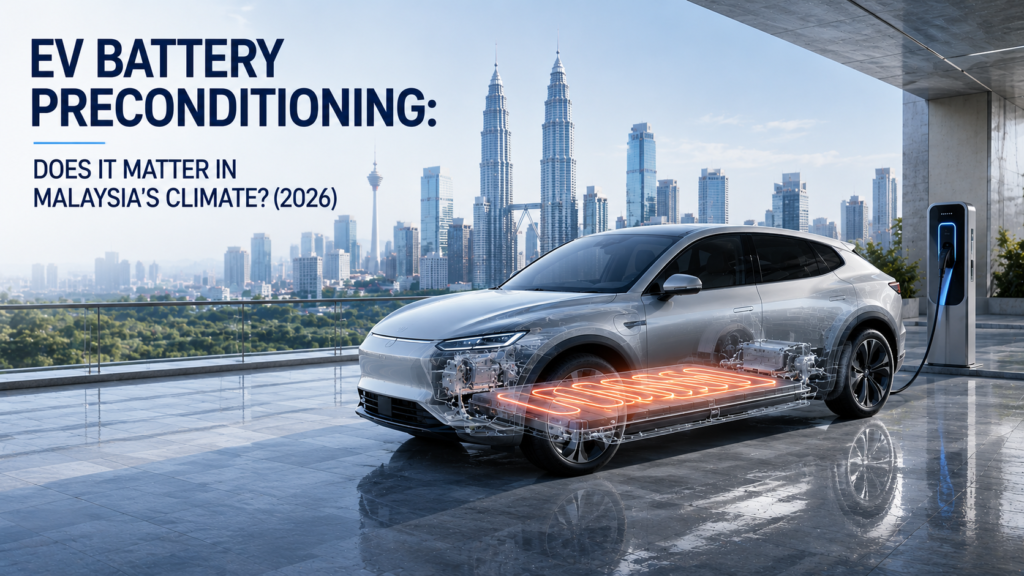
The answer is more nuanced than a simple yes or no. This guide explains what battery preconditioning actually does, why the cold-weather use case doesn’t apply here, and the specific situations where it genuinely still matters for EV owners driving in Malaysia’s heat.
What Is Battery Preconditioning?
Battery preconditioning is a thermal management process that actively heats or cools an EV’s battery pack to bring it within its optimal operating temperature window before charging or driving. Lithium-ion cells generally perform best within a range of roughly 20°C to 30°C (68°F to 95°F) — inside that window, ions move freely between electrodes, allowing the battery to safely accept high charging power and deliver consistent performance. Outside that window in either direction, charging speed and performance both suffer.
Why Most Preconditioning Advice Doesn’t Apply in Malaysia
The vast majority of preconditioning content published online focuses on cold-weather scenarios, and for good reason — in freezing temperatures, a cold battery’s electrolyte becomes more viscous, ions move sluggishly, and the battery management system deliberately reduces charging power to prevent lithium plating, a damaging condition where metallic lithium deposits on the electrode surface instead of properly absorbing into it. In genuinely cold climates, an unconditioned battery can charge at roughly half the speed of a properly preconditioned one.
None of this applies to daily driving in Malaysia. With year-round ambient temperatures typically sitting well above 25°C, Malaysian EV batteries essentially never face the cold-start charging penalty that dominates preconditioning advice written for temperate or cold climates. If you’ve read guides recommending you precondition your battery 20-30 minutes before a winter fast charge, that specific advice simply isn’t relevant here.
Where Preconditioning Still Matters in Malaysia: The Heat Problem
Here’s the part most generic preconditioning guides miss entirely: temperature management works in both directions. Just as a battery that’s too cold charges slowly, a battery that’s too hot also charges slowly — and Malaysia’s heat creates exactly this scenario more often than most owners realize.
Cars Parked in Direct Sun
A vehicle parked outdoors under Malaysia’s intense equatorial sun for several hours can see its battery temperature climb well above the 20-30°C optimal window, sometimes exceeding 40°C even before you start driving. When you arrive at a DC fast charger with an already-hot battery, the car’s thermal management system has to actively cool the pack before — or even during — charging, which can throttle charging speed rather than allow it to ramp up quickly.
Hot-Weather Fast Charging Throttling
Unlike cold climates, where the charging limitation comes from a sluggish, underheated battery, hot ambient conditions create a different bottleneck: reduced heat rejection capacity. If the heat generated during fast charging exceeds what the battery’s cooling system can dissipate, the car automatically throttles charging speed to keep the pack within safe temperature limits. This means on Malaysia’s hottest afternoons, particularly after highway driving that’s already warmed the battery through use, fast charging speeds can genuinely suffer — not because the battery is cold, but because it’s already running hot before charging even begins.
Back-to-Back Fast Charging on Road Trips
If you’re driving a longer route — say, from Kuala Lumpur toward Penang or Johor Bahru — and stopping at multiple DC fast chargers along the way, the battery may not have adequate time to cool between charging sessions. Each fast charge session adds heat, and in Malaysia’s already-warm ambient conditions, that heat has less opportunity to dissipate naturally compared to a cooler climate. This is one of the more practical scenarios where active preconditioning — in this case, active cooling rather than heating — genuinely helps maintain consistent charging speeds across a multi-stop journey.
How Preconditioning Works When It’s Too Hot, Not Too Cold
Most owners assume preconditioning only means warming up a battery, but the same system works in reverse. If a battery is too hot, the vehicle’s thermal management system actively cools it before you arrive at a fast charger, using the same climate control infrastructure that would otherwise heat the pack in cold conditions. Extremely hot batteries charge slowly for a straightforward safety reason: the car’s systems reduce power specifically to prevent overheating, protecting both charging speed and long-term battery health simultaneously.
Common Myths About Battery Preconditioning in Malaysia
“Preconditioning only matters in cold countries, so it’s irrelevant here entirely.” Not quite — while the cold-weather use case doesn’t apply, the heat-related version of preconditioning genuinely matters for Malaysian owners, particularly before fast charging on hot days or after a car has been parked in direct sun.
“My EV never needs preconditioning if I live somewhere tropical.” For most daily driving, this is largely true, since ambient temperatures rarely push the battery outside its optimal range. But road trips involving multiple fast-charging stops are a genuine exception worth planning around.
“If my charging speed drops, something is wrong with the charger.” Not always. A battery that’s already hot from sun exposure or highway driving can cause the car itself to throttle charging speed as a protective measure, which can look identical to a charger-side problem but isn’t actually one.
“Preconditioning always means heating the battery.” This is the most common misconception. Preconditioning works in both directions — the same thermal management system that would heat a cold battery in a temperate climate cools an overheated one in Malaysia’s climate, using the same underlying mechanism.
How This Differs From Cold-Climate EV Ownership
It’s worth explicitly contrasting the Malaysian experience with what EV owners in colder climates deal with, since so much online content assumes a cold-climate baseline. In places with real winters, preconditioning is often a deliberate, planned step — owners manually trigger battery heating 20-30 minutes before a fast charge to avoid the dramatic charging speed penalty that comes with a cold battery. In Malaysia, this entire category of concern simply doesn’t exist for the vast majority of driving. Instead, the equivalent consideration is more passive: parking in shade when possible, being mindful of back-to-back fast charging on hot days, and understanding that unexpectedly slow charging on a scorching afternoon likely traces back to heat management rather than any fault with your vehicle or the charging station.
Should Malaysian EV Owners Actively Use Preconditioning?
For most daily driving and short trips, actively triggering preconditioning isn’t necessary — Malaysia’s consistent warmth means the battery is rarely far outside its optimal window during typical use. However, a few specific situations are worth the extra step:
- Before a fast-charging stop on a long road trip, particularly after your car has been parked in direct sun for an extended period, triggering preconditioning (if your model supports manual activation) can help the thermal management system get ahead of cooling the pack before you arrive
- After highway driving in peak afternoon heat, if you know you’ll be fast charging soon after, allowing the navigation system to route you to a charger (many EVs automatically begin preconditioning when a charging stop is set as a destination) can help avoid a slower-than-expected charging session
- When charging speed at a DC fast charger seems unexpectedly slow, checking whether the battery was already hot before you arrived is a useful diagnostic step before assuming something is wrong with the charger itself
Does Preconditioning Affect Battery Health in Malaysia’s Climate?
Yes, indirectly. Keeping the battery within its optimal temperature range during charging isn’t just about speed — it also reduces stress on the battery pack over time. Consistently charging a battery that’s running hot, without adequate cooling, can contribute to accelerated degradation over the long term, which connects directly to broader climate-related battery health considerations for EV owners in Malaysia. If you’re interested in how Malaysia’s tropical climate affects long-term battery health beyond just charging speed, our EV Battery Lifespan Guide for Malaysia covers degradation factors specific to local conditions in more depth.
Practical Tips for Malaysian EV Owners
- Park in shade or a covered area when possible, especially before a planned fast-charging trip, since this reduces how hot the battery gets before you even start driving
- Use your EV’s navigation system to set a charging stop as a destination, since many modern EVs automatically trigger appropriate thermal management (heating or cooling) when a charger is set as the destination, without requiring manual preconditioning
- Avoid back-to-back fast charging sessions without a break on longer trips if you notice charging speeds dropping — a short stop to let the battery cool naturally can help subsequent charging sessions perform better
- Don’t worry about cold-weather preconditioning advice you find in international guides — it simply doesn’t apply to Malaysia’s climate, and following it (like preconditioning to warm a battery that’s already warm) offers no benefit
- Check your specific model’s preconditioning behavior, since some EVs handle this fully automatically while others require manual activation through the infotainment system or a connected app
What About EVs Without Manual Preconditioning Controls?
Not every EV sold in Malaysia offers a manual button or app trigger for battery preconditioning — some rely entirely on automatic thermal management that runs in the background without any driver input. If your vehicle falls into this category, the practical takeaway doesn’t really change: the same passive habits (parking in shade, avoiding unnecessary back-to-back fast charging on the hottest days) still help, since the car’s automatic systems are working with whatever starting temperature the battery already has when you begin a charging session. For models that do include manual battery preconditioning controls, checking your owner’s manual or infotainment settings is worth the five minutes it takes, since the toggle is sometimes buried in a climate or “trip planning” menu rather than somewhere obvious.
Final Thoughts
EV battery preconditioning in Malaysia’s climate flips the usual script most owners read about online. The classic cold-battery charging penalty essentially doesn’t exist here, but the inverse problem — an overheated battery from direct sun exposure or back-to-back fast charging — genuinely can slow down your charging sessions and add unnecessary stress to the battery over time. For most daily driving, Malaysia’s consistent warmth means you don’t need to think about preconditioning at all. But before a long fast-charging road trip, especially after your car has been baking in direct sun, understanding that your EV’s thermal management system is working to cool the battery — not heat it — is the more useful mental model for anyone driving electric in the tropics.
Frequently Asked Questions
Do I need to precondition my EV battery before charging in Malaysia?
Generally not for routine daily charging, since Malaysia’s climate rarely pushes battery temperature outside its optimal range during normal use. It matters more specifically before fast charging after your car has been sitting in direct sun or during back-to-back charging stops on a road trip.
Why does my EV charge slower on a very hot day in Malaysia?
If your battery is already hot from sun exposure or highway driving, the car’s thermal management system may throttle charging speed to protect the battery from overheating, which is a hot-climate equivalent of the cold-weather charging penalty seen elsewhere.
Is cold-weather preconditioning advice from US or European guides relevant here?
No. That advice addresses heating a cold battery before charging, which essentially never applies in Malaysia’s consistently warm climate.
Can preconditioning damage my battery if used unnecessarily?
No, but it does use a small amount of energy from the battery or grid (if plugged in) to run the thermal management system, so there’s little benefit to triggering it when the battery is already within its optimal range.
Does my EV automatically precondition the battery, or do I need to do it manually?
This varies by model — many modern EVs automatically begin appropriate thermal management when a charging stop is set as a navigation destination, while others require manual activation through the infotainment system.