
Vehicle-to-Load (V2L) is a feature that lets an EV discharge power from its high-voltage battery to run external devices — appliances, tools, or even another EV — through a built-in outlet or adapter, turning the car into a mobile power bank capable of outputs typically ranging from 1.5 kW to 3.6 kW on passenger EVs, and up to 10.2 kW on high-output electric trucks. Unlike charging your car, which draws power in, V2L flows power the other way — out of the battery and into whatever you plug in — with no special installation, permit, or grid connection required.
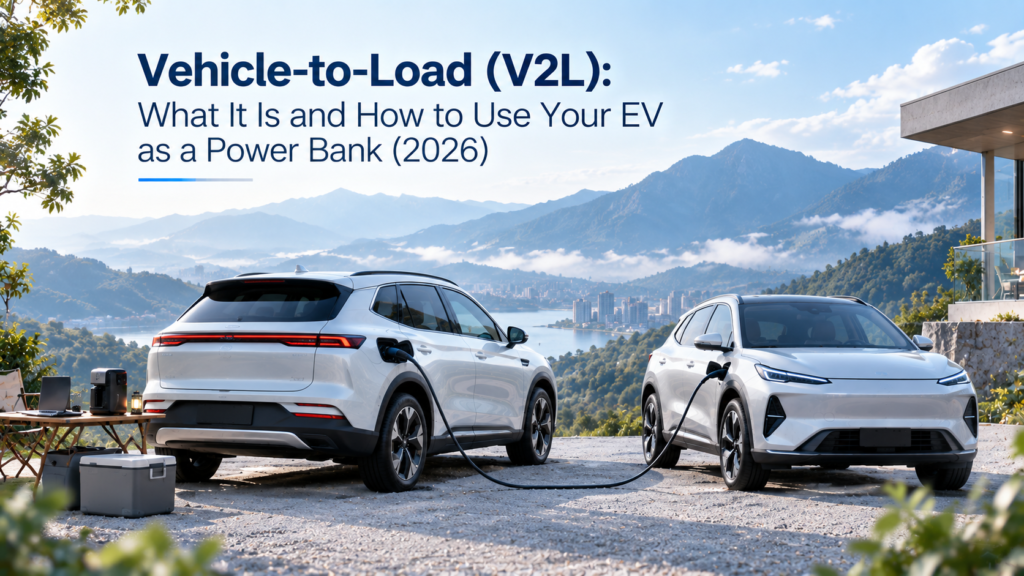
This guide explains exactly how V2L works, which EVs support it as of 2026, what it can and can’t realistically power, and how to use it safely.
How V2L Actually Works
The process happens in three steps: the EV’s lithium-ion battery stores energy as direct current (DC), an onboard inverter converts that DC power into standard AC electricity, and external devices connect either through a built-in outlet or a charge-port adapter. This is the same inverter that normally works in reverse to charge the battery from an AC wall socket — V2L simply runs that same hardware backward, delivering power out instead of drawing it in. The vehicle’s software manages load limits throughout, cutting power or throttling output if a connected device draws more than the system can safely deliver.
Key distinction: V2L is unidirectional — energy flows only out of the battery, with no ability to recharge the EV through this same connection. This sets it apart from Vehicle-to-Home (V2H) and Vehicle-to-Grid (V2G), which are more complex bidirectional systems requiring additional home equipment; V2L needs none of that.
How Much Power Can You Actually Get?
A typical EV battery holds 60-100 kWh — roughly 30 to 50 times the capacity of even a high-end 2-3 kWh portable power station. To put this in practical terms: a 77 kWh battery can run a 2.4 kW household load for approximately 24 continuous hours, making V2L genuinely useful for extended power needs rather than just topping up a phone.
V2L output limits vary meaningfully by vehicle:
| Output Level | Typical kW | Example Use Case |
|---|---|---|
| Standard passenger EV | 1.5-3.6 kW | Laptops, lights, small appliances, camping gear |
| BYD models (Atto 3, Dolphin, Seal) | ~3.3 kW | Same as above, slightly higher headroom |
| High-output electric trucks | Up to 10.2 kW | Power tools, larger appliances, job-site equipment |
Which EVs Support V2L in 2026?
V2L has moved from a rare feature to near-standard equipment on new EVs — dozens of models now offer it, with the list expanding every year. Notable examples include:
- Hyundai IONIQ 5, IONIQ 6, and IONIQ 9 — V2L standard, up to 3.6 kW
- Kia EV3, EV5, EV6, and EV9 — built on the same E-GMP platform as Hyundai, V2L included on most trims
- BYD Atto 3, Dolphin, Seal, and Sealion 6 — V2L on most market versions, around 3.3 kW
- Genesis GV60, Electrified GV70, and Electrified G80 — V2L via an included external adapter
- Polestar 3 and Polestar 4, Volvo EX30 and EX90 — bidirectional charging supporting V2L and beyond
Before assuming your EV has V2L, check whether the required adapter is included in the box or needs separate purchase — some brands bundle the vehicle load cable, while others treat it as an accessory buyers need to source themselves.
What Can You Actually Power With V2L?
V2L is well-suited for portable and short-term power needs — camping equipment, power tools, laptops, small kitchen appliances, and emergency device charging during outages — but it cannot energize a home’s full electrical circuits the way V2H can. For household emergency use, the practical approach is running an extension cord from the EV’s built-in outlet to a power strip with overload protection, distributing electricity to multiple devices while staying within the vehicle’s rated output.
Common V2L use cases:
- Camping and outdoor recreation — running lights, coolers, or a portable stove
- Job-site power — running tools without a separate generator
- Emergency backup during grid outages — keeping a fridge, fans, or medical equipment running temporarily
- Tailgating and events — powering speakers, lights, or small appliances
- Charging another EV in a pinch — using one car’s battery to give another a small emergency top-up
V2L vs V2H vs V2G: Knowing the Difference
These three terms get confused constantly, but they represent genuinely different levels of capability and complexity.
- V2L (Vehicle-to-Load): The car powers a device directly through an outlet or adapter — no special equipment, no grid connection, works immediately with any V2L-capable EV.
- V2H (Vehicle-to-Home): The EV powers a home’s electrical circuits, requiring additional home equipment (a bidirectional charger and often an inverter/transfer switch) to integrate with household wiring.
- V2G (Vehicle-to-Grid): The EV sells power back to the electricity grid, requiring a compatible bidirectional charger, utility program enrollment, and often a specific tariff arrangement.
V2L is the simplest of the three by a wide margin — it’s the only one that works out of the box with no additional hardware, permits, or utility involvement, which is exactly why it’s become so widely available across EV models while V2H and V2G remain far less common.
How to Use V2L Safely
- Check your total connected load against the vehicle’s rated output — exceeding the limit will trigger the system to cut power or throttle output automatically, but it’s better to plan within limits from the start
- Use a power strip with overload protection (preferably 12-gauge or lower cabling) when running multiple devices through an extension cord
- Don’t rely on V2L as a substitute for proper home backup power for critical medical equipment — it’s a portable and short-term solution, not a certified home backup system
- Monitor your EV’s remaining range while using V2L for extended periods, since discharging the battery for external use reduces how far you can drive afterward
- Confirm your specific model’s adapter requirements before you need V2L in an emergency — discovering you need a separate cable during a power outage isn’t the ideal time to find out
Common Myths About V2L
“V2L can power my entire house during an outage.” Not accurate. V2L powers individual devices through an extension cord and power strip, not a home’s wired electrical circuits. That capability belongs to V2H, which requires additional bidirectional charging hardware and professional installation.
“Using V2L will quickly wear out my EV battery.” Occasional V2L use for camping, tools, or short-term emergencies has a negligible impact on battery health, since it’s essentially the same kind of discharge cycle the battery already experiences during normal driving.
“Every EV can be plugged in to power devices.” Not yet — while V2L has become increasingly common, it’s still not universal across all EV models, and some vehicles that do support it require a separate adapter not included in the standard purchase.
“V2L and V2G are basically the same thing.” They’re fundamentally different. V2L simply powers a device directly with no grid involvement, while V2G sells power back to the electricity grid and requires a compatible bidirectional charger plus utility program enrollment.
Does V2L Affect Battery Health?
Using V2L occasionally for camping, tools, or emergency backup has a negligible impact on long-term battery health, since it’s functionally similar to any other discharge cycle the battery already experiences during normal driving. Frequent, heavy V2L use that regularly drains the battery to very low levels before recharging is the scenario worth moderating, following the same general principle covered in our EV Battery Degradation research guide — avoiding habitual deep discharges preserves long-term capacity regardless of whether the discharge comes from driving or V2L use.
Is V2L Available in Malaysia?
Several EVs sold in Malaysia — including the BYD Atto 3, which comes with a complimentary V2L adapter as part of its 2026 launch package — support this feature locally. If you’re considering an EV specifically for its V2L capability, checking whether the adapter is included with your specific Malaysian-market trim, rather than assuming it matches international specifications, is worth confirming with the dealer before purchase. Our BYD Atto 3 Malaysia review covers what’s included in the current local launch package.
The Bigger Picture: EVs as Mobile Energy Assets
V2L represents an early, accessible step in a broader shift toward EVs functioning as flexible energy assets rather than purely transportation. As V2H and V2G technology matures and becomes more widely available, the same battery pack sitting in a driveway could eventually do far more than power a few devices — participating in home backup systems or even earning money by selling stored power back during peak grid demand. V2L is the version of this idea that’s already here, working today with no waiting list, no permits, and no additional purchase beyond the vehicle (and sometimes a simple adapter) itself.
Final Thoughts
Vehicle-to-Load transforms an EV’s substantial battery capacity into a genuinely useful, no-hassle power source — capable of running everything from camping gear to emergency household devices without any special installation, permits, or grid involvement. With dozens of 2026 models now offering V2L as standard or via an included adapter, it’s increasingly a baseline feature worth checking for on any new EV purchase, even if you don’t have an immediate use case in mind. Understanding its limits — no home circuit backup like V2H, no grid resale like V2G, and output capped well below what a generator can deliver on the largest trucks — helps set realistic expectations for what is otherwise one of the more genuinely practical everyday features to come out of the EV transition.
Frequently Asked Questions
What’s the difference between V2L and V2H?
V2L powers individual devices directly through an outlet with no special equipment, while V2H powers an entire home’s electrical circuits and requires additional bidirectional charging hardware to integrate with household wiring.
How long can an EV run a device using V2L?
A typical 77 kWh battery can run a 2.4 kW load for roughly 24 continuous hours, though actual runtime depends on your specific battery size and the power draw of whatever you’re running.
Does using V2L drain my EV’s driving range?
Yes — any energy discharged through V2L comes from the same battery used for driving, so extended V2L use will reduce your remaining range until you recharge.
Do all EVs come with the adapter needed for V2L?
Not always. Some brands include the vehicle load cable or adapter in the box, while others require purchasing it separately — this is worth confirming for your specific model before you need it.
Is V2L available on EVs sold in Malaysia?
Yes, several models available in Malaysia support V2L, including the BYD Atto 3, which includes a complimentary V2L adapter as part of its current launch package.