
EV range anxiety is still the number one reason people hesitate before buying an electric car — but the gap between how scary it sounds and what actually happens on the road has never been wider. In 2026, most of what people fear about running out of charge simply doesn’t match how modern EVs, charging networks, and real driving patterns actually work.
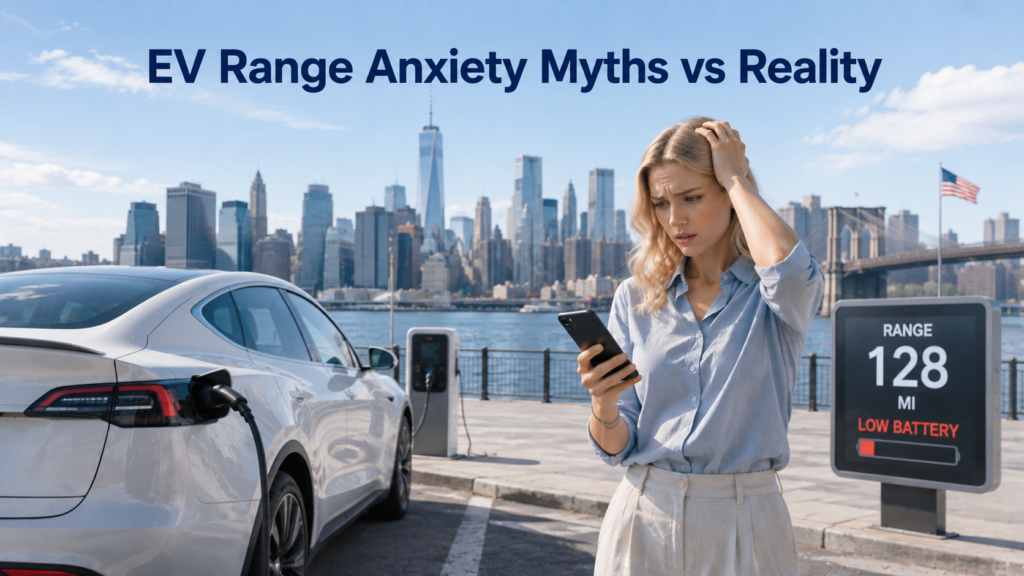
This guide separates EV range anxiety myths from what the data actually shows, using real-world driving statistics, survey research, and charging infrastructure numbers from the US, UK, and beyond — plus a look at how it applies if you’re driving in Malaysia too.
What Is EV Range Anxiety, Exactly?
EV range anxiety is the fear that an electric vehicle’s battery will run out before reaching your destination, leaving you stranded without a way to recharge. It’s a psychological barrier more than a technical one — and understanding that distinction is the first step to seeing why it matters less than most people assume.
Myth #1: “EVs Don’t Have Enough Range for Daily Driving”
The myth: Most people assume an EV’s range won’t cover their normal day-to-day driving.
The reality: The average American drives between 20 and 45 miles per day, while most mainstream EVs sold between 2024 and 2026 offer 230 to 320 miles of range, with some long-range models exceeding 400 miles. More than 98% of on-road passenger trips in the US are under 75 miles. In other words, a single charge covers the average driver’s needs for the better part of a week, not just a day. EV range anxiety around daily commuting is, for most drivers, a mismatch between perceived risk and actual usage.
Myth #2: “You’ll Frequently Run Out of Charge on the Road”
The myth: EVs regularly leave drivers stranded with a dead battery.
The reality: Fewer than 2% of EV breakdowns are actually caused by running out of charge — the vast majority of EV breakdowns stem from the same causes as any other car, like flat tires or a dead 12V battery. This single statistic does more to undercut EV range anxiety than almost any other data point, since it shows the fear doesn’t match the actual failure pattern on the road.
Myth #3: “There Aren’t Enough Charging Stations”
The myth: Public charging infrastructure is too sparse to rely on.
The reality: Public charging has expanded dramatically. In the UK alone, there are now more than 88,000 EV charging points across over 45,000 locations, and public charging ports in the US have roughly doubled since 2020, with fast-charging growth accelerating further through 2024 and 2025. Charging infrastructure has genuinely caught up to — and in many regions surpassed — what most drivers assume is available.
Myth #4: “EV Batteries Degrade Fast, So Real-World Range Shrinks Quickly”
The myth: An EV’s range drops off a cliff within a few years of ownership.
The reality: Real-world data tells a very different story. A 2026 model offering 325 miles of range today would typically still deliver around 309 miles five years later — a loss most drivers wouldn’t notice in daily use. Even more strikingly, 68% of 2023 EV models are still exceeding their original EPA-estimated range today, meaning real-world performance has outperformed the official figures for the majority of vehicles tracked. Some automakers — including Cadillac, Ford, Hyundai, Mercedes, and Rivian — show effectively no noticeable range loss over the first five years of ownership.
Myth #5: “Range Anxiety Gets Worse the Longer You Own an EV”
The myth: Living with an EV makes you more nervous about range over time, not less.
The reality: It’s the opposite. Survey data shows that nearly two-thirds of current EV owners report zero range anxiety once they’ve settled into ownership, and 78% of owners say their range anxiety decreased the longer they owned the car. EV range anxiety consistently peaks before purchase and fades quickly with real-world experience — a pattern researchers have observed across multiple independent surveys.
Where Real EV Range Anxiety Still Shows Up
To be fair, EV range anxiety isn’t entirely a myth in every scenario. A few situations genuinely warrant a bit more planning:
- Long road trips through rural areas with sparse charging infrastructure, where route planning matters more than in dense urban corridors
- Cold weather driving, since battery range can drop meaningfully in freezing temperatures — though modern EVs with thermal management systems handle this far better than early-generation models
- Buying a used EV, where confidence is notably lower — only around 31% of buyers feel confident purchasing a used electric car, compared to nearly 50% for new EVs, largely due to uncertainty around battery health
- First-time EV ownership, where unfamiliarity with charging habits and route planning naturally creates more anxiety than it will after a few months of regular use
How to Practically Eliminate EV Range Anxiety
- Track your actual weekly mileage before buying — most drivers are surprised how far their real driving falls below what they assumed they needed
- Charge at home overnight rather than waiting until the battery runs low, similar to keeping a phone topped up rather than running it to zero
- Use built-in trip planning — most modern EVs and navigation apps automatically suggest charging stops along a route, factoring in weather, elevation, and traffic
- Plan charging stops around breaks you’d take anyway — on longer trips, a 20–80% rapid charge often takes 25–40 minutes, roughly the same length as a typical meal or rest stop
- Check a used EV’s battery health report before buying, rather than relying on range anxiety instincts alone — most manufacturers or third-party services can provide this
Does EV Range Anxiety Apply Differently in Malaysia?
Malaysia’s driving context actually works in favour of EV owners on this front. Average daily commuting distances in Malaysian cities are generally short — well within the range of even compact EVs like the BYD Dolphin or Proton eMas — and public charging infrastructure has expanded significantly across Klang Valley and major highways in recent years. If you’re weighing up range and charging logistics specifically for Malaysian roads, our EV Charging Malaysia guide breaks down home and public charging costs and timing in more local detail, and our EV battery lifespan guide covers degradation specifics for Malaysia’s climate.
Why EV Range Anxiety Persists Despite the Data
If the numbers so clearly favor modern EVs, why does EV range anxiety remain the top-cited concern among prospective buyers? Part of it comes down to a lingering mental image from early mass-market EVs, which offered only 70 to 100 miles of range compared to the 200 to 350+ miles common today. Part of it is also rhetorical — some resistance to EVs isn’t really about range at all, but uses range as a stand-in objection for broader hesitation about switching to new technology. Either way, the consistent theme across nearly every study on this topic is the same: EV range anxiety is highest among people who haven’t yet owned one, and drops sharply once they have.
Popular EVs and Their Real-World Range (2026)
To put the “not enough range” myth into concrete numbers, here’s how some of the most popular EVs on the market currently compare on real-world range:
| Model | EPA-Rated Range | Typical Daily Driving Covered |
|---|---|---|
| Chevrolet Bolt EUV | ~247 miles | 5-8 days of average US driving |
| Tesla Model 3 (Long Range) | ~340 miles | 7-11 days of average US driving |
| Hyundai Ioniq 6 | ~305 miles | 6-10 days of average US driving |
| Ford Mustang Mach-E | ~290 miles | 6-9 days of average US driving |
| Lucid Air Grand Touring | ~512 miles | 11-17 days of average US driving |
Even the shortest-range model on this list comfortably covers close to a week of average American driving on a single charge — which is exactly why EV range anxiety, measured against actual usage patterns rather than worst-case road-trip scenarios, tends to be a manufactured concern rather than a daily reality.
How Automakers Are Actively Reducing Range Anxiety
The industry hasn’t just relied on drivers adjusting their mindset — manufacturers have made concrete engineering changes specifically aimed at reducing EV range anxiety:
- Larger, more efficient battery packs — entry-level EVs sold today often out-range luxury EVs from just five or six years ago
- Faster charging speeds — many 2026 models support 20-80% charging in under 30 minutes on a suitable DC fast charger, shrinking the practical downside of a mid-trip stop
- Smarter route planning software — built-in navigation now factors in real-time weather, elevation, and charger availability, something no gas car navigation system has ever needed to do
- Reserved hidden battery capacity — some manufacturers intentionally hold back a small buffer of usable range and release it gradually through over-the-air updates, which is part of why several 2023 models are now measuring more real-world range than their original EPA rating, not less
- Expanding fast-charging networks — competing charging networks have accelerated build-out specifically along major highway corridors, targeting the exact routes where road-trip range anxiety is most likely to surface
Taken together, these changes mean the EV range anxiety many people still associate with electric cars is largely based on a technological snapshot from several years ago, not where the industry actually stands in 2026.
Does Chasing Maximum Range Cost You Money?
One overlooked side effect of EV range anxiety is that it often pushes buyers toward paying a premium for range they’ll rarely use. A long-range trim can add several thousand dollars to the sticker price, yet the data above shows most drivers only need a fraction of that extra capacity on a typical week. Before paying extra for maximum range, it’s worth running the numbers: if your honest weekly driving fits comfortably within a mid-range trim’s capacity, that price difference is often better spent on a home charger, a service plan, or simply kept in your pocket. This is one of the more practical ways EV range anxiety quietly costs buyers money without them realizing it.
Final Thoughts
EV range anxiety made a lot more sense a decade ago, when ranges were shorter and charging networks were genuinely sparse. In 2026, the data tells a different story — daily driving needs are comfortably covered by modern EV ranges, breakdowns from running out of charge are rare, charging infrastructure has expanded dramatically, and battery degradation is far more gradual than most people assume. If you’re on the fence, the most reliable fix isn’t more research — it’s tracking your own weekly driving for a week and comparing it honestly against what any modern EV can actually deliver.
Frequently Asked Questions
How much does EV range typically drop after 5 years of ownership?
A 2026 model offering around 325 miles of range would typically still deliver about 309 miles after five years — a loss most drivers wouldn’t notice in everyday use.
Do EVs really run out of charge on the road often?
No. Fewer than 2% of EV breakdowns are caused by running out of charge, with most breakdowns stemming from the same causes as any other vehicle.
Does cold weather significantly affect EV range?
Yes, range can drop in freezing temperatures, though modern EVs with thermal management systems handle this considerably better than early-generation models did.
Is range anxiety worse for used EV buyers?
Yes — confidence is notably lower for used EVs, largely due to uncertainty around battery health, which is why checking a battery health report before buying is worth the extra step.
Does EV range anxiety fade with ownership experience?
Yes. Multiple surveys show that the majority of EV owners report reduced or zero range anxiety after living with the car for a few months, even if they were nervous before buying.
Pingback: Home EV Charger Installation Guide (2026)
Pingback: Best Electric Cars 2026: Global Buying Guide
Pingback: EV Battery Degradation: What the Research Actually Shows
Pingback: EV Safety Features Explained: ADAS, Autopilot & Protection
Pingback: Regenerative Braking Explained: How It Works & Why It Matter