
Flooding is a common concern in many countries, especially during the rainy season. With the growing popularity of electric vehicles (EVs), many drivers are asking the same question: Can EVs drive through floods safely?
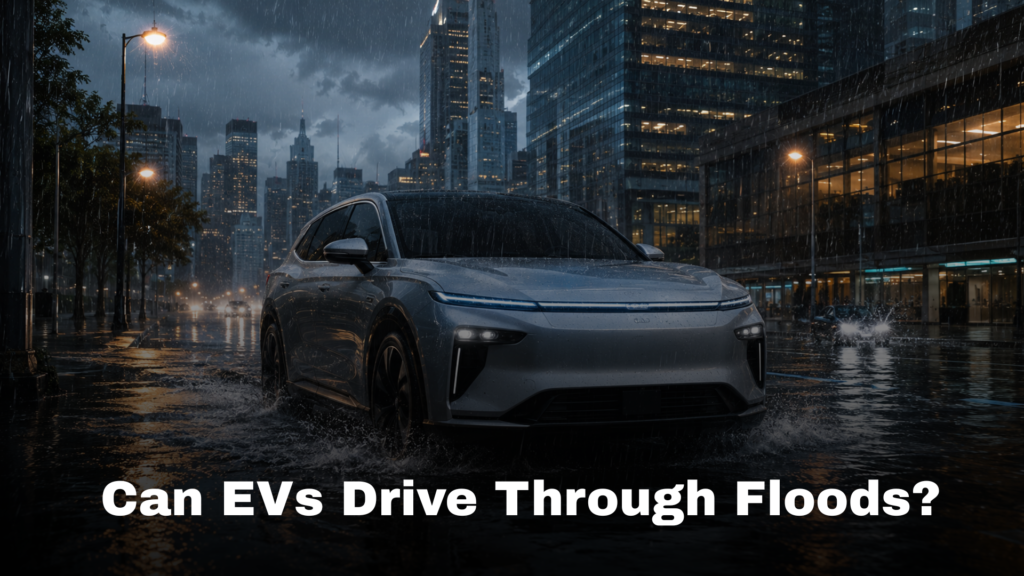
The short answer is yes—but only to a certain extent. Modern electric vehicles are designed with waterproof components and advanced safety systems, but driving through deep floodwater is still dangerous and should be avoided whenever possible.
In this guide, we’ll explain how EVs handle flood conditions, whether electric cars can get electrocuted, and what you should do if your EV has been exposed to floodwater.
Are EV Batteries Waterproof?
Most modern EV batteries are housed inside sealed metal enclosures located underneath the vehicle. Manufacturers design these battery packs to withstand rain, splashes, and temporary water exposure.
Many EV batteries are rated with IP67 or IP68 protection standards, which means they can resist dust and survive temporary immersion in water.
However, “water-resistant” does not mean “flood-proof.”
Driving through deep floodwater can still damage:
- Electrical connectors
- Sensors
- Brake systems
- Motors
- Electronic control units
Even if the battery remains protected, other components may suffer serious damage.
What Is an Electric Vehicle (EV)?
Can Electric Cars Drive Through Floods?
Electric vehicles can usually handle shallow water better than many people expect, but they are not designed to drive through flooded roads.
Generally speaking:
- Light rain and wet roads are safe.
- Small puddles are not a problem.
- Water reaching the bottom of the doors can be dangerous.
- Deep floodwater should always be avoided.
The biggest risk is not electric shock—it’s damage to the vehicle and loss of control.
Floodwater may contain:
- Mud and debris
- Sharp objects
- Hidden potholes
- Chemicals and contaminants
These hazards can damage the battery housing and other critical components.
Can EV Batteries Electrocute People in Floods?
This is one of the most common misconceptions about electric vehicles.
Modern EVs are equipped with multiple safety mechanisms that automatically disconnect the high-voltage battery in the event of a collision or electrical fault.
Under normal circumstances:
- Drivers will not be electrocuted.
- Rescue personnel are trained to handle EVs safely.
- High-voltage systems automatically shut down when necessary.
According to safety experts, the risk of electrocution from a flooded EV is extremely low.
Are EVs Safer Than Petrol Cars in Floods?
Both electric and petrol vehicles face risks during floods, but the dangers are different.
| Category | Electric Vehicle | Petrol Vehicle |
|---|---|---|
| Engine failure | No engine stall | High risk |
| Electric shock risk | Very low | Very low |
| Battery damage | Possible | Not applicable |
| Water damage repair cost | High | Medium |
| Fire risk | Low | Low |
Unlike petrol cars, EVs do not have air intakes that can cause immediate engine failure. However, battery and electrical repairs can be extremely expensive if water enters the system.
What Should You Do If Your EV Is Flooded?
If your EV has been exposed to floodwater, follow these steps:
- Do not attempt to restart the vehicle.
- Move away from the flooded area if it is safe to do so.
- Contact your insurance company immediately.
- Arrange for towing to an authorized service center.
- Do not charge the vehicle until it has been inspected.
Charging a flooded EV without proper inspection may cause severe damage.
Does Car Insurance Cover Flood Damage?
Insurance coverage depends on the type of policy you have.
In Malaysia, comprehensive insurance policies often cover flood damage, while third-party insurance generally does not.
Before the rainy season, check whether your policy includes:
- Natural disaster coverage
- Flood protection
- Battery replacement coverage
- Towing assistance
EV owners should pay special attention to battery-related coverage, as replacement costs can be significant.
Final Verdict: Can EVs Drive Through Floods?
Yes, electric vehicles can handle rain and shallow water thanks to their sealed battery systems and advanced safety features.
However, no vehicle—electric or petrol—should drive through deep floodwater.
If you encounter a flooded road, the safest decision is always to turn around and find an alternative route.
Protecting your vehicle is far less expensive than dealing with major repairs or insurance claims later.
FAQ
Can Tesla drive through floods?
Tesla vehicles are designed to resist water exposure, but Tesla does not recommend driving through flooded roads.
Can BYD vehicles drive through floodwater?
BYD EVs have sealed battery packs, but deep floodwater should still be avoided.
Will an EV explode in water?
No. Modern EVs include multiple safety systems that minimize the risk of fire or explosion.
Can I charge my EV after flood damage?
No. You should have the vehicle inspected by professionals before charging it.
Does insurance cover EV flood damage?
Comprehensive insurance policies may cover flood damage, depending on your policy terms.
Are EVs More Waterproof Than Petrol Cars?
Many people assume that electric vehicles are more dangerous in floods because they use high-voltage batteries. Surprisingly, EVs are often designed with stricter waterproof standards than conventional petrol cars.
Modern EV manufacturers seal their battery packs and critical electrical components to prevent water intrusion. In contrast, petrol vehicles rely on air intakes and combustion systems that can fail immediately when water enters the engine.
However, this does not mean EVs are designed to operate underwater. Floodwater remains a serious threat to all vehicles.
| Feature | Electric Vehicle | Petrol Vehicle |
|---|---|---|
| Battery protection | Sealed enclosure | Not applicable |
| Engine stalling | No | Yes |
| High-voltage safety system | Yes | No |
| Air intake flooding | No | Yes |
| Repair cost after flooding | High | Medium |
How Deep Can an EV Drive Through Water?
There is no universal answer because every model has different water-wading capabilities.
Several factors affect how safely an EV can pass through water:
- Battery placement
- Ground clearance
- Vehicle speed
- Water depth
- Road conditions
- Manufacturer specifications
As a general rule:
- Less than 10 cm: Usually safe.
- 10–20 cm: Exercise caution.
- More than 30 cm: Avoid driving.
- Above the wheel hub: Dangerous.
Even if your EV survives the flood, hidden damage may appear weeks or months later.
What Happens If Floodwater Enters the Battery Pack?
Battery packs are designed to resist water, but severe flooding can still damage internal components.
Possible consequences include:
- Battery corrosion
- Short circuits
- Sensor failure
- Reduced battery performance
- Thermal management issues
- Expensive replacement costs
In some cases, manufacturers may recommend replacing the entire battery pack after severe flood exposure.
Can EV Charging Stations Be Used During Floods?
Public charging stations are built with safety protection systems, but they should never be used if the area is flooded.
Never charge your EV if:
- Water is surrounding the charging station.
- The charging cable is wet or damaged.
- The charging port contains moisture.
- Your vehicle has recently been submerged.
If you suspect flood damage, have the car inspected before charging.
Flood Safety Tips for EV Owners
Before driving during heavy rain, remember these safety tips:
- Check weather and flood warnings.
- Avoid flooded roads whenever possible.
- Drive slowly in wet conditions.
- Keep emergency contact numbers ready.
- Verify that your insurance includes flood coverage.
- Never attempt to restart a flooded EV.
The best strategy is simple: if you are unsure about the water depth, turn around and find another route.
Expert Verdict
Electric vehicles are designed with advanced waterproofing and safety systems, making them safer in wet conditions than many people realize.
However, EVs are not amphibious vehicles. Deep floodwater can still damage the battery, electronics, brakes, and other components.
Whether you drive an EV or a petrol car, avoiding flooded roads is always the safest option.
Real-Life Examples: EVs and Flooding Incidents
Flooding incidents around the world have raised concerns about electric vehicle safety. However, investigations show that most EV-related problems are caused by severe water damage rather than electric shock.
For example, during major floods in countries such as China, Malaysia, and the United States, both petrol and electric vehicles suffered damage after being submerged for long periods.
Common causes of damage include:
- Water entering electronic control modules
- Corrosion inside connectors
- Battery contamination
- Damaged cooling systems
- Brake failure
Experts emphasize that floodwater itself is usually more dangerous than the electric system.
How Manufacturers Protect EV Batteries from Water
Modern EV manufacturers use multiple layers of protection to keep batteries safe.
1. Sealed Battery Enclosures
The battery pack is protected by a strong metal casing designed to prevent water and dust from entering.
2. Waterproof Connectors
High-voltage cables and connectors are sealed to reduce the risk of short circuits.
3. Automatic Power Cut-Off
If the system detects a collision or electrical fault, it can automatically disconnect the battery.
4. Battery Monitoring System (BMS)
The Battery Management System constantly monitors:
- Temperature
- Voltage
- Charging status
- Battery health
- Fault detection
How Floods Affect EV Insurance Claims in Malaysia
If your EV is damaged by flooding, your insurance coverage depends on the policy you purchased.
Typically, comprehensive insurance may include:
- Flood damage coverage
- Natural disaster protection
- Vehicle towing
- Repair costs
- Battery replacement (depending on the policy)
Third-party insurance usually does not cover flood-related damage.
Before purchasing insurance, EV owners should ask the following questions:
- Does the policy cover floods?
- Is the battery included in the coverage?
- Is roadside assistance provided?
- What is the maximum claim amount?
Signs That Your EV May Have Flood Damage
Even if your vehicle appears normal after driving through water, hidden damage may develop later.
Watch for these warning signs:
- Warning lights on the dashboard
- Charging problems
- Strange noises
- Reduced battery range
- Brake issues
- Unusual smells
- Power loss
If any of these symptoms appear, stop driving and contact an authorized service center.
Conclusion
Electric vehicles are engineered with advanced waterproof technology and multiple safety systems, making them safe for daily driving in rain and wet conditions.
However, no EV is designed to drive through deep floods. Floodwater can damage the battery, electronics, and braking systems, leading to expensive repairs.
The safest advice for all drivers is simple:
If the road is flooded and you cannot judge the water depth, do not drive through it.
Protecting your safety is always more important than reaching your destination a few minutes earlier.
EV Water Resistance Ratings Explained: What Do IP67 and IP68 Mean?
When people hear that electric vehicle batteries are IP67 or IP68 rated, they often assume that EVs are completely waterproof. In reality, these ratings indicate how well the battery pack is protected against dust and water under specific testing conditions.
Understanding these ratings can help EV owners make better decisions during heavy rain or flooding.
What Is an IP Rating?
IP stands for Ingress Protection, an international standard used to measure how resistant a device is to dust and water.
The rating consists of two numbers:
IP67
- First number: Dust protection
- Second number: Water protection
For example:
- IP67
- IP68
The higher the number, the greater the protection.
What Does IP67 Mean?
An IP67 rating means that the battery pack is:
- Completely protected against dust.
- Resistant to temporary immersion in water.
- Tested in water up to one meter deep for approximately 30 minutes.
This level of protection is common in many electric vehicles.
However, the test is performed in clean laboratory conditions—not in real floodwater filled with mud, chemicals, and debris.
What Does IP68 Mean?
IP68 provides even greater protection.
Generally, an IP68-rated battery can withstand:
- Continuous immersion in water.
- Greater depths than IP67.
- Extended periods underwater.
The exact specifications vary depending on the manufacturer.
Even with IP68 protection, manufacturers do not recommend driving through floods.
Why Floodwater Is More Dangerous Than Clean Water
Floodwater is very different from the clean water used in laboratory testing.
Floodwater may contain:
- Mud and sand
- Oil and chemicals
- Sharp debris
- Tree branches
- Sewage
- Salt and corrosive substances
These contaminants can damage:
- Sensors
- Electrical connectors
- Cooling systems
- Brakes
- Suspension components
Therefore, even if the battery survives, other parts of the vehicle may still require expensive repairs.
EV Flood Safety Checklist
Before driving during heavy rain, follow this checklist:
✅ Check weather forecasts.
✅ Avoid flooded roads.
✅ Slow down in wet conditions.
✅ Keep your battery charged.
✅ Make sure your insurance includes flood coverage.
✅ Save your roadside assistance number.
✅ Never drive into water if you cannot see the road surface.
Emergency Steps If Your EV Is Stuck in a Flood
If your EV becomes trapped in floodwater, stay calm and follow these steps:
- Stop the vehicle immediately.
- Turn on the hazard lights.
- Exit the vehicle if it is safe.
- Move to higher ground.
- Call emergency services if necessary.
- Contact your insurance company.
- Arrange for towing.
- Do not restart or charge the vehicle.
Trying to restart a flooded EV may worsen the damage.
Malaysia-Specific Advice for EV Owners
Malaysia experiences heavy rainfall and flash floods every year, especially in areas such as:
- Kuala Lumpur
- Selangor
- Johor
- Penang
- Kelantan
If you own an EV in Malaysia, consider the following:
- Purchase comprehensive insurance.
- Add flood coverage if available.
- Park on higher ground during storms.
- Know the location of nearby service centers.
- Review your insurance policy annually.
Final Safety Reminder
Electric vehicles are designed to handle rain and wet roads, but they are not designed to drive through deep floodwater.
Remember these three rules:
- Never underestimate flood depth.
- Never restart a flooded EV.
- Never charge an EV after flooding without inspection.
Following these precautions can protect both your vehicle and your safety.