
Electric vehicles (EVs) are becoming increasingly popular around the world, but many people still have one important question:
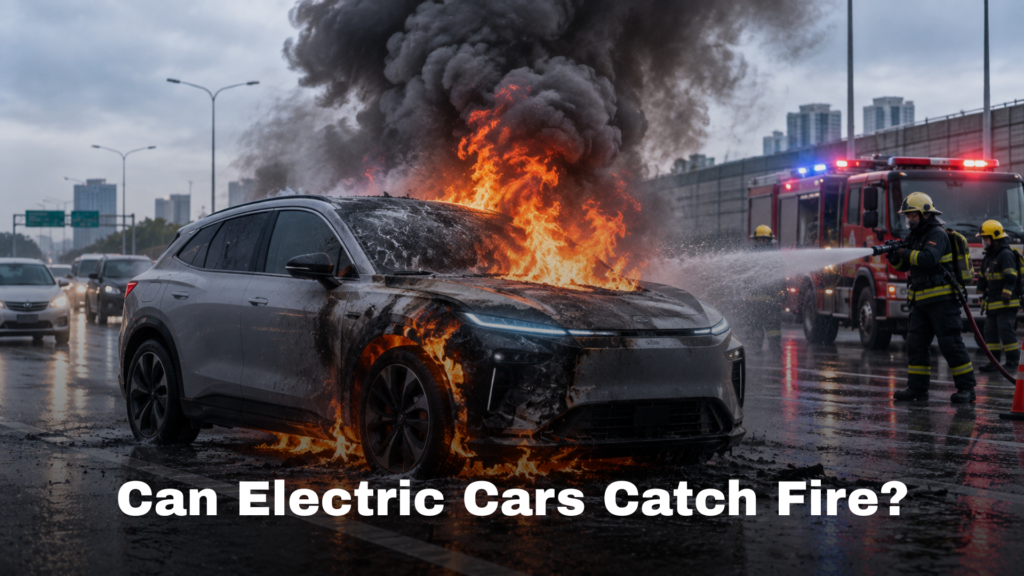
Can electric cars catch fire?
The short answer is yes. Electric cars can catch fire, just like petrol and diesel vehicles. However, EV fires are relatively rare, and modern electric vehicles are equipped with multiple safety systems designed to reduce the risk of battery failures.
In this guide, we’ll explain why electric cars catch fire, how common EV fires really are, and whether electric vehicles are safer than traditional petrol cars.
Can Electric Cars Really Catch Fire?
Yes, electric vehicles can catch fire, but the risk is generally low.
Most EV fires are caused by:
- Severe collisions
- Battery damage
- Manufacturing defects
- Electrical failures
- Extreme overheating
- Improper charging
Unlike petrol cars, electric vehicles do not contain gasoline. Instead, they use large lithium-ion battery packs to store energy.
Why Do Electric Cars Catch Fire?
There are several reasons why an electric vehicle battery may catch fire.
Battery Damage After an Accident
A major collision can damage the battery pack, causing internal short circuits.
If the battery cells are punctured or crushed, heat may build up rapidly, increasing the risk of fire.
Thermal Runaway
Thermal runaway is a chain reaction that occurs when one battery cell overheats and spreads heat to nearby cells.
Once thermal runaway begins, battery temperatures can rise uncontrollably.
Common causes include:
- Extreme heat
- Manufacturing defects
- Overcharging
- Physical damage
Charging Problems
Using damaged charging cables or faulty chargers may increase the risk of battery failure.
Always use manufacturer-approved charging equipment whenever possible.
What Is Thermal Runaway?
Thermal runaway is one of the most important concepts in EV safety.
It happens when:
- A battery cell overheats.
- Heat spreads to nearby cells.
- Battery temperature rises rapidly.
- Smoke and fire may occur.
Modern EVs use advanced cooling systems and software to reduce this risk.
Are Electric Cars More Likely to Catch Fire Than Petrol Cars?
Contrary to popular belief, research suggests that petrol vehicles catch fire more frequently than electric vehicles.
| Vehicle Type | Fire Risk |
|---|---|
| Petrol vehicles | Higher |
| Diesel vehicles | Medium |
| Electric vehicles | Lower |
Petrol cars contain:
- Flammable fuel
- Engine oil
- Hot exhaust systems
Electric vehicles do not use gasoline, but battery fires can be more difficult to extinguish.
How Do Manufacturers Prevent EV Fires?
Modern electric vehicles include multiple layers of protection.
Battery Cooling Systems
Liquid cooling systems help keep battery temperatures within a safe range.
Battery Management System (BMS)
The Battery Management System continuously monitors:
- Temperature
- Voltage
- Charging speed
- Battery health
If a problem is detected, the system can automatically shut down the battery.
Protective Battery Housing
Most EV batteries are protected by reinforced metal casings designed to withstand impacts.
What Happens If an Electric Car Catches Fire?
If an EV catches fire, emergency responders may need additional time to cool the battery.
Possible warning signs include:
- Smoke
- Burning smell
- Warning lights
- Unusual noises
- Excessive heat
If you notice any of these signs:
- Stop the vehicle immediately.
- Exit the vehicle safely.
- Move away from the car.
- Call emergency services.
Can Water Put Out an EV Fire?
Yes. Firefighters often use large amounts of water to cool the battery pack and stop thermal runaway from spreading.
However, EV battery fires may require much more water than conventional car fires.
Professional firefighters should always handle EV battery fires.
Are Tesla and BYD Batteries Safe?
Tesla, BYD, Hyundai, BMW and other manufacturers use advanced safety technologies to reduce fire risks.
Examples include:
- Battery cooling systems
- Fire-resistant materials
- Automatic power cut-off systems
- Battery monitoring software
BYD’s Blade Battery, for example, is designed to improve safety and reduce the risk of thermal runaway.
How Long Do EV Batteries Last in Malaysia? EV Battery Lifespan Guide (2026)
How Can EV Owners Reduce Fire Risks?
Here are some practical safety tips:
- Use certified chargers.
- Avoid damaged charging cables.
- Follow manufacturer maintenance schedules.
- Avoid parking in extreme heat for long periods.
- Inspect the vehicle after an accident.
- Update vehicle software regularly.
Final Verdict: Can Electric Cars Catch Fire?
Yes, electric cars can catch fire, but so can petrol and diesel vehicles.
Modern EVs are equipped with advanced safety systems, cooling technology and battery management software that significantly reduce the risk of fire.
For most drivers, electric vehicles remain a safe and reliable transportation option.
The key is proper maintenance, safe charging habits and regular inspections.
Frequently Asked Questions
Can electric cars explode?
Explosions are extremely rare. Modern EVs include multiple safety systems designed to prevent catastrophic battery failures.
Are electric cars safer than petrol cars?
In many situations, electric vehicles are considered just as safe or safer than petrol vehicles.
Can charging an EV cause a fire?
Improper charging equipment or damaged batteries may increase the risk.
How common are EV fires?
EV fires are relatively rare compared to petrol vehicle fires.
Can firefighters extinguish EV fires?
Yes, but EV battery fires may require specialized procedures and large amounts of water.
Are EV Battery Fires Harder to Extinguish?
One of the biggest concerns surrounding electric vehicles is whether EV battery fires are more difficult to extinguish than fires in petrol cars.
The answer is yes—EV battery fires can be more challenging for firefighters because lithium-ion batteries behave differently from gasoline.
Unlike traditional vehicle fires, EV batteries can continue generating heat even after the flames appear to be under control.
Why Are EV Battery Fires Difficult to Put Out?
Electric vehicle batteries contain hundreds or even thousands of individual battery cells.
When one cell enters thermal runaway, the heat can spread to neighboring cells, creating a chain reaction.
Firefighters face several challenges:
- Extremely high temperatures
- Re-ignition risk
- Hidden fires inside the battery pack
- Toxic smoke
- Long cooling times
In some cases, firefighters may need several hours to fully cool an EV battery.
Can an EV Battery Reignite After the Fire Is Extinguished?
Yes.
Unlike petrol fires, EV battery fires can reignite hours or even days later if the battery cells remain damaged.
This is why damaged electric vehicles are often monitored after an accident.
Manufacturers and emergency responders may isolate the vehicle and inspect the battery for signs of overheating.
What Do Firefighters Do During an EV Fire?
Emergency responders follow specific procedures when handling electric vehicle fires.
Typical steps include:
- Secure the area.
- Evacuate nearby people.
- Cool the battery using large amounts of water.
- Monitor the battery temperature.
- Transport the vehicle to a safe location.
- Continue observing for possible reignition.
Because of the risk of thermal runaway, EV fires often require more time and resources than conventional car fires.
Does Fast Charging Increase Fire Risk?
Fast charging does not automatically increase the risk of fire.
Modern electric vehicles include safety systems that carefully control:
- Battery temperature
- Charging speed
- Voltage
- Current flow
However, problems may occur if:
- The charging equipment is damaged.
- The battery has been involved in an accident.
- Unofficial chargers are used.
- The battery cooling system fails.
Always follow the manufacturer’s charging recommendations.
Which EV Batteries Are Considered Safer?
Different manufacturers use different battery technologies.
Lithium Iron Phosphate (LFP)
Advantages:
- Better thermal stability
- Lower fire risk
- Longer lifespan
- Better resistance to overheating
Examples:
- BYD Blade Battery
- Tesla Standard Range models
Nickel Manganese Cobalt (NMC)
Advantages:
- Higher energy density
- Longer driving range
- Better performance
Disadvantages:
- More sensitive to extreme temperatures
Many modern EVs use advanced cooling systems to improve safety regardless of battery type.
Common Myths About EV Fires
Myth 1: Electric cars explode easily.
False.
Most electric vehicles are equipped with multiple safety systems designed to prevent catastrophic failures.
Myth 2: EVs catch fire more often than petrol cars.
False.
Studies suggest that petrol vehicles experience fires more frequently than electric vehicles.
Myth 3: Rain can cause EV batteries to explode.
False.
Modern EV batteries are sealed and designed to withstand rain and normal weather conditions.
Myth 4: You cannot extinguish an EV fire.
False.
EV fires can be extinguished, but the process is different from extinguishing petrol fires.
Key Takeaways
- Electric cars can catch fire, but the risk is relatively low.
- Thermal runaway is the main cause of EV battery fires.
- EV fires are usually more difficult to extinguish than petrol fires.
- Modern EVs use advanced cooling and safety systems.
- Proper charging and maintenance can reduce fire risks.
Real-World EV Fire Incidents: What Can We Learn?
Although electric vehicle fires are relatively rare, several high-profile incidents have raised concerns among consumers.
However, experts emphasize that every fire incident is different, and the cause is often related to severe collisions, battery damage, or manufacturing defects rather than normal driving.
Let’s look at some of the most common causes.
Common Causes of EV Fires
Severe Traffic Accidents
High-speed collisions can damage the battery pack underneath the vehicle.
In extreme cases, the impact may puncture battery cells and trigger thermal runaway.
Potential consequences include:
- Battery overheating
- Smoke generation
- Fire
- Electrical failure
Fortunately, modern EVs are designed with reinforced battery enclosures to minimize these risks.
Manufacturing Defects
Like all electronic products, batteries can occasionally suffer from manufacturing defects.
Possible issues include:
- Internal short circuits
- Damaged battery cells
- Faulty wiring
- Software failures
Automakers regularly issue recalls and software updates to fix safety issues.
Improper Repairs
Repairing a damaged EV battery without proper training can be extremely dangerous.
Owners should avoid:
- Unauthorized battery repairs
- Unofficial replacement parts
- DIY modifications
- Battery tampering
Always use certified service centers for battery-related repairs.
Which Electric Vehicles Use the Safest Batteries?
Battery technology continues to improve every year.
Today, two of the most common battery types are:
| Battery Type | Safety | Range |
|---|---|---|
| LFP (Lithium Iron Phosphate) | Higher | Medium |
| NMC (Nickel Manganese Cobalt) | Good | Higher |
LFP Batteries
Advantages:
- Better thermal stability
- Lower fire risk
- Longer lifespan
- Lower maintenance costs
Commonly used by:
- BYD
- Tesla Standard Range models
- MG
- GWM
NMC Batteries
Advantages:
- Higher energy density
- Longer driving range
- Better performance
Commonly used by:
- BMW
- Mercedes-Benz
- Hyundai
- Kia
Both battery technologies are considered safe when properly designed and maintained.
How Long Can an EV Battery Burn?
Unlike petrol fires, EV battery fires may continue burning for an extended period because battery cells store a large amount of energy.
Depending on the severity of the damage, firefighters may need:
- Several thousand liters of water
- Hours of cooling
- Thermal cameras
- Continuous monitoring
In some cases, damaged vehicles are isolated for 24 to 48 hours to prevent reignition.
How Can You Protect Your EV Battery?
There are several ways to reduce battery-related risks.
Follow Charging Recommendations
Always use manufacturer-approved chargers and avoid damaged charging cables.
Avoid Extreme Temperatures
Whenever possible:
- Park in shaded areas.
- Avoid prolonged exposure to direct sunlight.
- Do not leave the battery fully charged for extended periods.
Update Your Vehicle Software
Modern EVs rely heavily on software to monitor battery health and safety.
Software updates may improve:
- Battery cooling
- Charging efficiency
- Safety features
- Thermal management
Inspect the Vehicle After an Accident
Even minor collisions can damage the battery pack.
If your vehicle has been involved in an accident, have it inspected by an authorized service center.
Should You Be Worried About EV Fires?
For most drivers, the answer is no.
Electric vehicles undergo extensive safety testing before reaching the market.
Modern EVs are equipped with:
- Battery Management Systems (BMS)
- Cooling systems
- Reinforced battery enclosures
- Automatic shut-off mechanisms
- Fire-resistant materials
Although no vehicle is completely risk-free, electric vehicles remain one of the safest transportation options available today.
Final Conclusion
Can electric cars catch fire?
Yes, but so can petrol and diesel vehicles.
The difference is that electric vehicles use advanced battery technology and multiple safety systems to minimize the risk.
As battery technology continues to evolve, EVs are expected to become even safer in the future.
For consumers, the most important things are proper maintenance, safe charging habits, and following the manufacturer’s recommendations.
EV Fire Statistics: Are Electric Cars More Dangerous Than Petrol Cars?
One of the biggest misconceptions about electric vehicles is that they catch fire more frequently than petrol cars. In reality, several studies suggest that petrol-powered vehicles are more likely to experience fires.
Although EV fires often receive significant media attention, they remain relatively uncommon compared to fires involving gasoline and diesel vehicles.
Why Do EV Fires Receive More Media Attention?
Electric vehicle fires tend to attract more headlines because EV technology is still relatively new.
There are several reasons why EV fires become major news stories:
- Electric vehicles are still unfamiliar to many people.
- Battery fires are more difficult to extinguish.
- EV incidents often involve expensive vehicles.
- Social media spreads videos rapidly.
- People are naturally concerned about new technologies.
However, media coverage does not necessarily mean that EVs are more dangerous.
How Safe Are Modern Electric Vehicles?
Before reaching the market, electric vehicles must pass strict safety tests.
These tests include:
- Crash tests
- Water resistance tests
- Battery puncture tests
- Extreme temperature tests
- Fire resistance tests
- High-voltage safety tests
Manufacturers spend billions of dollars developing safer battery technologies.
Safety Features Found in Modern EVs
Most modern electric vehicles include the following safety systems:
Battery Management System (BMS)
The BMS monitors:
- Battery temperature
- Voltage
- Current
- Charging speed
- Battery health
If an abnormal condition is detected, the system can automatically disconnect the battery.
Thermal Management System
Modern EVs use liquid cooling or air cooling systems to regulate battery temperature.
This helps prevent overheating during:
- Fast charging
- Long-distance driving
- Hot weather
- Heavy acceleration
Automatic High-Voltage Shut-Off
In the event of an accident, many EVs automatically disconnect the high-voltage system to protect passengers and rescue workers.
Reinforced Battery Housing
Battery packs are usually protected by:
- Aluminum casings
- Steel frames
- Impact-resistant materials
These structures are designed to absorb impact during collisions.
What Should You Do If You Smell Burning From Your EV?
If you notice unusual heat, smoke, or a burning smell, take immediate action.
Follow these steps:
- Pull over safely.
- Turn off the vehicle.
- Exit the car immediately.
- Move away from the vehicle.
- Call emergency services.
- Do not attempt to open the battery pack.
Your safety should always come first.
Warning Signs of a Potential Battery Problem
Although battery failures are rare, watch for these warning signs:
- Battery overheating
- Smoke
- Burning odor
- Dashboard warning lights
- Sudden loss of power
- Charging issues
- Strange noises
If you notice any of these symptoms, stop driving and contact an authorized service center.
The Future of EV Battery Safety
Battery technology continues to evolve rapidly.
Future technologies may include:
- Solid-state batteries
- Improved cooling systems
- Faster fault detection
- Advanced fire-resistant materials
- AI-powered battery monitoring
Many experts believe that future EV batteries will be safer, lighter, and more durable than today’s lithium-ion batteries.
Final Thoughts
Can electric cars catch fire?
Yes, but the overall risk remains low.
Modern EVs are equipped with multiple safety systems designed to detect faults, regulate temperature, and protect passengers.
As battery technology improves, electric vehicles are expected to become even safer in the coming years.
For drivers, the best way to minimize risk is simple:
- Use approved chargers.
- Maintain your vehicle regularly.
- Follow manufacturer guidelines.
- Have your EV inspected after an accident.
Electric vehicles are not fireproof, but they are engineered with safety as a top priority.
FAQ
Are electric cars more likely to catch fire than petrol cars?
No. Research suggests that petrol vehicles experience fires more frequently than electric vehicles.
Can a damaged EV battery be repaired?
Minor damage may be repairable, but severe battery damage often requires replacement.
Are EV batteries safe in hot weather?
Yes. Modern EVs use advanced cooling systems to manage battery temperatures.
Should I charge my EV overnight?
Most manufacturers consider overnight charging safe when using approved charging equipment.
Will future EV batteries be safer?
Yes. Technologies such as solid-state batteries are expected to improve safety significantly.
Government Safety Tests for Electric Vehicles
Before an electric vehicle can be sold, it must pass strict safety regulations and crash tests.
Different regions have their own testing standards:
- Euro NCAP (Europe)
- NHTSA (United States)
- C-NCAP (China)
- ASEAN NCAP (Southeast Asia)
These organizations test:
- Front collisions
- Side impacts
- Battery puncture resistance
- Fire resistance
- Water resistance
- High-voltage safety
Modern EVs are designed to automatically disconnect the battery after a severe crash.
EV Fire Safety Tips for Families
If your family owns an electric vehicle, follow these safety recommendations:
Install a Certified Home Charger
Always use certified charging equipment and avoid cheap third-party chargers.
Park in Well-Ventilated Areas
Avoid charging in enclosed spaces with poor ventilation.
Check for Software Updates
Manufacturers regularly release updates that improve battery safety and thermal management.
Inspect the Vehicle After Floods or Accidents
Even if the car appears normal, hidden battery damage may exist.
Learn Emergency Procedures
All family members should know:
- How to turn off the vehicle
- How to exit safely
- How to contact emergency services
Preparation can save lives during an emergency.
Expert Opinion
Electric vehicles are not immune to fires, but neither are petrol or diesel vehicles.
Modern EVs undergo some of the strictest safety testing in the automotive industry.
For most consumers, the risk of an EV fire remains extremely low.
The future of transportation will depend on safer batteries, smarter software, and better safety systems.
Pingback: EV Maintenance Cost: Complete Guide to EV Service Costs