
If you’re planning to buy a new car in 2026, you’ve probably asked yourself one question:
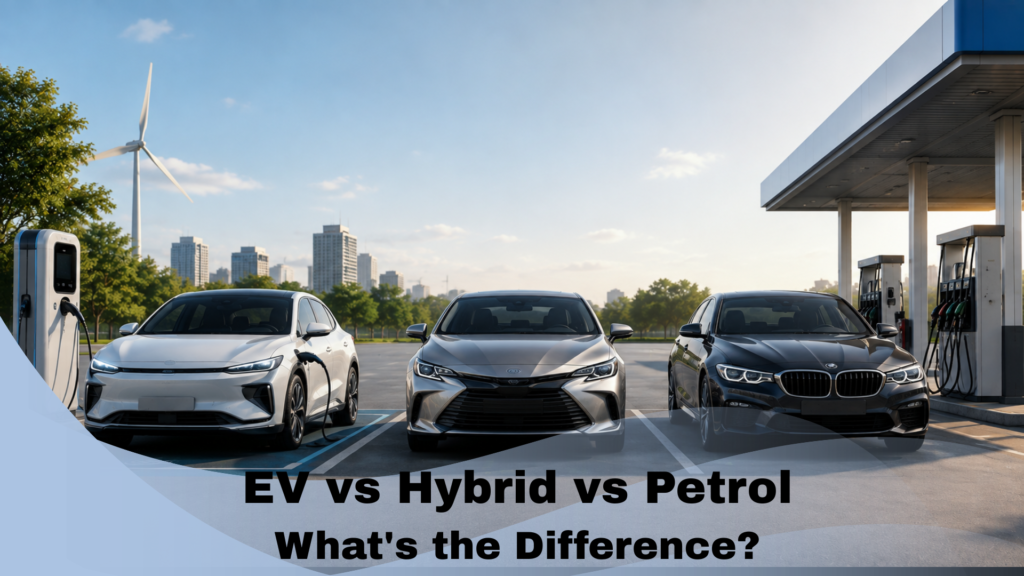
Should I buy an electric vehicle (EV), a hybrid, or a traditional petrol car?
With brands like Tesla, BYD, Toyota, Honda, BMW, and Mercedes offering multiple powertrain options, choosing the right vehicle has become more complicated than ever.
Each type of vehicle has its own strengths and weaknesses.
Some offer lower running costs, while others provide greater convenience or longer driving range.
In this guide, we’ll compare EVs, hybrids, and petrol cars to help you decide which option is best for your lifestyle.
Quick Comparison
| Feature | EV | Hybrid | Petrol |
|---|---|---|---|
| Fuel Source | Electricity | Petrol + Electricity | Petrol |
| Charging Required | Yes | No (HEV) | No |
| Running Cost | Low | Medium | High |
| Maintenance | Low | Medium | High |
| Purchase Price | High | Medium | Low |
| Range | Medium | High | High |
| Emissions | Very Low | Medium | High |
What Is an EV?
An electric vehicle (EV) runs entirely on electricity.
Instead of using a petrol engine, an EV uses:
- Large battery pack
- Electric motor
- Power electronics
- Charging system
Examples:
- Tesla Model 3
- Tesla Model Y
- BYD Seal
- BYD Atto 3
- Hyundai IONIQ 5
- Proton e.MAS 7
EVs produce zero tailpipe emissions and can be charged at home or at public charging stations.
What Is an Electric Vehicle (EV)?
What Is a Hybrid Car?
A hybrid vehicle combines:
- Petrol engine
- Electric motor
- Battery pack
The battery charges automatically while driving.
Unlike EVs, most hybrid cars do not require external charging.
Examples:
- Toyota Corolla Hybrid
- Toyota Camry Hybrid
- Honda CR-V Hybrid
Hybrid cars use electricity mainly to improve fuel efficiency.
What Is a Petrol Car?
A petrol car relies entirely on an internal combustion engine.
Fuel is burned inside the engine to generate power.
Examples include:
- Honda City
- Toyota Vios
- Mazda 3
- Proton Saga
- BMW 320i
Petrol cars remain the most common type of vehicle worldwide.
Running Costs
Electric vehicles are usually the cheapest to operate because electricity costs less than petrol.
Estimated monthly energy costs
| Vehicle Type | Monthly Cost |
|---|---|
| EV | RM 150–250 |
| Hybrid | RM 250–450 |
| Petrol | RM 400–800 |
For drivers who travel long distances every month, the savings can be significant.
Maintenance Costs
Electric vehicles contain fewer moving parts and generally require less maintenance.
EV maintenance
- No engine oil
- No spark plugs
- No transmission oil
- No exhaust repairs
Hybrid maintenance
- Engine oil changes
- Brake maintenance
- Battery maintenance
Petrol maintenance
- Engine oil changes
- Spark plugs
- Timing belts
- Exhaust system repairs
In terms of maintenance costs:
EV < Hybrid < Petrol
Performance and Acceleration
Electric vehicles deliver instant torque, which means faster acceleration.
EV
- Instant acceleration
- Smooth driving
- Quiet operation
Hybrid
- Balanced performance
- Better fuel economy
Petrol
- Familiar driving feel
- Strong highway performance
Many EVs can accelerate from 0–100 km/h faster than petrol vehicles in the same price range.
Convenience
EV
Pros:
- Charge at home
- Lower fuel cost
- Quiet
Cons:
- Charging takes time
- Charging stations may be limited
Hybrid
Pros:
- No charging required
- Excellent fuel economy
Cons:
- More complex system
Petrol
Pros:
- Refuel in minutes
- Fuel stations everywhere
Cons:
- Higher running costs
Environmental Impact
One of the biggest differences between EVs, hybrids, and petrol cars is their environmental impact.
EV
- Zero tailpipe emissions
- Lower air pollution
- Reduced noise pollution
- Environmentally friendly in cities
Hybrid
- Lower emissions than petrol cars
- Better fuel efficiency
- Reduced fuel consumption
Petrol
- Higher carbon emissions
- Produces exhaust gases
- Greater environmental impact
Although EVs produce zero emissions while driving, electricity production and battery manufacturing still have environmental costs.
Driving Range
Range is another important factor when choosing a vehicle.
| Vehicle Type | Typical Range |
|---|---|
| EV | 300–700 km |
| Hybrid | 700–1,000 km |
| Petrol | 600–900 km |
EV
Modern EVs can travel hundreds of kilometers on a single charge, but long-distance travel requires charging stops.
Hybrid
Hybrid vehicles combine fuel and electricity, giving them excellent range.
Petrol
Petrol vehicles can be refueled quickly and remain ideal for long road trips.
Charging vs Refueling
EV
Charging options include:
- Home charging
- Public charging stations
- Fast DC chargers
Charging time:
- Home charging: 6–10 hours
- Fast charging: 20–40 minutes
EV Charging Malaysia Guide (2026): Cost, Time & Home Charging
Hybrid
Most hybrid cars do not require charging.
The battery automatically recharges while driving.
Refueling time:
- 3–5 minutes
Petrol
Petrol vehicles can be refueled almost anywhere.
Refueling time:
- 3–5 minutes
Which Car Is Best for You?
Buy an EV if you:
- Mainly drive in the city
- Have access to home charging
- Want lower operating costs
- Prefer quiet driving
- Care about the environment
Best EV Cars in Malaysia (2026): Prices, Range & Buying Guide
Buy a Hybrid if you:
- Drive both in the city and on highways
- Want better fuel economy
- Do not have access to charging
- Want fewer compromises
Buy a Petrol Car if you:
- Frequently travel long distances
- Need the lowest purchase price
- Want quick refueling
- Live in areas without charging stations
Pros and Cons
EV
Pros
- Lowest running costs
- Quiet and smooth
- Instant acceleration
- Low maintenance
Cons
- Higher purchase price
- Charging takes time
- Charging infrastructure is still growing
Hybrid
Pros
- Better fuel economy
- Long driving range
- No charging required
Cons
- More complicated system
- Higher purchase price than petrol cars
Petrol
Pros
- Lower purchase price
- Easy refueling
- Proven technology
Cons
- Higher fuel costs
- More maintenance
- Higher emissions
Conclusion
There is no single “best” choice between EV, hybrid, and petrol cars.
Each option serves different needs:
- EVs offer the lowest running costs and the best environmental benefits.
- Hybrids provide a balance between efficiency and convenience.
- Petrol cars remain practical for long-distance travel and lower upfront costs.
Before buying a vehicle, consider:
- Your daily mileage
- Charging availability
- Budget
- Maintenance costs
- Long-term ownership expenses
Choosing the right vehicle depends on your lifestyle and driving habits.
Frequently Asked Questions (FAQ)
Is an EV cheaper than a petrol car?
Although EVs usually cost more upfront, they often have lower fuel and maintenance costs over time.
Are hybrid cars better than petrol cars?
Hybrid cars generally offer better fuel efficiency and lower emissions, but they are usually more expensive to purchase.
Can hybrid cars run without petrol?
Most standard hybrid vehicles still require petrol to operate.
Which car type is best for long-distance driving?
Hybrid and petrol cars are currently more convenient for long road trips because refueling is faster.
Should I buy an EV in 2026?
If you have access to home charging and mainly drive in the city, an EV can be an excellent choice.