
Why your EV needs window film comes down to a fact most new electric vehicle owners don’t realize until their first hot summer: unlike a gas car, every watt your climate control system uses comes directly out of the same battery that powers the wheels. A gas engine throws off enough waste heat to run the cabin heater essentially for free, but an EV has no such luxury — air conditioning is a direct draw against your driving range, every single time you use it.
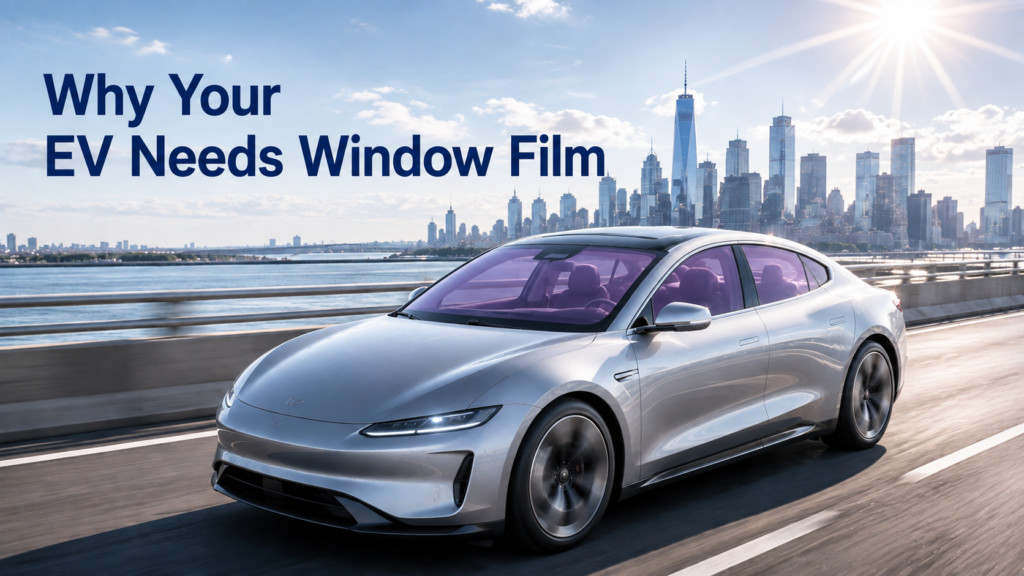
This guide covers exactly why EV window film matters more than it does for a gas car, how much range it can actually save, what type of film to choose, and the EV-specific considerations — glass roofs, sensors, and connectivity — that don’t apply to a typical tinting job.
The Core Reason: Every Watt of AC Comes From the Same Battery
In a gas-powered car, running the AC has a negligible effect on fuel economy because the engine produces far more heat than the cabin needs, making climate control essentially a free byproduct. In an EV, there’s no such free lunch — the climate control system draws from the exact same high-voltage battery pack that drives the motor. Studies show that running air conditioning in an EV can reduce range by 15% to 25% in hot weather, and for a vehicle rated at 300 miles, that’s potentially 75 miles lost purely to keeping the cabin cool. This single mechanical difference is the entire reason why your EV needs window film in a way a gas car simply doesn’t.
How Much Range Can Window Film Actually Save?
The numbers here are more concrete than most people expect. Controlled studies conducted in Phoenix and Las Vegas found that tinted EVs consistently delivered 8% to 12% better range performance in temperatures above 90°F compared to untinted counterparts. Other industry estimates put the real-world range benefit at 3% to 7% during hot months, with ceramic tint capable of reducing AC-related energy draw by 30% to 50%. High-quality film can block up to 60% of the solar heat entering through the windows, and premium ceramic options can reject as much as 80% of infrared energy specifically — the wavelength primarily responsible for cabin heat buildup.
Beyond the range numbers, window film also delivers a practical daily benefit: faster cool-down times. Instead of blasting the AC at full power for ten minutes after getting into a hot car, quality film can cut that down to three or four minutes, meaningfully reducing cumulative energy draw over thousands of miles in a hot climate.
Why Your EV Needs Window Film for Battery Health, Not Just Range
The benefits go beyond a single drive’s range figure. Temperature plays a critical role in long-term battery health — when an EV battery consistently operates at high temperatures, the chemical reactions inside the cells accelerate, leading to faster wear and reduced capacity over time. While most EVs use active thermal management to regulate battery temperature directly, reducing how hot the cabin (and by extension, surrounding components) gets in the first place takes some of the ongoing burden off that system. This is a big part of why your EV needs window film as a long-term investment, not just a comfort upgrade for hot afternoons.
Ceramic Tint: The Clear Choice for EVs
Not all window film is created equal, and the type matters more for EVs than for gas cars. Ceramic (or nano-ceramic) film is widely considered the standard for EVs in 2026, and for good reason:
- Superior heat rejection — ceramic film blocks significantly more infrared heat than older dyed film, without needing to go extremely dark to do it
- No electronic interference — metallic films, once common for their heat-blocking properties, can interfere with the wireless systems, GPS, and sensors that EVs rely on heavily; ceramic film contains no metallic content and avoids this risk entirely
- Works with ADAS and cameras — modern ceramic films are designed to remain compatible with driver assistance sensors and cameras, an increasingly important consideration as EVs add more tech
- Longevity — quality ceramic film is built to last the life of the vehicle without the color-fading that cheaper dyed films experience over time
Premium options like XPEL XR Plus or 3M Crystalline are frequently cited by professional installers as leading choices for EVs specifically, offering close to 98% infrared heat rejection alongside strong UV protection and minimal impact on visible light clarity — exactly the profile that explains why your EV needs window film built on ceramic technology rather than older film types.
Don’t Forget the Glass Roof
Many modern EVs — Tesla in particular, but increasingly other brands too — feature large panoramic glass roofs that face the sun more directly than any side window and typically carry no legal darkness restriction the way side windows do. This makes the roof one of the biggest sources of solar heat gain in the entire vehicle, yet it’s the panel most commonly overlooked when owners think about window film. If you’re evaluating why your EV needs window film in practical terms, the glass roof is often the single highest-impact panel to treat, precisely because it receives the most direct and sustained sun exposure of any glass on the car.
UV Protection: The Underrated Second Benefit
Heat rejection gets most of the attention, but UV protection matters just as much for EV owners specifically. EVs tend to feature more premium, tech-heavy interiors — large touchscreens, exposed wiring for driver assistance systems, and often lighter interior color schemes that show sun fading more visibly. Quality window film blocks up to 99% of UV rays, protecting both the interior materials and the electronics embedded throughout the cabin from long-term sun damage that accumulates gradually and often goes unnoticed until it’s significant.
Legal Considerations Before You Tint
Window tint darkness limits (measured as VLT, or visible light transmission) are set at the state or regional level and apply to EVs the same way they apply to any other vehicle — an EV’s efficiency benefits don’t create an exception to local tint laws. Before scheduling an install, it’s worth confirming your local VLT limits for front side windows specifically, since these tend to carry the strictest restrictions, while rear windows and the glass roof often allow darker film in most jurisdictions. A reputable installer will know your local limits and won’t apply film darker than what’s legally permitted.
What Does EV Window Film Cost?
Understanding why your EV needs window film also means understanding what you’re paying for. Pricing varies by film quality, vehicle glass area, and region, but ceramic film for a full vehicle — including the glass roof, where applicable — typically falls in a similar range to premium tinting for any comparable gas vehicle, generally running from several hundred to over a thousand dollars depending on coverage and film tier. Given that quality ceramic film is designed to last the life of the vehicle and can meaningfully offset AC-related energy draw across years of hot-weather driving, most EV owners and detailers alike consider it one of the higher-value upgrades available, both for comfort and for the cumulative range and battery-health benefits over time.
Window Film vs Other EV Efficiency Upgrades
Window film isn’t the only way to manage cabin heat and preserve range, but it’s one of the few upgrades that delivers a benefit on every single drive without requiring any change in habits. Parking in shade, using scheduled pre-conditioning while still plugged in, and light-colored interior accessories all help too, but window film works passively and continuously, making it a practical first step before considering more involved changes to charging or driving habits.
Common Myths About EV Window Film
“Window tint is just cosmetic — it doesn’t actually affect performance.” This might be true for a gas car, but it’s not accurate for an EV. Because climate control draws directly from the driving battery, reducing solar heat gain has a measurable, repeatable effect on range that’s been documented across multiple independent studies.
“Any dark tint will give you the range benefit.” Not quite. The benefit comes from infrared heat rejection specifically, not just visible darkness. A very dark dyed film can look effective while doing relatively little for heat rejection compared to a lighter but properly engineered ceramic film.
“Metallic tint is fine as long as it’s not too dark.” Darkness isn’t the issue with metallic film — the metallic content itself is what can interfere with GPS, wireless charging, and sensor systems that EVs depend on. This is why ceramic, not metallic, is the recommended choice regardless of shade preference.
“Tinting the glass roof isn’t worth the extra cost.” Given that the glass roof faces the sun more directly than any side window and often has no legal darkness limit, it’s frequently one of the highest-impact panels to treat — skipping it leaves one of the biggest sources of cabin heat gain unaddressed.
Does This Apply the Same Way in Malaysia?
If anything, why your EV needs window film applies even more directly in Malaysia’s climate than in much of the US — consistent year-round heat and intense equatorial sun make cabin heat management a daily concern rather than a seasonal one. The efficiency principle is identical: less solar heat entering the cabin means less energy diverted to air conditioning and more available for driving. If you’re comparing local window tint options and pricing specifically for Malaysia, our Window Tint Malaysia Guide and Malaysia Window Tint Law guide cover local VLT regulations and film options in detail, and our PPF for EVs Malaysia guide covers the paint protection side of EV-specific care.
Quick Checklist Before Booking
- Confirm the installer uses non-metallic ceramic film specifically, not older dyed or metallic options
- Ask about coverage for the glass roof, not just side and rear windows
- Check your local VLT limits before choosing a shade, especially for front side windows
- Request infrared rejection specs (ideally 80%+) rather than relying on darkness percentage alone
- Confirm the film carries a warranty covering fading, bubbling, or peeling over the life of the vehicle
Final Thoughts
Why your EV needs window film ultimately comes down to a mechanical reality that gas car owners never have to think about: every watt spent cooling the cabin is a watt not spent driving. The data backs this up consistently — studies showing 8-12% better hot-weather range with quality tint, AC energy draw reductions of 30-50%, and meaningful long-term battery health benefits from reduced heat exposure. For EV owners in hot climates especially, ceramic window film isn’t a cosmetic add-on — it’s one of the more measurable, low-effort upgrades available for protecting both your range and your battery’s long-term health.
Frequently Asked Questions
How much range can window tint actually save on an EV?
Studies show a range of outcomes, from 3-7% during hot months in general estimates, up to 8-12% in controlled tests conducted in extreme heat above 90°F.
What type of window film is best for EVs?
Ceramic (nano-ceramic) film is the recommended standard, offering strong heat rejection without the electronic interference risk that metallic films can cause with EV sensors and wireless systems.
Does window tint affect an EV’s cameras or driver assistance sensors?
Quality ceramic film is designed to be compatible with ADAS sensors and cameras, but it’s important to use non-metallic film and work with an experienced installer familiar with EV-specific sensor placement.
Is the glass roof worth tinting too?
Yes — panoramic glass roofs common on many EVs face the sun more directly than side windows and typically have no legal darkness restriction, making them one of the highest-impact panels to treat, and another reason why your EV needs window film covering more than just the side glass.
Are EV window tint laws different from regular car tint laws?
No. VLT (visible light transmission) limits are set at the state or regional level and apply equally to EVs and gas vehicles — there’s no separate legal allowance based on vehicle type.