
BYD overtook Tesla as the world’s top battery-electric vehicle seller in 2025, delivering 2.26 million BEVs versus Tesla’s 1.64 million — but the lead has swung back and forth through 2026, with Tesla briefly retaking the global quarterly crown in Q1 (358,023 vs BYD’s ~310,000) before BYD reclaimed it in Q2 (557,090 vs Tesla’s 480,126). The honest answer to “who’s winning” depends entirely on which metric you’re asking about — sales volume, market valuation, profitability, or regional dominance each tell a genuinely different story.
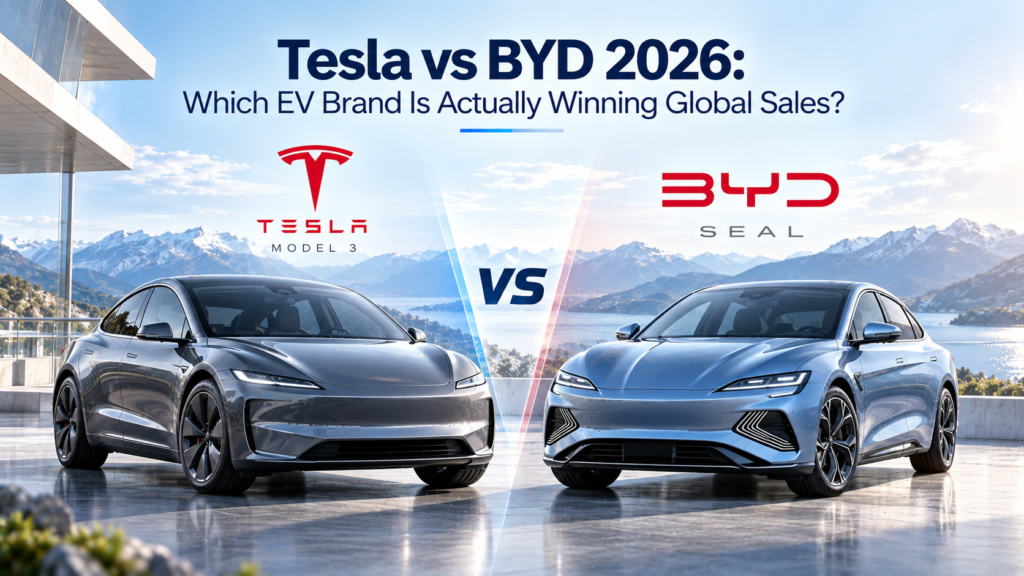
This guide breaks down exactly how Tesla and BYD compare on sales, market capitalization, regional strength, and technology strategy in 2026, so you can understand what’s actually happening rather than relying on a single headline number.
The 2025 Baseline: BYD Takes the Volume Crown
BYD’s 2025 performance was decisive on pure sales volume — 2.26 million BEVs sold, up nearly 28% year-over-year, compared to Tesla’s 1.64 million, down 8.6%. This marked the first time BYD outsold Tesla in battery-electric vehicles for a full calendar year, officially making it the world’s largest BEV seller. Including plug-in hybrids in the broader New Energy Vehicle (NEV) category, BYD’s total sales reached 4.6 million units — a figure that dwarfs Tesla’s, though it’s worth noting Tesla sells exclusively battery-electric vehicles while BYD’s total includes PHEVs, making a pure BEV-to-BEV comparison the fairer measure.
The 2026 Back-and-Forth: A Genuine Two-Horse Race
The lead has changed hands twice already in 2026, making this the closest, most competitive year yet between the two companies. Tesla opened the year strong, delivering 358,023 vehicles in Q1 — roughly 47,000 more than BYD’s approximately 310,000 BEV deliveries, aided by refreshed Model Y variants and new lower-priced “Standard” trims. BYD’s Q1 dip reflected a 25% year-over-year decline tied to new EV taxes, stricter regulations, and domestic price-war pressure in China.
BYD reclaimed the lead decisively in Q2 2026, delivering 557,090 passenger BEVs against Tesla’s 480,126 — though Tesla’s own number represented a strong 25% year-over-year jump and roughly 34% growth from the prior quarter, comfortably beating analyst expectations of around 406,000. By the first half of 2026, the gap between the two companies had narrowed to just 3.5%, down from BYD’s 38% lead over the full 2025 calendar year.
Sales Comparison: Full 2025-2026 Timeline
| Period | Tesla BEV Deliveries | BYD BEV Deliveries | Leader |
|---|---|---|---|
| Full year 2025 | 1.64 million | 2.26 million | BYD (+38%) |
| Q1 2026 | 358,023 | ~310,000 | Tesla |
| Q2 2026 | 480,126 | 557,090 | BYD |
| H1 2026 combined | — | — | BYD (narrow, ~3.5% gap) |
| July 2026 (BYD monthly) | — | 233,105 (+31% YoY) | BYD momentum rebuilding |
Market Capitalization: A Completely Different Story
Despite BYD’s volume lead, Tesla is valued at roughly $1.31 trillion — about 11.5 times BYD’s approximately $114 billion market capitalization. This isn’t a contradiction so much as two fundamentally different investment theses: BYD is priced as an industrial manufacturer that needs to keep selling cars profitably at scale, while Tesla is priced as an AI, autonomy, robotics, and energy platform that happens to sell cars today. Investors valuing Tesla are largely betting on Full Self-Driving, a future robotaxi network, and the Optimus robot program — not car sales growth alone.
Regional Battlegrounds: Where Each Brand Actually Dominates
The US and Europe tell very different stories, and neither market is a simple Tesla-vs-BYD contest everywhere.
United States: Tesla remains dominant and essentially unchallenged by BYD directly — BYD has explicitly stated it has no plans to sell passenger cars in America, citing prohibitive tariffs and political headwinds. For American buyers, this rivalry plays out mostly as a headline story rather than a genuine showroom choice, since BYD passenger vehicles simply aren’t available for US purchase.
Europe: This is where the real head-to-head competition happens. BYD first surpassed Tesla in European EV sales in April 2025, and by the first half of 2026, the two brands were running essentially neck-and-neck — each holding roughly 2.4% market share, with BYD edging ahead on total registrations. BYD’s new Hungary factory (in Szeged) is expected to begin production in 2026, reducing import costs and tariff exposure, while the brand already sells across Germany, France, the Netherlands, the UK, Sweden, Spain, Belgium, Denmark, Austria, and Poland.
China and emerging markets: BYD’s home-market dominance and rapidly expanding manufacturing footprint — with new factories planned or operating in Thailand, Hungary, Turkey, Indonesia, Brazil, Uzbekistan, and Cambodia — give it a structural cost and distribution advantage Tesla currently can’t match outside its four existing Gigafactories (Fremont, Austin, Berlin, Shanghai).
Strategy Divergence: Autonomy Bets vs Manufacturing Scale
Tesla and BYD are fundamentally playing different long-term games, which explains why comparing them on sales alone misses the bigger picture. Tesla’s bull case centers on leadership in AI and vision-based autonomy, with Cybercab production already underway at Giga Texas and Musk targeting an unsupervised Full Self-Driving rollout later in 2026 — a bet that could unlock a large, high-margin robotaxi network if it succeeds. BYD’s strategy instead emphasizes deep vertical integration (BYD makes its own batteries, chips, and semiconductors), competing across more price points and propulsion types (BEV and PHEV) than Tesla, and using manufacturing scale to keep costs structurally lower.
Common Myths About the Tesla vs BYD Rivalry
“BYD winning on sales means BYD is now the more valuable company.” Not remotely true. Despite outselling Tesla in 2025, BYD’s roughly $114 billion valuation sits at a fraction of Tesla’s $1.31 trillion — the market prices Tesla based on future technology bets, not current vehicle sales volume.
“Tesla is losing the EV race entirely.” This oversimplifies a genuinely close contest. Tesla reclaimed the global quarterly lead in Q1 2026 and posted a strong 25% year-over-year delivery jump in Q2, even while losing that quarter’s crown to BYD — this is a back-and-forth rivalry, not a one-sided decline.
“BYD will eventually sell cars in the US like it does in Europe.” BYD has been explicit that it currently has no plans to enter the US passenger vehicle market, citing tariffs and political headwinds specifically — this isn’t a temporary gap but a stated strategic position.
“Comparing Tesla and BYD sales numbers is a straightforward apples-to-apples comparison.” It isn’t, since Tesla sells exclusively battery-electric vehicles while BYD’s broader NEV total includes plug-in hybrids — the fairest comparison specifically isolates BYD’s BEV-only figures against Tesla’s totals, as this guide does throughout.
Battery Technology: A Quieter but Important Difference
Beyond sales figures, the two companies also diverge meaningfully on battery technology strategy. BYD’s Blade Battery, based on lithium iron phosphate (LFP) chemistry, emphasizes safety and manufacturing cost efficiency, and the company produces its battery cells largely in-house as part of its vertical integration strategy. Tesla uses a mix of battery chemistries across its lineup, including LFP cells sourced from suppliers for standard-range models and higher-density nickel-based chemistry for long-range variants, while continuing to develop its own 4680 cell format in-house. This underlying technology difference feeds directly into each company’s broader strategy — BYD’s approach favors cost control and safety at scale, while Tesla’s mixed approach aims to balance range performance with cost across different price tiers.
Does This Rivalry Matter to Malaysian and Global Buyers?
For buyers outside the US specifically, this rivalry has genuine practical relevance — BYD’s aggressive regional expansion and competitive pricing directly shape which models and trims become available locally, while Tesla’s technology-first positioning continues to define the premium end of the EV market globally. If you’re comparing a specific BYD model available in your market, our BYD Atto 3 Malaysia review covers current local pricing and specifications in detail.
What the Rest of 2026 Could Look Like
Based on the momentum visible through mid-2026, several factors are likely to shape how the second half of the Tesla vs BYD race plays out. BYD’s July 2026 monthly BEV sales rose 31% year-over-year to 233,105 vehicles, suggesting its post-Q1 slowdown was temporary rather than a structural decline. Tesla’s continued rollout of lower-priced “Standard” trim variants and progress on its robotaxi ambitions will likely determine whether its Q2 rebound was a genuine turning point or a single strong quarter. Neither company’s near-term trajectory is fully settled, which is precisely why analysts consistently caution against reading too much into any single month or quarter’s delivery numbers in isolation.
Final Thoughts
There’s no single correct answer to who’s “winning” the Tesla vs BYD race in 2026 — it depends entirely on which metric matters to you. By raw volume and revenue, BYD held the clear 2025 advantage and remains competitive through 2026’s back-and-forth quarterly swings. By market valuation and brand recognition outside China, Tesla remains dramatically larger, reflecting investor bets on unproven but potentially transformative technology rather than current car sales alone. In the US specifically, the comparison is largely theoretical since BYD doesn’t sell passenger cars there; in Europe, it’s a genuine, closely fought contest that could go either way through the rest of 2026.
Frequently Asked Questions
Did BYD really overtake Tesla in EV sales?
Yes, for full-year 2025 — BYD sold 2.26 million BEVs compared to Tesla’s 1.64 million. However, the lead has swung back and forth through 2026, with Tesla winning Q1 and BYD reclaiming the lead in Q2.
Why is Tesla worth so much more than BYD despite selling fewer cars?
Tesla’s roughly $1.31 trillion valuation reflects investor bets on autonomous driving, robotics, and energy businesses beyond car sales, while BYD’s roughly $114 billion valuation prices it primarily as an industrial vehicle manufacturer.
Can I buy a BYD in the United States?
No, not currently. BYD has explicitly stated it has no plans to sell passenger vehicles in the US, citing tariffs and political headwinds, making Tesla the dominant domestic EV brand for American buyers.
Who’s winning in Europe, Tesla or BYD?
It’s essentially a tie as of mid-2026 — both brands hold roughly 2.4% market share, with BYD edging slightly ahead on total registrations, and BYD’s new Hungary factory expected to strengthen its position further.
Does BYD sell more than Tesla including hybrids?
Yes, by a wide margin — BYD’s total New Energy Vehicle sales (BEVs plus plug-in hybrids) reached 4.6 million units in 2025, far exceeding Tesla’s BEV-only total, since Tesla doesn’t sell hybrid vehicles.