EV charging networks in Malaysia now operate 6,416 public charging points as of 31 May 2026 (4,273 AC and 2,143 DC), spread across more than a dozen operators — and for most drivers the practical choice comes down to four networks: JomCharge and Gentari Go for highway DC fast charging, ChargEV for cheap AC charging at malls and hotels, and ChargeSini for mall and condominium coverage. Prices run from roughly RM0.40/kWh on ChargEV AC chargers to RM1.80/kWh at Tesla Superchargers for non-members, so the network you rely on affects your running costs almost as much as the car you drive.
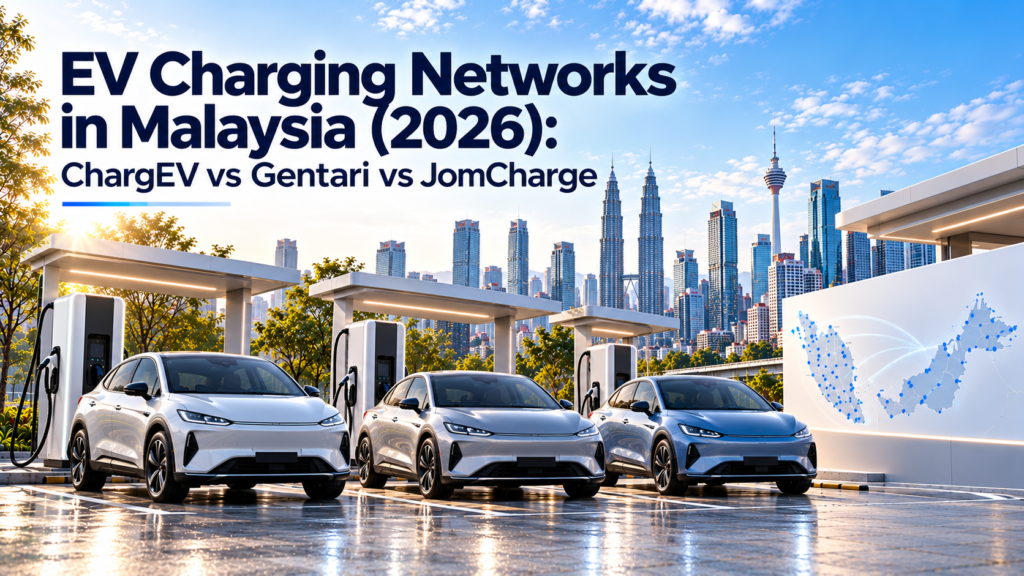
This guide compares the main EV charging networks in Malaysia on coverage, price per kWh, subscriptions, idle fees, and the type of driving each one suits best, using the most recent figures available as of October 2026.
Last updated: October 2026. Charging prices and promotions change often, so confirm the current rate in each network’s app before you plug in.
Quick Comparison: EV Charging Networks in Malaysia
| Network | Charging Points (2025) | Typical DC Price | Best For |
|---|---|---|---|
| JomCharge | 680 | ~RM1.40/kWh | Highway CCS2 fast charging, no subscription |
| ChargEV | 501 | RM0.85–1.10/kWh (AC: RM0.40–0.55) | Malls, hotels, office car parks |
| Gentari Go | 395 | RM1.60–1.80/kWh (cut to RM1.30–1.40 at select sites from July 2026) | North-South Expressway and Petronas stations |
| ChargeSini | Not published in the sources reviewed | From RM1.19/kWh | Mall and condominium charging |
| Tesla Supercharger | Four Klang Valley sites opened March 2026 | RM1.80/kWh non-member | Tesla owners, Klang Valley trips |
Point counts come from ChargeSini’s 2025 operator ranking and are year-end figures, so every network has likely grown since. Prices are typical ranges and vary by site.
How Big Is Malaysia’s Public Charging Network in 2026?
Malaysia’s public charging network is growing quickly but is still well short of the government’s original target. According to Carlist.my’s report on MITI figures, Malaysia had 6,416 public chargers on 31 May 2026, made up of 4,273 AC points and 2,143 DC fast chargers. The country closed 2025 with 5,360 units, so the network added roughly 1,050 chargers in five months. The original goal of 10,000 chargers by the end of 2025 was missed, and the current targets are 8,000 AC chargers by Q3 2026 and 30,000 public chargers by 2030. The earlier MEVnet dashboard count was 5,839 on 31 March 2026, so check the latest national figure before quoting it.
The practical takeaway: DC fast chargers are still the scarce resource. Only about one in three public points (2,143 of 6,416) is DC, which is why highway trips need more planning than city driving, and why the network you choose matters most on longer routes.
JomCharge: Best for Highway Fast Charging
JomCharge, operated by EV Connection, has the largest CCS2 fast-charging footprint in Malaysia and is the default network for most highway drivers. It grew from 476 charging points in 2024 to 680 in 2025, making it one of the two or three largest operators by total points.
Key points:
- Typical DC pricing is around RM1.40/kWh, which sits between ChargEV’s lower rates and Gentari’s premium highway rates
- No subscription is required, since you pay per kWh through the app
- Roaming agreements with Gentari and ChargEV mean you can often activate chargers on partner networks from the JomCharge app
Best for: Drivers who regularly take North-South Expressway trips and want straightforward pay-as-you-go pricing without committing to a membership.
Gentari Go: Premium Highway Network With Tiered Pricing
Gentari, owned by Petronas, runs the most complicated pricing of any major network in Malaysia, with location-based DC rates, two annual subscriptions, an off-peak discount, and an idle fee. It reached 395 charging points in 2025, up from 324 in 2024, and focuses on highway and Petronas station locations.
How Gentari prices charging:
- DC by location type: RM1.60/kWh at destination sites, RM1.70/kWh at highway sites, and RM1.80/kWh at battery-storage-backed sites
- July 2026 price cut: Gentari lowered selected DC chargers across Peninsular Malaysia to RM1.30–1.40/kWh, with the new rates also reflected on partner apps such as JomCharge and ChargEV
- AC pricing: RM1.00/kWh at 7 kW and RM1.15/kWh at 11–22 kW
- Off-peak rate: RM1.36/kWh between midnight and 6:59 a.m.
- Subscriptions: Go Starter at RM350 a year for 15% off, and Go Plus at RM699 a year for 30% off
Does a Gentari subscription pay for itself? At the RM1.70 highway rate, both plans break even at roughly 1,370 kWh of Gentari charging per year, or about 115 kWh a month. If you charge less than that on Gentari, pay-per-use is cheaper.
Idle fees: Gentari charges RM0.40 per minute, around the clock since 30 March 2026, starting 15 minutes after your session ends.
Best for: Drivers who mostly use Petronas stations and the North-South Expressway, and who charge enough on Gentari to justify a subscription.
ChargEV: Best for Cheap AC Charging at Malls and Hotels
ChargEV is Malaysia’s oldest charging network, launched in 2015, and it is still the cheapest per kWh at the places where your car is parked anyway. Typical pricing is RM0.85–1.10/kWh on DC and just RM0.40–0.55/kWh on AC, which is a fraction of what highway DC chargers cost. Its growth has been the fastest of the three big names: ChargeSini’s 2025 ranking has it expanding from 196 to 501 charging points, an increase of about 155%.
Where it is strongest: Older malls, hotels, and corporate car parks, where a few hours of AC charging costs far less than a DC session.
Where it is weaker: On the open highway, ChargEV is thinner than JomCharge and Gentari, so it is not the network to plan a long inter-state run around.
Pricing model: Among EV charging networks in Malaysia, ChargEV has changed its model the most. The old annual plans are gone. Most recent guides describe ChargEV as fully pay-per-use for both AC and DC, with nothing to buy before you charge. Because older articles still circulate with outdated membership prices (such as the RM240 yearly plan), confirm the current terms in the app.
Best for: Drivers who park at malls, hotels, or offices for hours at a time and want the lowest cost per kWh.
Other EV Charging Networks in Malaysia Worth Knowing
ChargeSini positions itself as the largest network by number of charging points and the one with the most mall chargers. It lowered its DC rates in 2026, with condominium DC chargers and public DC chargers rated 40 kW and below now at RM1.19/kWh, and 60–80 kW chargers at a flat RM1.29/kWh. Membership plans offer up to a further 20% off, but free idle time was removed from those plans after complaints about drivers occupying bays.
Shell Recharge operates at Shell petrol stations, mostly as premium DC hubs, with rates in the range of RM1.20–1.80/kWh depending on charger speed.
TNB Electron runs chargers at TNB-affiliated sites and is generally priced in a similar range to ChargEV.
Tesla Superchargers opened at four Klang Valley sites in March 2026, with a non-member rate of RM1.80/kWh and a reported member rate of roughly RM0.99–1.08/kWh. Tesla also ended free destination charging at malls and introduced an RM0.88/kWh rate, reported in July 2026.
How Much Does Public Charging Actually Cost vs Home Charging?
Public DC fast charging in Malaysia typically costs RM1.10–1.80/kWh, while home charging costs roughly 40–55 sen/kWh, making home charging about three to four times cheaper. Under TNB’s time-of-use off-peak tariff, one 2026 guide calculates home charging at about 41.83 sen/kWh all-in below 1,500 kWh a month, while RinggitPlus puts domestic electricity under the standard tariff at roughly 44 to 55 sen per kWh.
Even at the newly reduced rates, public DC charging remains a premium service. A discounted Gentari rate of RM1.30/kWh is still several times the cost of charging at home. Residents with building-level AC charging at around RM0.60–0.90/kWh, a common rate structure for managed condominiums, will almost always prefer that over public DC for regular top-ups. If you are weighing the full running-cost picture, our EV Total Cost of Ownership Malaysia guide shows how charging habits change the 5-year numbers, and our Home EV Charger Installation guide covers what it costs to set up charging at home.
How to Choose Between the EV Charging Networks in Malaysia
The honest answer is that most drivers end up using two or three EV charging networks in Malaysia, because no single operator covers every route and price point. One 2026 apps guide suggests that JomCharge plus Gentari Go together cover roughly 80% of North-South Expressway rest-stop chargers, which makes that pair a sensible practical minimum for highway drivers.
- Frequent North-South Expressway driver: JomCharge and Gentari Go
- Charging at malls, hotels, or the office: ChargEV, with ChargeSini as a backup
- Condominium resident without in-building charging: ChargeSini and ChargEV for AC, plus a DC network for emergencies
- Tesla owner: Tesla’s own network first, with JomCharge or Gentari as backup when you are off the Supercharger map
- Budget-focused driver: ChargEV AC wherever you park for hours, and avoid DC fast charging except when you genuinely need the speed
Common Myths About EV Charging Networks in Malaysia
“One charging app is enough.” Not for highway trips. Roaming agreements between Gentari, JomCharge, and ChargEV let you activate chargers across those networks from one app in some cases, but coverage and pricing still differ by app, and not every charger on every network is roaming-enabled.
“The biggest network is always the cheapest.” Network size and price are unrelated. ChargEV is smaller than JomCharge on the highway but is typically the cheapest per kWh, while Gentari’s premium highway pricing sits at the top of the range.
“DC fast charging is the normal way to charge an EV in Malaysia.” It is the expensive and occasional way. Most owners with home or workplace access charge on AC and use DC only for longer trips.
“A Gentari subscription always saves money.” Only if you use enough. At the highway rate, you need roughly 1,370 kWh of Gentari charging per year before either plan recovers its annual fee.
“Charging prices are stable, so a guide from last year still applies.” Pricing moved several times in 2026 alone, including Gentari’s July cut, ChargeSini’s lower DC rates, and Tesla ending free destination charging. Always check the live rate in the app.
Which EV Charging Network Is Best for Each Type of Trip?
The best network depends on the trip, not the brand. The same driver can reasonably use three different EV charging networks in a single week.
- Daily commute (under 60 km): Charge at home or at a workplace AC point. A public network is only a backup, and a ChargEV or ChargeSini AC point at the mall covers any gaps.
- Klang Valley to Penang (about 350 km): Plan one fast-charge stop on the North-South Expressway. JomCharge and Gentari Go both have rest-stop coverage, so install both apps before you leave.
- Klang Valley to Johor Bahru (about 330 km): Same logic, with one DC stop of 20–30 minutes. Arrive at the charger with 10–20% battery for the fastest charging curve.
- East Coast trips: Coverage is thinner, so check each charger’s status in the app the night before and keep a second network ready.
- Weekend city errands: Use mall AC charging while you shop. ChargEV’s RM0.40–0.55/kWh AC rate makes a two-hour mall visit cost a few ringgit.
What to Check Before Relying on Any Charging Network
A charger on the map is not the same as a working charger. Faulty and occupied bays are the most common complaint from Malaysian EV owners, so a short pre-trip routine saves more time than choosing the “perfect” network.
- Live status: Open the app and confirm the charger shows as available, not just listed.
- Power rating: A 60 kW charger and a 180 kW charger are priced differently and charge very differently, so check which one you are heading to.
- Payment method: Some networks need a pre-loaded wallet, while others accept a card on file, so top up before you leave Wi-Fi coverage.
- Roaming status: Confirm whether your home app can activate that charger, and what rate it will charge you on a partner network.
- Backup site: Note the next charger along the route within your remaining range.
Practical Tips Before You Plug In
- Check the connector first. Most DC fast chargers in Malaysia use CCS2, while AC points use Type 2, so confirm your car’s port matches before you drive to a site.
- Watch the idle fees. Gentari charges RM0.40 per minute after a 15-minute grace period, and Tesla applies congestion fees at busy sites, so move your car as soon as charging finishes.
- Confirm whether billing is per kWh or per minute. Per-kWh billing is now standard and fairer, but always check, especially at smaller operators.
- Install at least two apps before a long trip. A backup network costs nothing and avoids being stranded by a single faulty charger.
- Plan for heat. Malaysia’s climate affects fast-charging speed, particularly on back-to-back sessions, which our EV Battery Preconditioning Malaysia guide explains in detail.
- Know the AC and DC difference. Our AC Charging vs DC Fast Charging guide explains when each makes sense.
Final Thoughts
There is no single best EV charging network in Malaysia — the right choice depends on where and how you charge. JomCharge is the straightforward pay-as-you-go choice for highway driving, Gentari offers strong highway coverage but needs careful reading of its tiered pricing and subscriptions, ChargEV is the value leader for AC charging at malls and hotels, and ChargeSini and the other operators fill gaps in city and condominium charging. With public DC charging costing three to four times more than home charging, the most effective way to cut your charging bill is to charge at home or at a low-cost AC point whenever you can, and to treat DC fast charging as a tool for longer trips rather than a daily habit. If you are still choosing a car, our Best EV Cars in Malaysia guide compares models by price, range, and charging speed.
Frequently Asked Questions
How many public EV charging points are there in Malaysia in 2026?
As of 31 May 2026, MITI figures counted 6,416 public chargers, made up of 4,273 AC points and 2,143 DC fast chargers. The national target is 30,000 public chargers by 2030.
Which EV charging network is cheapest in Malaysia?
ChargEV is typically the cheapest, at roughly RM0.85–1.10/kWh on DC and RM0.40–0.55/kWh on AC. ChargeSini’s DC rates now start from RM1.19/kWh, and Gentari’s discounted sites start from RM1.30/kWh.
Which network is best for highway driving?
JomCharge has the largest CCS2 fast-charging footprint, and Gentari is strong along the North-South Expressway. Using both apps together covers most highway rest-stop chargers.
Is a Gentari Go subscription worth it?
Only if you charge heavily on Gentari. At the RM1.70 highway rate, Go Starter (RM350 a year) and Go Plus (RM699 a year) both break even at roughly 1,370 kWh of Gentari charging per year.
Is it cheaper to charge an EV at home than at a public charger in Malaysia?
Yes, by a wide margin. Home charging costs roughly 40–55 sen/kWh, which is about three to four times cheaper than public DC fast charging at RM1.10–1.80/kWh.
Related Guides
- EV Charging Malaysia Guide (2026): Cost, Time & Home Charging
- Best EV Cars in Malaysia (2026): Prices, Range & Buying Guide
- EV Total Cost of Ownership Malaysia: 5-Year Breakdown (2026)
- Best EV Charging Networks in the US 2026: Tesla Supercharger vs Electrify America vs EVgo
- Home EV Charger Installation Guide: Cost, Process & What to Expect (2026)