
Tesla Supercharger remains the dominant EV charging network in the US in 2026, with roughly 36,900 DC fast-charging stalls — about 50% of all US DC fast charging capacity, more than the next four networks combined — plus the industry’s best reliability at a 4% session-failure rate versus an industry average of roughly 22%. Electrify America and EVgo remain essential for non-Tesla drivers on the CCS standard, but neither matches Supercharger’s combination of scale and consistency, and the gap matters more than most buyers realize before their first road trip.
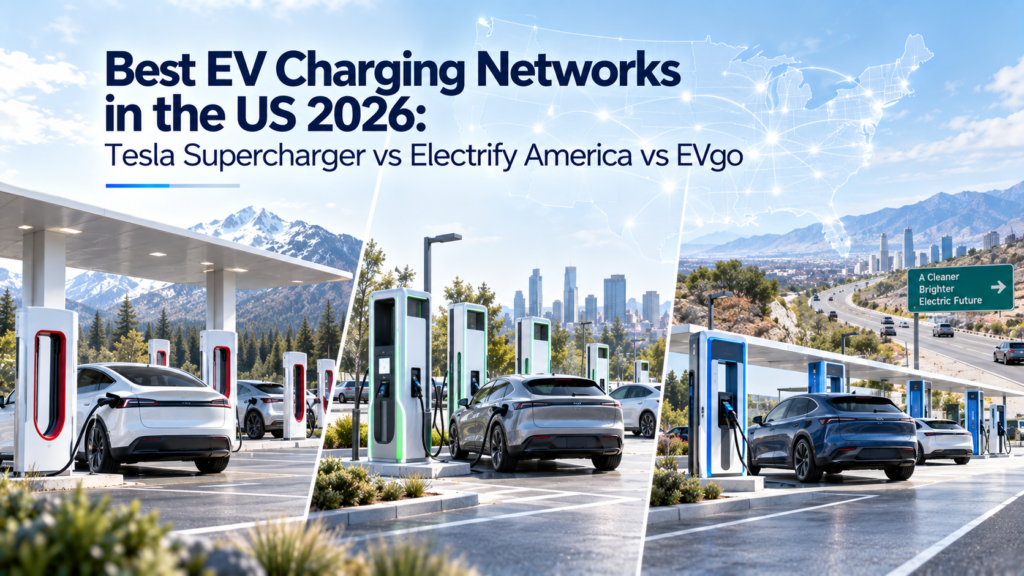
This guide compares Tesla Supercharger, Electrify America, EVgo, and ChargePoint on coverage, speed, reliability, and price, so you know exactly which network fits your actual driving needs.
Network Comparison at a Glance
| Network | US DC Fast Stalls | Reliability | Best For |
|---|---|---|---|
| Tesla Supercharger | ~36,900 | ~99% session success (4% failure rate) | Road trips, highway corridors |
| Electrify America | ~5,452 | ~85% session success (up from ~70% in 2023) | CCS road trips, 800V fast charging |
| EVgo | Dense urban footprint | 43% of sessions encounter some issue | Urban/city DC fast charging |
| ChargePoint | 5,000+ total stations (mostly Level 2) | Varies by location | Daily charging at home, work, retail |
Tesla Supercharger: Still the Reliability Leader
Tesla Supercharger has ranked as the most reliable public charging network in J.D. Power’s studies for five consecutive years, with a session success rate around 99% compared to an industry average closer to 78%. Beyond reliability, its scale is genuinely unmatched — roughly 36,900 US stalls means Supercharger alone accounts for about half of all DC fast-charging capacity in the country. Its route consistency along interstate corridors is what road-trip-focused reviewers consistently cite as its single biggest practical advantage: you can plan a long drive around Supercharger locations with real confidence the stall will actually be working when you arrive.
Non-Tesla access has expanded dramatically. Since 2024, Supercharger access opened to non-Tesla EVs at most US sites, with billing handled through the Tesla app. Compatibility depends on whether your vehicle ships with a native NACS port or needs a CCS-to-NACS adapter — nearly every EV brand sold in the US in 2026, including Ford, GM, Rivian, Hyundai, Kia, Polestar, Volvo, Mercedes, and BMW, has adopted NACS either natively or via adapter.
Electrify America: The Core Non-Tesla Road Trip Network
Electrify America operates roughly 5,452 DC fast ports, making it the second-largest network in this comparison, and remains the primary CCS-based option for road trips. Its biggest technical advantage over Supercharger’s older hardware is peak charging speed on 800-volt vehicles — Electrify America’s 350 kW stalls deliver some of the fastest sustained charging speeds available today for vehicles like the Porsche Taycan, Hyundai Ioniq 5/6, Kia EV6, and Lucid Air, since many legacy Tesla V3 stalls cap out around 250 kW (though newer V4 stalls are catching up).
Pricing runs on a plan-based structure: a guest “Pass” tier, and a “Pass+” membership tier priced around $4-7/month depending on the source, advertised to reduce per-kWh charging costs by roughly 25% compared to guest pricing. Without a membership, expect to pay approximately $0.48/kWh; with Pass+, closer to $0.36/kWh.
EVgo: Best for Urban and City Charging
EVgo’s core strength is charger density in metro areas rather than highway coverage, making it more useful for city dwellers without home charging than for cross-country road trips. This is also where EVgo’s biggest weakness shows up most starkly: independent tracking found 43% of EVgo sessions encounter some kind of issue — nearly half of all charging attempts. For drivers who primarily need a quick top-up during errands or work hours in a city, EVgo remains practical despite this reliability gap, but it’s not the network to rely on for a long-distance trip without backup options.
ChargePoint: The Daily-Charging Champion, Not a Road-Trip Network
ChargePoint’s strength is entirely different from the other three — it dominates Level 2 charging at home, work, and retail locations rather than DC fast charging for road trips. Its Home Flex unit is ranked as the top Level 2 home charger for 2026, and with over 5,000 total stations (mostly slower Level 2 rather than DC fast), it’s the network most drivers will interact with daily rather than on a highway drive. Reliability varies meaningfully by specific location, since ChargePoint’s network includes many third-party-hosted stations rather than a uniformly maintained system.
IONNA: The Emerging High-Power Network Worth Watching
IONNA, a joint venture launched in 2024 by BMW, GM, Honda, Hyundai, Kia, Mercedes-Benz, and Stellantis, targets highway corridors with high-power 100-400 kW charging and puts both NACS and CCS plugs on every stall. It’s still building out its footprint in 2026 and functions best as a backup or supplementary network rather than a primary road-trip solution today, but its dual-connector approach and automaker backing make it worth tracking as coverage expands.
Which Network Should You Actually Use?
The honest, practical breakdown by use case:
- Road trips: Tesla Supercharger, by a wide margin — reliability and coverage both matter more on a long drive than marginal speed differences
- CCS-only road trips (non-Tesla, no NACS adapter): Electrify America as your primary network, with awareness that you may occasionally need to move to a different stall if one is malfunctioning
- Urban living without home charging: EVgo for retail-located density, combined with Tesla Supercharger where available for backup
- Apartment or workplace charging: ChargePoint Level 2 for daily top-ups, reserving DC fast networks for weekend trips
- 800V vehicle owners wanting maximum charging speed: Electrify America’s 350 kW stalls or EVgo’s newest deployments currently edge out most Supercharger V3 stalls, though V4 rollout is narrowing this gap
The Single Biggest Mistake Drivers Make
Choosing a network based on port count alone, rather than reliability, is the most common planning mistake. A network with fewer total ports but a 99% session success rate delivers a meaningfully better real-world experience than one with more ports but a 43% problem rate — you may need to try two or three stalls before finding a working one on lower-reliability networks. Whether a charger actually works when you arrive matters more than how many total chargers a network claims to operate.
Common Myths About EV Charging Networks
“More charging stations always means a better network.” Not necessarily. ChargePoint has the most total stations by raw count, but most are slower Level 2 chargers rather than DC fast charging — the metric that actually matters for road trips is DC fast-charging reliability and coverage along your specific route, not total station count across all charger types.
“Non-Tesla EVs can’t use Supercharger stations.” This was true before 2024 but is now outdated. Most Supercharger sites in the US now accept non-Tesla vehicles, either through a native NACS port or an adapter, with billing handled directly through the Tesla app.
“All charging networks charge roughly the same price per kWh.” Pricing varies significantly by network, membership tier, and even by state — Electrify America’s guest pricing runs meaningfully higher than its Pass+ membership rate, and per-kWh versus per-minute billing structures differ by state regulation.
“Faster peak charging speed (kW) means a genuinely faster charging experience.” Peak kW numbers are often marketing figures rather than sustained real-world speeds — a vehicle’s actual charging curve, battery temperature, and state of charge all affect how much of that peak speed you actually experience during a session.
How to Choose Based on Your Specific EV
Your vehicle’s native connector and NACS adapter compatibility should be the very first filter in choosing a charging strategy, before comparing reliability or pricing at all. A Tesla owner has straightforward native access to the largest, most reliable network by default. A non-Tesla EV owner needs to confirm whether their specific model ships with a native NACS port (increasingly common on 2025-2026 model years) or requires a manufacturer-supplied or aftermarket adapter for Supercharger access — and in either case, keeping Electrify America or EVgo as a backup option for situations where Supercharger coverage doesn’t reach remains a sensible practice regardless of primary network choice.
What About EV Charger Tax Credits in 2026?
The federal §30C tax credit (30% of installation cost, up to $1,000) ended for home charging equipment placed in service after 30 June 2026 — meaning there’s currently no federal credit available for a new home charger installation. Utility-level and state rebates remain the primary financial incentive available now. If you’re planning a home charging setup, our Home EV Charger Installation guide covers current costs and what incentives remain available.
Final Thoughts
Tesla Supercharger’s combination of scale and near-99% reliability makes it the clear default choice for road trips in 2026, and its growing non-Tesla accessibility means this advantage now extends well beyond Tesla owners. Electrify America remains the essential CCS road-trip backup, particularly for 800V vehicles chasing maximum charging speed, while EVgo and ChargePoint each serve specific, narrower use cases — urban top-ups and daily home/work charging respectively — better than they serve as primary road-trip networks. The single most important planning principle across all of them: prioritize reliability data over raw port counts when deciding which network to trust for your next long drive.
Frequently Asked Questions
Which EV charging network is the most reliable in the US?
Tesla Supercharger, with a session success rate around 99% (roughly 4% failure rate), compared to an industry average closer to 22% failure across all networks combined.
Can non-Tesla EVs use Tesla Superchargers?
Yes, at most US sites since 2024, either through a native NACS port or a CCS-to-NACS adapter, with billing handled through the Tesla app.
Is Electrify America good for road trips?
Yes, particularly for CCS-based non-Tesla vehicles and 800V cars seeking maximum charging speed, though its reliability, while improved to around 85% session success, still lags behind Tesla Supercharger.
Why does EVgo have a high problem rate despite good urban coverage?
Independent tracking has found roughly 43% of EVgo sessions encounter some issue, reflecting broader hardware reliability challenges across the network despite its strong metro-area density.
Is there still a federal tax credit for home EV chargers in 2026?
No. The federal §30C credit expired for equipment placed in service after 30 June 2026, leaving utility and state-level rebates as the main remaining financial incentives.