
Electric SUV vs sedan is one of the first forks in the road for anyone shopping for an EV in 2026, and unlike the gas-powered version of this debate, the trade-offs are sharper and more measurable. Body style affects an EV’s range, efficiency, and price more directly than it does for a gas car, simply because aerodynamics play a bigger role in how far a battery can carry you.
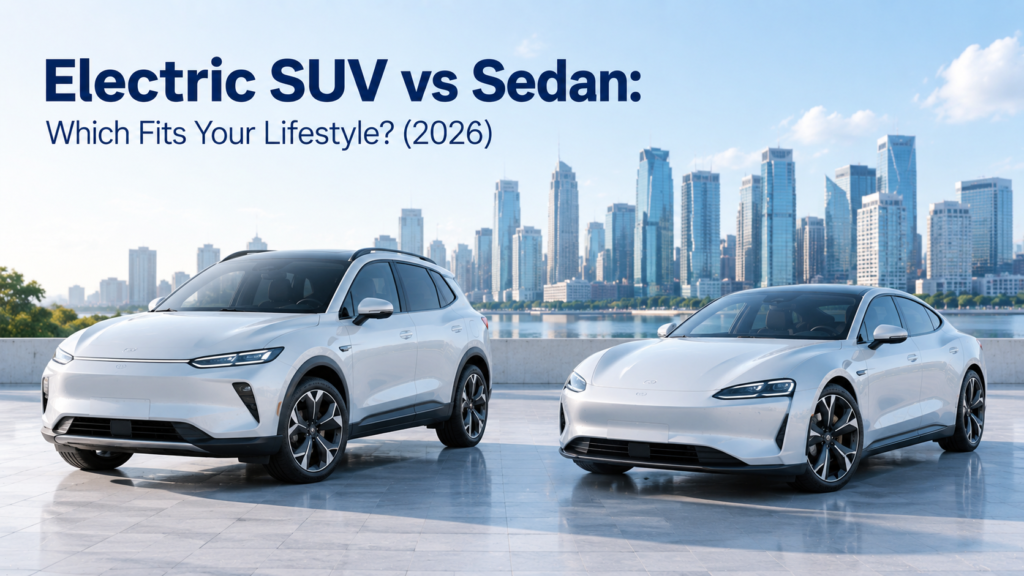
This guide breaks down exactly how electric SUVs and sedans compare on range, efficiency, cargo space, price, and driving feel, so you can match the decision to how you actually live rather than which body style looks better on paper.
Why Body Style Matters More for EVs Than Gas Cars
In a gas car, body style mostly affects fuel economy at the margins. In an EV, it has a much more direct effect on real-world range. Sedans have a naturally lower, more aerodynamic profile that creates less wind resistance, which translates directly into more miles per kWh of battery capacity. SUVs sit taller and push more air out of the way, which is the single biggest reason electric SUV vs sedan comparisons consistently show sedans achieving better range per kWh, even when both vehicles carry similarly sized battery packs.
Range and Efficiency: Sedans Generally Win
Looking at real 2026 pricing and range data makes the pattern clear. The Tesla Model 3 Premium RWD delivers 363 miles of range at 137 MPGe, while the Tesla Model Y Long Range RWD — built on similar underlying technology — delivers 357 miles at 134 MPGe. The gap is modest between these two specific models, but it widens considerably when comparing purpose-built sedans against taller, boxier SUVs. The Hyundai Ioniq 6 sedan is frequently praised specifically for its exceptional range relative to its battery size, a direct result of its aerodynamic shape, while the more upright Ioniq 5 SUV trades some of that efficiency for interior space and a more conventional crossover silhouette.
This doesn’t mean every electric SUV underperforms — some, like the Hyundai Ioniq 9, deliver over 300 miles of range in every configuration despite being a three-row SUV — but pound for pound, a sedan will typically extract more range from the same battery pack than an SUV of comparable price and technology.
Cargo Space and Practicality: SUVs Generally Win
This is where the electric SUV vs sedan comparison flips entirely. Electric SUVs offer meaningfully more cargo versatility, with the best models in 2026 delivering 30 to 75 cubic feet of usable cargo space, expandable further by folding rear seats flat. Sedans are constrained by a traditional trunk that, however clever the packaging, can’t match an SUV’s open cargo area or the ability to haul larger, irregularly shaped items.
For families, this gap matters even more once you factor in three-row SUVs like the Kia EV9 or Hyundai Ioniq 9, which offer genuine six-to-seven-seat capacity that no sedan can match. If cargo flexibility or hauling capacity is a real, recurring need rather than an occasional one, this is usually the deciding factor in the electric SUV vs sedan decision.
Price Comparison: Similar Segments, Different Sweet Spots
Pricing overlaps more than most buyers expect. At the affordable end, the Chevrolet Equinox EV starts in the mid-$30,000s and delivers up to 319 miles of range on its long-range trim — competitive with sedans in the same price bracket. Compact and mid-size electric sedans and SUVs tend to cluster in similar price bands once you match trim and range, meaning the electric SUV vs sedan choice usually comes down to body style preference rather than a significant price penalty either way.
Where the price gap widens is at the top end: three-row SUVs with genuine off-road capability or luxury positioning — think Rivian R1S, Cadillac Escalade IQ, or Lucid Gravity — carry a meaningful premium over comparable sedans, since you’re paying for both battery capacity and a larger, more complex platform.
Side-by-Side: Popular Electric Sedans vs SUVs (2026)
| Model | Body Style | EPA Range | Starting Price (approx.) |
|---|---|---|---|
| Tesla Model 3 (Premium RWD) | Sedan | 363 miles | ~$42,490 |
| Tesla Model Y (Long Range RWD) | SUV | 357 miles | ~$44,990 |
| Hyundai Ioniq 6 | Sedan | ~305 miles | ~$40,000 |
| Hyundai Ioniq 5 | SUV | ~318 miles | ~$41,000 |
| Kia EV6 | SUV (coupe-styled) | ~319 miles | ~$41,200 |
| Chevrolet Equinox EV | SUV | Up to 319 miles | ~$34,995 |
| Hyundai Ioniq 9 | SUV (3-row) | 300+ miles | ~$60,000+ |
This table highlights something worth noting: several modern electric SUVs — particularly coupe-styled crossovers like the Kia EV6 — have narrowed the efficiency gap considerably compared to older-generation SUVs, thanks to more aggressive aerodynamic design.
Driving Feel: Sedans Favor Handling, SUVs Favor Confidence
Beyond the numbers, electric SUV vs sedan also comes down to how each feels behind the wheel. Sedans sit lower to the ground, which combined with an EV’s naturally low center of gravity (thanks to the floor-mounted battery pack) creates an engaging, planted driving feel that many enthusiasts genuinely prefer. SUVs sit higher, giving drivers a commanding view of the road that plenty of buyers find more comfortable and confidence-inspiring, particularly in traffic or unfamiliar driving conditions. Neither is objectively “better” here — it’s a matter of what kind of driving experience you personally prioritize.
Which Should You Choose? A Practical Framework
Choose an electric sedan if:
- Maximizing range per dollar and per kWh is your top priority
- You mostly drive solo or with one or two passengers
- You value a lower, sportier driving feel
- Your cargo needs are occasional rather than routine
- You want the lowest possible entry price for a given range figure
Choose an electric SUV if:
- You regularly haul cargo, gear, or need to fold seats flat for larger items
- You have a family requiring three-row seating or car seats that benefit from easier access
- You prefer a higher seating position and commanding road view
- You want maximum interior flexibility even at some cost to efficiency
- Towing capability matters, even occasionally
A Middle Ground: Coupe-Styled Crossovers
If the electric SUV vs sedan choice feels like it’s forcing a compromise you don’t want to make, a growing category of coupe-styled crossovers splits the difference. Models like the Kia EV6 combine an SUV’s elevated seating position and useful cargo area with a lower, more aerodynamic roofline that claws back some of the efficiency sedans typically win on. The trade-off is usually reduced rear headroom compared to a boxier SUV — the swept-back roofline that improves efficiency also eats into space for taller rear passengers — but for buyers who want a bit of both worlds, this middle category is worth cross-shopping before committing to either extreme.
Total Cost of Ownership: Does Body Style Change the Math?
Sticker price is only part of the electric SUV vs sedan equation — running costs diverge too, mostly as a downstream effect of the efficiency gap discussed above. Because sedans typically achieve higher MPGe, they cost less per mile to charge over the life of the vehicle, even when electricity rates and driving patterns are identical. Using the price-per-mile-of-range figures from current market data, a Tesla Model 3 sedan works out to roughly $117 per mile of range, compared to about $126 per mile for the Model Y SUV — a gap that, while modest per mile, compounds over years of ownership and tens of thousands of miles.
Insurance costs also tend to run slightly higher for SUVs than sedans in the same price bracket, largely reflecting higher repair costs tied to larger body panels and, in some cases, more complex all-wheel-drive systems. None of this makes SUVs a bad financial choice — the practicality they offer is worth the modest premium for many buyers — but it’s worth factoring into a genuine electric SUV vs sedan cost comparison rather than looking at sticker price alone.
Maintenance and Tire Wear: A Smaller but Real Difference
One often-overlooked factor in the electric SUV vs sedan decision is tire wear. SUVs carry more weight — largely from a taller body and, in some cases, all-wheel-drive hardware — which translates into faster tire wear compared to a similarly equipped sedan. Since EVs already tend to wear through tires somewhat faster than gas cars due to instant torque and added battery weight, this effect is more noticeable in electric SUVs specifically. Budgeting for slightly more frequent tire replacement is a small but real part of SUV ownership costs that many first-time EV buyers don’t anticipate.
The core physics behind electric SUV vs sedan — aerodynamics affecting range, body style affecting cargo space — apply globally, but the specific models and price positioning look different in the Malaysian market. Popular local options like the BYD Seal (sedan) and BYD Atto 3 (SUV) follow the same general pattern seen internationally, with the sedan typically delivering better range efficiency and the SUV offering more cargo flexibility. If you’re comparing specific models available in Malaysia, our Best EV Cars in Malaysia guide breaks down local pricing and range figures, and our Tesla Model 3 review covers how the sedan option stacks up specifically for Malaysian buyers.
Final Thoughts
There’s no universally correct answer to electric SUV vs sedan — the right choice depends entirely on how you actually use a car day to day. Sedans win decisively on range efficiency and driving feel, typically stretching further on the same battery while costing less for a given range figure. SUVs win just as decisively on cargo flexibility, family practicality, and driving position. If you’re genuinely torn, start by being honest about how often you actually need the extra cargo space or seating an SUV provides — for many buyers, that need is smaller than they initially assume, and a sedan ends up delivering more range and a lower price for the same money. Whichever way you lean, test-driving both body styles back to back — ideally on the same day — remains the most reliable way to settle an electric SUV vs sedan decision that numbers alone can’t fully resolve.
Quick Checklist Before You Decide
- Map your last 10 trips — how many actually needed SUV-level cargo space or a third row?
- Compare price-per-mile-of-range for your shortlisted models, not just the sticker price
- Test-drive both body styles on the same day so the driving-feel difference is fresh in memory
- Check charging speed and architecture (like 800V systems) separately from body style, since it varies by model regardless of sedan or SUV form
- Factor in tire and insurance costs if you’re genuinely torn on a tight budget
Frequently Asked Questions
Do electric sedans really get better range than electric SUVs?
Generally yes, for a given battery size, due to better aerodynamics. However, the gap has narrowed with newer coupe-styled SUVs and larger battery packs in some SUV models.
Are electric SUVs more expensive than electric sedans?
Not always — pricing overlaps significantly in the compact and mid-size segments. The gap widens mainly at the high end, where large three-row luxury SUVs carry a meaningful premium over comparable sedans.
Which is better for a family: an electric SUV or sedan?
SUVs are generally the better fit for families needing cargo flexibility, three-row seating, or easier access for car seats, though a sedan can work well for smaller families with lighter cargo needs.
Do electric SUVs have worse charging times than sedans?
Not inherently — charging speed depends more on the battery chemistry and charging architecture (like 800V systems) than on body style specifically.
Is a coupe-styled electric SUV a good compromise?
Yes, for many buyers. Coupe-styled crossovers like the Kia EV6 offer a blend of SUV practicality and sedan-like efficiency, though usually with somewhat reduced rear headroom compared to a traditional SUV shape.