
DIY car detailing vs professional detailing is a debate that looks simple on the surface — pay someone or do it yourself — but the real answer depends on factors most people don’t consider until they’ve already sunk a Saturday afternoon into a job that didn’t turn out the way YouTube made it look. The upfront math seems obvious: DIY is cheaper. The real math, once you factor in tools, time, and the risk of a costly mistake, tells a more nuanced story.
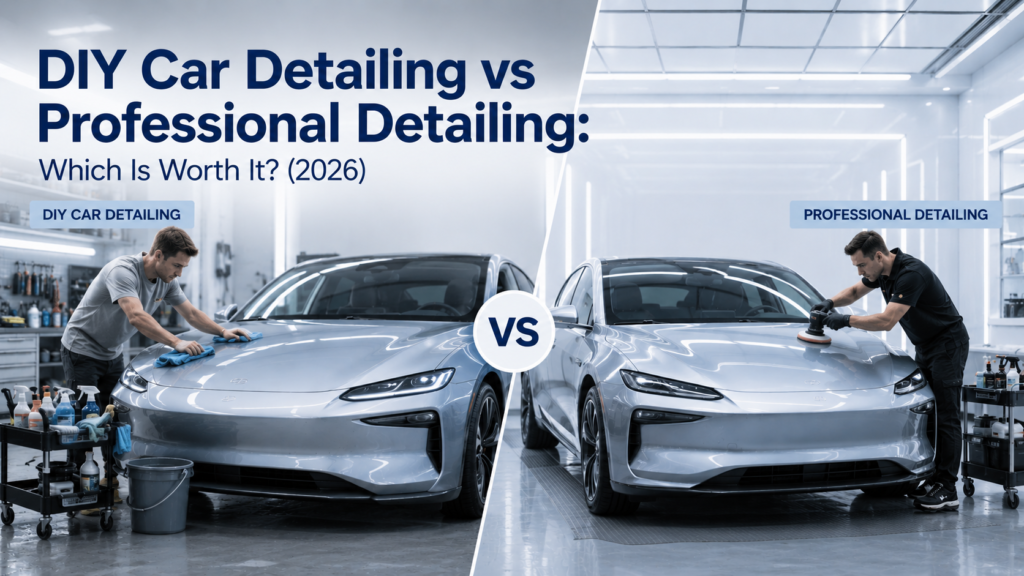
This guide breaks down exactly what DIY car detailing vs professional detailing actually costs in 2026, where each option makes sense, and why most experienced detailers land on a hybrid approach rather than picking one side permanently.
The Real Cost of DIY Car Detailing
A basic DIY kit — wash mitt, microfiber towels, wax or sealant, interior cleaner — runs roughly $60 to $170 and can handle 5 to 8 detailing sessions before needing replenishment. That sounds cheap compared to a professional visit, but the full picture includes more than just product cost.
First-year DIY costs typically break down like this:
| Item | Estimated Cost |
|---|---|
| Basic wash and wax supplies | $60 – $170 |
| Interior cleaning products | $30 – $60 |
| Machine polisher (optional, for paint correction) | $100 – $300 |
| Ceramic coating DIY kit (optional) | $40 – $300 |
| Total first-year product cost | $230 – $830 |
On top of product cost, a full DIY detail typically takes 4 to 8 hours per session, depending on your car’s condition and how thorough you’re being. If you value your time at even a modest hourly rate, that time investment adds real cost that a pure price comparison misses — some detailers estimate the “true cost” of a DIY session, once time is factored in, lands closer to $800-$1,300 across a full year of regular details.
The Real Cost of Professional Detailing
Professional detailing pricing varies significantly by region, vehicle size, and service tier, but 2026 national averages in the US cluster around these ranges:
| Service Tier | Typical 2026 Price |
|---|---|
| Basic exterior wash + interior vacuum | $50 – $150 |
| Full interior + exterior detail | $200 – $400 |
| Premium detail (paint correction, deep clean) | $443 – $1,000+ |
| Professional ceramic coating | $800 – $3,500+ |
Most professional detailers charge $70 to $110 per hour, and pricing shifts based on vehicle size (SUVs typically run 20% to 40% more than sedans due to surface area) and location — the same basic detail that costs under $100 in one state can run closer to $270 in another. A mobile detailer who comes to you often adds a $25-$50 convenience fee on top of standard pricing, while a fixed-location shop tends to charge more overall but offers a controlled environment better suited to paint correction and coating work.
DIY Car Detailing vs Professional Detailing: Side-by-Side
| Factor | DIY | Professional |
|---|---|---|
| Upfront cost | Lower | Higher |
| Time required | 4-8 hours per session | Zero hours of your time |
| Skill/risk | Learning curve, mistake risk | Trained technicians |
| Equipment needed | You buy and store it | Shop provides everything |
| Results consistency | Varies with skill | Generally consistent |
| Best for | Regular maintenance washes | Paint correction, coatings, PPF |
This table captures the core trade-off at the heart of DIY car detailing vs professional detailing: one option asks more of your time and skill, the other asks more of your wallet.
When DIY Car Detailing Makes Sense
DIY genuinely shines for routine maintenance rather than corrective or protective work — one of the clearest patterns in the DIY car detailing vs professional detailing decision. Weekly or biweekly maintenance tasks — a proper two-bucket wash, interior vacuuming, glass cleaning, tire dressing — are well within reach for most car owners, and doing them yourself both saves money and, for many people, becomes a genuinely relaxing weekend routine rather than a chore. If you’re the type of owner who enjoys the process and maintains multiple vehicles, the investment in tools pays off meaningfully over time.
DIY also makes sense for owners on a tight budget who are willing to invest the learning time, and for anyone applying a straightforward, well-reviewed product (a spray sealant or an entry-level ceramic coating kit) on paint that’s already in good condition, since the risk of a visible mistake is lower on well-maintained paint than on neglected or damaged paint.
When Professional Detailing Is Worth It
There’s a specific category of work where the DIY car detailing vs professional detailing decision tips firmly toward professional, mainly because the cost of a mistake is high and hard to reverse.
Paint correction tops this list. Removing swirl marks, oxidation, or water spots requires a machine polisher used correctly — get the technique wrong, and you can burn through clear coat, creating damage that costs far more to fix than the service would have cost in the first place.
Ceramic coating and PPF installation are the next clearest case. While DIY ceramic coating kits ($40-$300) can deliver results close to professional work if the surface is properly decontaminated and corrected beforehand, a professional install ($800-$3,500+) typically includes paint correction as part of the service and comes with a multi-year warranty — something no DIY kit offers. If your paint needs correction first, or you don’t have a dust-free space to work in, the professional route removes both the prep risk and the application risk in one step.
New car delivery and annual deep details round out the list. Many detailers recommend a professional visit shortly after taking delivery of a new car and then roughly once a year afterward, treating it as a baseline reset rather than something to attempt yourself, particularly if you’re dealing with hard water spots, yellowed headlights, or heavy interior staining.
The Hybrid Approach Most Experienced Owners Land On
After weighing both sides, most experienced car owners don’t pick DIY car detailing vs professional detailing as an either/or decision — they split the work. Routine washing and light maintenance stay DIY, since the skill ceiling is low and the savings compound weekly. Paint correction, ceramic coating, and PPF go to a professional, since the skill ceiling is high and mistakes are expensive to fix. This hybrid model tends to deliver the best of both: lower ongoing costs from weekly DIY maintenance, and protection against costly errors on the higher-stakes jobs.
Mobile Detailing vs Shop Detailing: A Related Decision
If you do go professional, you’ll also face a secondary choice: mobile detailing or a fixed-location shop. Mobile detailers offer genuine convenience — no need to drop off your car or arrange a ride — but are limited by weather and typically can’t perform heavy paint correction or ceramic coating outdoors, since dust and inconsistent lighting compromise the result. Fixed-location shops cost somewhat more due to overhead, but offer controlled lighting, dust-free bays, and access to lifts and specialized equipment that make them the better choice for anything beyond a standard wash-and-detail.
Common DIY Mistakes That End Up Costing More
- Using the wrong pad or compound with a machine polisher — this is the single most common way DIY paint correction goes wrong, and the resulting clear coat damage often costs more to fix than a professional detail would have cost upfront
- Skipping the decontamination step before applying wax, sealant, or ceramic coating — trapping contaminants under a coating shortens its lifespan and can create a patchy, uneven finish
- Washing in direct sunlight — this causes soap and water to dry too quickly, leaving water spots and swirl marks from dragging a towel across dried residue
- Underestimating time investment — many first-time DIY detailers budget an hour or two, then find themselves five hours in in the driveway, which is where the “true cost” of DIY often gets underestimated
How to Decide: A Quick Framework
Use this simple framework to settle the DIY car detailing vs professional detailing question for your specific situation:
- Is this routine maintenance (wash, vacuum, wipe-down)? → DIY is almost always the right call
- Does your paint have visible swirl marks, oxidation, or water spots? → Lean professional for correction
- Are you applying a permanent protective layer (ceramic coating, PPF)? → Professional install is generally worth the premium, especially for the warranty
- Do you have a dust-free, shaded space to work in? → If not, even a well-executed DIY attempt risks contamination
- What’s your time actually worth? → If four to eight hours in the driveway costs you more in lost time or opportunity than the price difference, professional detailing may genuinely be the cheaper option once time is factored in
Common Myths in the DIY Car Detailing vs Professional Detailing Debate
“Professional detailing is always overpriced for what you get.” Not necessarily — once time, tool cost, and mistake risk are factored in, professional pricing often reflects genuine value rather than pure markup, especially for corrective or protective work.
“DIY always saves money in the long run.” Only if you actually use the tools repeatedly. Detailers commonly point out that owners who buy a full DIY kit, use it once or twice, then let it collect dust end up spending more per detail than if they’d simply booked a professional from the start.
“You need professional-grade equipment to get decent DIY results.” For routine maintenance, this isn’t true — a quality wash mitt, microfiber towels, and a spray sealant go a long way. The equipment gap matters far more for paint correction specifically, not for basic washing and light protection.
“A ceramic coating from a shop and a DIY kit are basically interchangeable.” They can produce similar surface results, but professional installs typically include correction beforehand and a multi-year warranty — protection a DIY kit simply doesn’t include if something goes wrong.
The core trade-offs in DIY car detailing vs professional detailing hold up globally, but Malaysia’s climate adds a specific wrinkle: high humidity and intense UV exposure make DIY paint correction and coating application considerably riskier without a controlled, shaded workspace, and outdoor products can cure unevenly in tropical heat. If you’re weighing this decision specifically for a Malaysian car, our PPF vs Ceramic Coating Malaysia guide and PPF Maintenance Guide cover local considerations in more detail, including which jobs are safer left to a professional studio given the climate.
Final Thoughts
DIY car detailing vs professional detailing doesn’t need to be a permanent choice between two extremes. Routine maintenance washing genuinely belongs in the DIY column for most owners — it’s low-risk, satisfying, and saves real money over a year of regular details. Paint correction, ceramic coating, and PPF installation belong on the professional side of the ledger, where the cost of a mistake far outweighs the money saved by attempting it yourself. The owners who get the best results long-term are usually the ones who’ve stopped treating this as an all-or-nothing decision and instead matched each specific job to whichever option actually fits its risk and skill level.
Frequently Asked Questions
Is DIY car detailing actually cheaper than professional detailing?
For routine maintenance, yes. But once you factor in tools, product cost, and the time investment, the gap in DIY car detailing vs professional detailing narrows considerably — and for high-risk jobs like paint correction, a DIY mistake can end up costing more than professional service would have.
Can DIY ceramic coating really match professional results?
It can come close if the paint is properly decontaminated and corrected beforehand, but professional installations typically include correction as part of the service and come with a warranty that DIY kits don’t offer.
How much does professional car detailing cost in 2026?
National US averages range from $200 to $400 for a full interior and exterior detail, with premium services running $443 to $1,000+ depending on vehicle size and condition.
Should I get my car professionally detailed after buying it new?
Many detailers recommend it, treating a post-delivery detail and roughly annual visits afterward as a baseline reset, particularly before applying any long-term paint protection.
Is mobile detailing as good as shop detailing?
Mobile detailing offers convenience for routine washes and light details, but shops generally deliver better results for paint correction and coating work due to controlled lighting and a dust-free environment.