
NCD in car insurance stands for No Claim Discount, one of the most important ways Malaysian drivers can reduce the cost of motor insurance.
If you remain claim-free during the relevant insurance period, you can gradually build up your NCD and receive a larger discount when renewing your car insurance.
For private cars in Malaysia, the NCD can eventually reach a maximum of 55%.
That means a driver who has maintained a good claim-free record for several years can potentially pay significantly less for the relevant portion of the insurance premium than a driver with no NCD.
However, NCD can also be affected by insurance claims, vehicle changes and the type of claim you make.
This guide explains how NCD works in Malaysia, how long it takes to reach 55%, what happens after an accident, how NCD transfers work and how you can protect your discount.
What Is NCD in Car Insurance?
NCD stands for No Claim Discount.
It is an insurance discount designed to reward eligible policyholders who do not make claims during the relevant insurance period.
Instead of starting from the maximum discount immediately, the percentage increases progressively as you accumulate claim-free years.
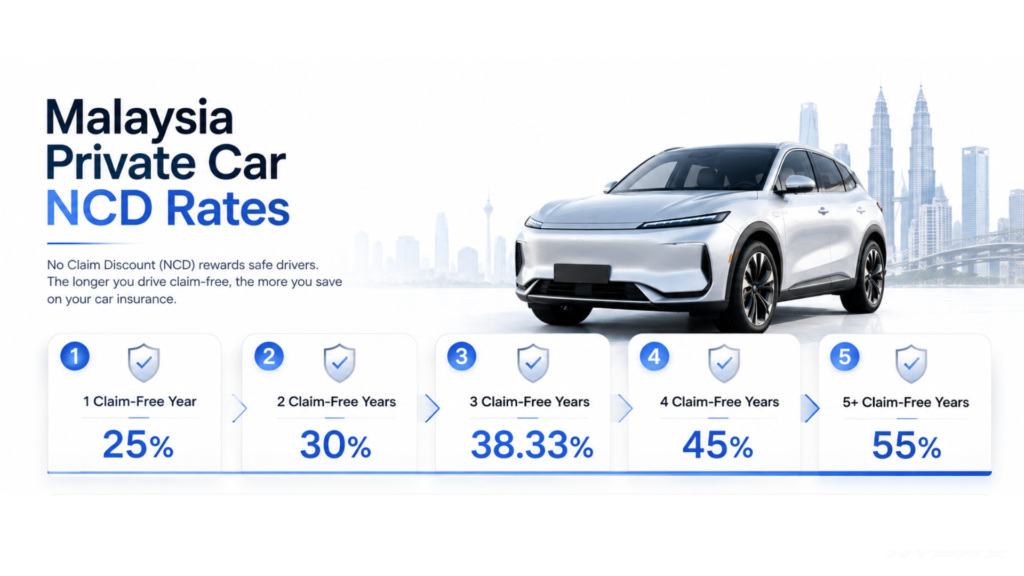
For Malaysian private cars, the progression begins at 25% after the first claim-free year and can eventually reach 55%.
NCD can therefore become financially valuable, especially when insuring a higher-value vehicle.
How Does NCD Work in Malaysia?
The concept is relatively simple.
You purchase motor insurance for your vehicle.
If you complete the relevant insurance period without making a claim that affects your NCD, your NCD entitlement increases according to the applicable scale.
When you renew the policy, the NCD is applied to the relevant premium calculation.
As your claim-free record becomes longer, your NCD percentage increases.
For private cars, the maximum is reached after five or more claim-free years.
Malaysia Private Car NCD Rates
According to the Persatuan Insurans Am Malaysia (PIAM), the NCD rates for private cars are:
| Claim-Free Period | NCD |
|---|---|
| 1 year | 25% |
| 2 years | 30% |
| 3 years | 38.33% |
| 4 years | 45% |
| 5 years and above | 55% |
The maximum private-car NCD is therefore 55%.
Once you reach this level, remaining claim-free allows you to retain the maximum rate, subject to the applicable insurance terms.
How Long Does It Take to Reach 55% NCD?
For a Malaysian private car, it normally takes five consecutive claim-free years to reach the maximum 55% NCD.
The progression works like this:
Year 1:
25%
Year 2:
30%
Year 3:
38.33%
Year 4:
45%
Year 5 and above:
55%
This means NCD should be viewed as a long-term financial benefit.
Losing a high NCD can have a noticeable effect on the cost of your next insurance renewal.
How Much Money Can NCD Save You?
Consider a simplified example.
Assume the relevant basic premium before NCD is:
RM2,000
If you have no NCD:
RM2,000
With 25% NCD:
RM2,000 − RM500 = RM1,500
With 45% NCD:
RM2,000 − RM900 = RM1,100
With 55% NCD:
RM2,000 − RM1,100 = RM900
In this simplified example, the difference between 0% and 55% NCD is RM1,100.
This is only an illustration.
Actual insurance premiums depend on the vehicle, sum insured, insurer, coverage, underwriting factors, optional benefits and applicable charges.
Nevertheless, the example demonstrates why a high NCD can be financially valuable.
How Much Does Car Insurance Cost in Malaysia?
What Happens to Your NCD After an Accident?
An accident itself does not automatically tell you what will happen to your NCD.
The important question is what type of insurance claim is made.
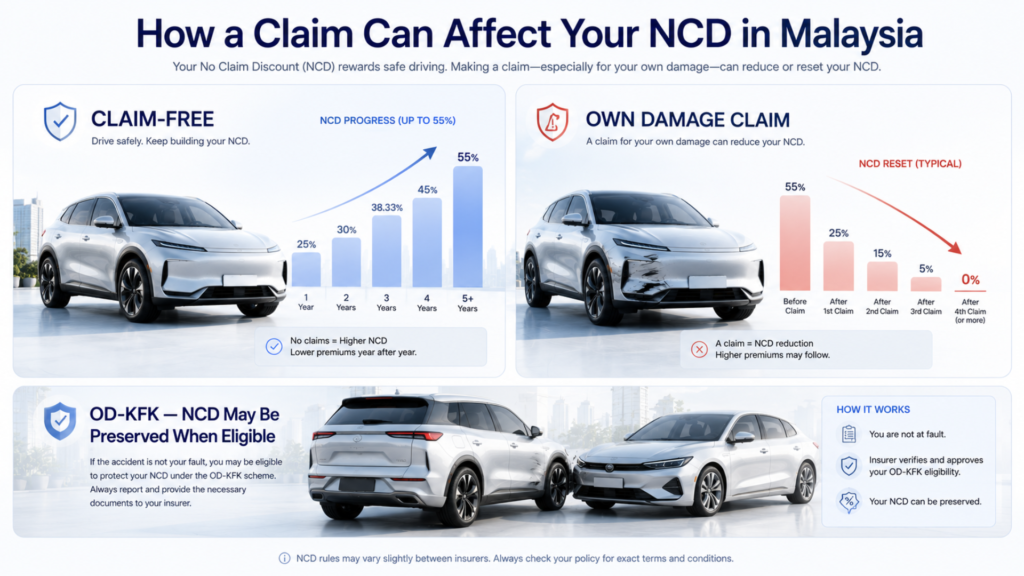
If you are at fault and make an Own Damage claim against your own comprehensive policy, PIAM’s Motor Insurance Consumer Guide states that you will lose your NCD entitlement.
PIAM also explains that when a claim is filed because of your fault, accumulated NCD generally resets to 0% at the next renewal.
This can make your following year’s insurance substantially more expensive.
For example, imagine you previously had a 55% NCD.
After an NCD-affecting claim, you may no longer receive that 55% discount at the next renewal.
This is why drivers should understand the type of claim being submitted.
PIAM – Motor Insurance Consumer Guide
Does Every Insurance Claim Affect NCD?
No.
Not every claim automatically results in the loss of NCD.
The effect depends on the type of claim and circumstances.
Some important examples include:
- Own Damage claim
- Own Damage Knock-for-Knock claim
- Third-party claim
- Windscreen claim under separate coverage
Understanding the difference is extremely important.
What Is an OD-KFK Claim?
OD-KFK stands for Own Damage Knock-for-Knock.
This mechanism can allow an eligible comprehensive private-car policyholder who was not responsible for the accident to claim through their own insurer without losing NCD.
According to PIAM’s Motor Insurance Consumer Guide, OD-KFK can preserve NCD when the applicable conditions are satisfied.
These include situations where:
- You have comprehensive private-car insurance.
- There is no bodily injury.
- The third-party vehicle meets the applicable eligibility conditions.
- The third-party vehicle can be identified.
- The third-party vehicle is insured by a Malaysian insurer.
PIAM also notes that OD-KFK can be more convenient because you deal with your own insurer rather than pursuing the third party’s insurer directly.
The exact eligibility of a claim should always be confirmed with the insurer.
Does a Windscreen Claim Affect NCD?
This depends on how the windscreen claim is made.
If you purchased dedicated windscreen coverage and make the claim under that specific coverage, PIAM states that your NCD will not be affected.
However, if you do not have dedicated windscreen coverage and claim the windscreen damage under the main comprehensive policy, your NCD can be reset to zero at renewal.
This is one reason windscreen coverage can be valuable, especially for vehicles with expensive windscreens.
Modern vehicles may have windscreens incorporating:
- Cameras
- Sensors
- Driver-assistance technology
- Rain sensors
- Heating elements
- Head-up display technology
Replacement can therefore be expensive.
Can You Transfer NCD to a New Car?
Yes.
One useful feature of NCD in Malaysia is that it can generally be transferred when you purchase a new vehicle.
For example:
You own Car A.
You have accumulated a 55% NCD.
You purchase Car B.
You may transfer the NCD from Car A to Car B, subject to the applicable insurer procedure.
This can be financially attractive if the new car has a higher insured value and therefore a higher insurance premium.
According to PIAM, the transfer does not happen automatically.
You need to inform the insurer that you want to withdraw the NCD from the old vehicle and apply it to the new vehicle.
Can You Transfer NCD to Another Person?
No.
PIAM states that NCD belongs to the named policyholder.
It can generally be transferred to another vehicle registered under the same owner’s name, but it cannot simply be given to someone else.
For example:
Father’s NCD → Father’s new car:
Potentially transferable.
Father’s NCD → Child’s car registered under the child’s name:
Not transferable as a normal NCD transfer.
The ownership details matter.
What Happens to the Old Car After NCD Transfer?
This is an important point that many car owners overlook.
Suppose you have:
Car A with 55% NCD.
You purchase Car B and transfer the 55% NCD to Car B.
The NCD does not remain simultaneously attached to both cars.
According to PIAM, when the NCD is withdrawn from the old vehicle, additional premium may need to be paid for the remaining insurance period of the old car if you continue to own and insure it.
The insurer updates the NCD status in the central database before the discount can be applied to the new policy.
This is why you should speak with the insurer before arranging the transfer.
How to Check Your NCD in Malaysia
Before renewing your insurance, it is useful to confirm your current NCD percentage.
You can usually check your NCD through:
- Your insurer
- Insurance agent
- Previous policy documents
- Online NCD checking services
MyCarInfo provides an online NCD checking facility for Malaysian motorists.
You should confirm that the NCD information is correct before completing your insurance renewal.
This is particularly useful when:
- Changing insurer
- Buying a new vehicle
- Transferring NCD
- Selling an old vehicle
- Checking your renewal quotation
What Is NCD Relief?
NCD Relief is an optional insurance add-on designed to reduce the financial impact of losing your NCD after an eligible claim.
It is important to understand that NCD Relief does not necessarily mean your NCD remains unchanged in the central NCD system.
Instead, depending on the insurer and policy terms, the add-on may compensate you for the financial value of the NCD that was lost.
PIAM has explained that NCD Relief can help cushion the financial impact when renewing insurance after a claim.
Coverage and pricing can differ between insurers.
Therefore, check the exact product wording before purchasing NCD Relief.
How to Protect Your NCD
A high NCD can represent significant long-term savings.
There are several ways to reduce the risk of losing it unnecessarily.
Drive Safely
Avoiding at-fault accidents is the most obvious way to preserve your NCD.
Understand Your Claim Type
Before submitting a claim, ask the insurer whether it will affect your NCD.
Understand OD-KFK
If another driver caused the accident, determine whether you qualify for an OD-KFK claim.
Consider Windscreen Coverage
Dedicated windscreen coverage can allow an eligible windscreen claim without sacrificing your NCD.
Consider NCD Relief
Drivers with a high NCD may want to compare the cost of NCD Relief with the potential financial impact of losing their discount.
Review Your Policy
Do not assume every insurer or policy has identical terms.
Read the Product Disclosure Sheet and policy wording.
Is 55% NCD Worth Protecting?
For many drivers, yes.
Consider a driver with a relatively high insurance premium.
If the relevant premium before NCD is RM3,000:
55% of RM3,000 = RM1,650.
That represents a substantial potential discount.
If the NCD is lost, the next renewal could be significantly more expensive.
The higher the relevant premium, the greater the monetary value of the percentage discount.
This is why drivers with expensive vehicles or high insurance premiums should understand how different types of claims affect NCD.
However, protecting NCD should never mean avoiding a necessary insurance claim after a serious loss simply to preserve a discount.
The financial value of the claim should also be considered.
Common NCD Mistakes
Malaysian drivers sometimes misunderstand how NCD works.
Common mistakes include:
- Thinking NCD belongs permanently to the vehicle.
- Assuming NCD can be transferred to another person.
- Assuming every claim destroys NCD.
- Assuming no claim can ever affect NCD.
- Claiming windscreen damage under the main policy without checking the NCD effect.
- Forgetting to transfer NCD when buying a new car.
- Assuming two cars can simultaneously use the same NCD.
- Not checking the NCD percentage before renewal.
Understanding these points can prevent unnecessary insurance costs.
PIAM – Motor Insurance Consumer Guide
NCD vs Cheap Car Insurance
A high NCD can make your insurance significantly cheaper, but NCD should not be the only factor you consider when choosing insurance.
Compare:
- Premium
- Sum insured
- Agreed value vs market value
- Special perils
- Windscreen coverage
- Excess
- Betterment
- Towing
- Claims support
- Panel workshop network
A cheap policy with insufficient protection may cost more when you actually need to make a claim.
NCD is one component of the overall insurance decision.
Final Verdict
What is NCD in car insurance?
NCD, or No Claim Discount, is a system that rewards eligible Malaysian motorists for maintaining a claim-free insurance record.
For private cars, the NCD progression is:
- 1 year: 25%
- 2 years: 30%
- 3 years: 38.33%
- 4 years: 45%
- 5 years and above: 55%
The maximum NCD of 55% can provide substantial savings on car insurance.
However, drivers should also understand what happens when they make a claim.
An at-fault Own Damage claim can result in the loss of accumulated NCD, while certain eligible OD-KFK claims can preserve it.
Dedicated windscreen coverage can also protect your NCD when making an eligible windscreen claim.
NCD can generally be transferred to a new vehicle registered under the same owner, but it cannot simply be transferred to another person.
For Malaysian drivers, understanding NCD is one of the easiest ways to make smarter decisions about car insurance and long-term vehicle ownership costs.
Frequently Asked Questions
What does NCD mean in car insurance?
NCD means No Claim Discount. It rewards eligible policyholders with a premium discount for maintaining a claim-free record.
What is the maximum NCD in Malaysia?
For private cars, the maximum NCD is 55%.
How long does it take to get 55% NCD?
A private-car owner normally reaches 55% after five consecutive claim-free years.
What is the NCD after one year?
The private-car NCD after one claim-free year is 25%.
Does an accident automatically cancel my NCD?
Not necessarily. The effect depends on the type of claim and circumstances.
Does an Own Damage claim affect NCD?
If you are at fault and make an Own Damage claim against your comprehensive policy, your NCD entitlement will generally be lost at the next renewal.
Does OD-KFK affect NCD?
An eligible OD-KFK claim can allow a non-fault comprehensive policyholder to claim through their own insurer without losing NCD, subject to the applicable conditions.
Does a windscreen claim affect NCD?
A claim under dedicated windscreen coverage does not affect NCD. A claim under the main comprehensive policy without dedicated windscreen coverage can affect it.
Can I transfer my NCD to my new car?
Yes, provided the applicable ownership and insurer requirements are satisfied.
Can I give my NCD to someone else?
No. PIAM states that NCD belongs to the named policyholder and cannot be transferred to another person’s vehicle.
Can two cars use the same NCD?
No. Transferring the NCD from the old vehicle means it cannot simultaneously remain applied to both policies.
Is NCD Relief worth buying?
It may be worth considering for drivers with a high NCD because losing a 45% or 55% discount can have a substantial financial impact. Compare the add-on cost and terms before purchasing.