
Legal Liability to Passengers is easily one of the most misunderstood add-ons in Malaysian motor insurance, and the confusion starts with the name itself — many drivers assume their passengers are automatically covered under a standard comprehensive policy, when in reality this protection only exists if it’s specifically added. Given that this add-on typically costs just a few ringgit a year, the gap between how cheap it is and how many drivers skip it entirely is genuinely surprising.
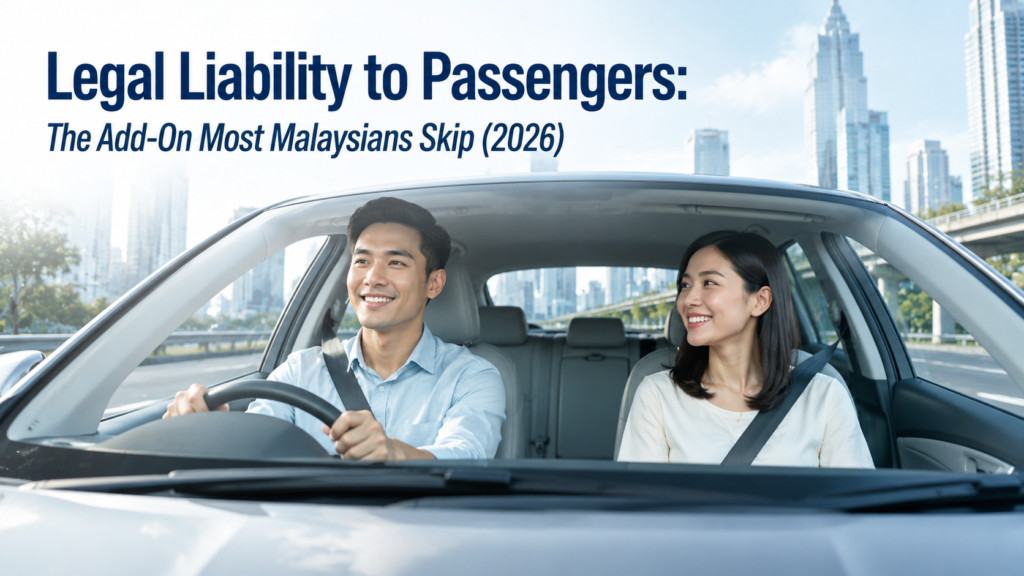
This guide explains exactly what Legal Liability to Passengers covers, how it differs from the similarly-named LLOP, what it costs, and a significant 2024 court ruling that expanded when passengers can actually claim.
LLP vs LLOP: Two Different Things With Confusingly Similar Names
Before going further, it’s worth clearing up the single biggest source of confusion around this topic — LLP and LLOP sound almost identical but protect against completely different risks.
Legal Liability to Passengers (LLP), sometimes called LLTP, protects you as the driver if your own passenger is injured or killed because of your driving — for example, if you lose control and crash, and your passenger sues you for medical expenses, lost income, or other damages. LLP pays for their claim against you, protecting your own finances.
Legal Liability of Passengers (LLOP), sometimes phrased as “Legal Liability of the Owner and/or Driver to Third Parties,” protects you if your passenger’s own actions injure someone else or damage their property — for example, if a passenger carelessly opens a car door into a passing cyclist. LLOP covers your legal and compensation costs to that third party, not to the passenger who caused the incident.
In short: LLP protects your passenger’s claim against you; LLOP protects a third party’s claim against you because of your passenger. Both are commonly bundled together at renewal, but they address genuinely different scenarios.
Why Standard Comprehensive Insurance Doesn’t Cover This
A standard comprehensive policy covers your liability to third parties outside your vehicle — other drivers, pedestrians, and property owners. Passengers riding inside your own car are typically treated as an exception by insurers rather than automatically falling under that third-party protection. This means if a passenger is injured in a crash you caused and decides to sue you personally for damages, your basic comprehensive policy may not respond at all, leaving you to cover legal costs and any court-awarded compensation entirely out of pocket unless LLP is specifically added.
How Much Does This Coverage Cost?
Both LLP and LLOP are priced differently, and both are strikingly affordable relative to the risk they cover:
| Add-On | Typical Pricing |
|---|---|
| LLOP | Flat rate, approximately RM7.50 per year for most vehicles |
| LLP | Roughly 25% of your basic third-party insurance premium |
For LLOP specifically, several sources place the typical range between RM7 and RM15 per year — a genuinely negligible cost relative to the potential lawsuit exposure it protects against. LLP pricing scales with your third-party premium rather than being a flat fee, but even so, it remains one of the more affordable add-ons available at renewal.
A Real-World Scenario
Consider a common situation: you’re giving a colleague a ride home from work, and on the way, you’re involved in a collision that results in your colleague sustaining a head injury. Even if the accident was entirely unintentional, your colleague could still take legal action against you for driving negligence — a lawsuit that, without LLP coverage, would leave you personally responsible for medical costs, lost income claims, and any court-awarded damages. With LLP in place, your insurer steps in to handle the claim on your behalf, protecting both your finances and, often, the relationship with the person you were driving.
Important 2026 Update: Federal Court Ruling Expands LLP Coverage
A significant Federal Court ruling in November 2024 clarified an important point that continues to shape how LLP claims are handled through 2026: passengers can claim under LLP even if the trip was for work or business purposes, closing a previous area of ambiguity where insurers had sometimes disputed liability for work-related rides. This ruling matters particularly for anyone who regularly drives colleagues, clients, or business contacts, since it removes uncertainty about whether LLP protection applies to those specific trips. Additionally, current LLP coverage typically extends to accidents occurring during the process of getting in or out of the vehicle, not just incidents while the car is actually moving.
The Singapore Myth: Is This Only Needed for Cross-Border Driving?
A persistent misconception among Malaysian drivers is that LLP and LLOP are only relevant if you’re planning to drive into Singapore, since Singapore mandates both coverages for foreign vehicles entering the country. While it’s true that Singapore requires this coverage for entry, that requirement doesn’t mean the protection is irrelevant within Malaysia itself. The risk LLP and LLOP address — a passenger suing you, or being sued because of your passenger’s actions — applies just as much to a daily commute in Kuala Lumpur as it does to a cross-border trip, making this coverage worth having regardless of whether Singapore travel is ever on your itinerary.
Common Myths About Legal Liability to Passengers
“My comprehensive insurance already covers passenger injuries since it’s comprehensive.” This is the exact misconception that leaves many drivers exposed — comprehensive policies typically treat passengers inside your own vehicle as an exception to standard third-party protection, which is precisely why Legal Liability to Passengers exists as a separate add-on.
“LLP and LLOP are the same thing, just spelled differently.” They’re genuinely different protections despite the similar names — LLP covers your passenger suing you, while LLOP covers a third party suing you because of your passenger’s actions. Confusing the two can lead to a false sense of security if you only have one.
“This coverage is only relevant if I drive to Singapore.” While Singapore does require this coverage for foreign vehicles entering the country, the underlying risk — a passenger or third party taking legal action after an accident — applies just as much to everyday driving within Malaysia.
“Work trips aren’t covered under LLP.” This was a genuine area of ambiguity until the November 2024 Federal Court ruling specifically confirmed that LLP claims apply even when the trip was for work or business purposes, removing this previous uncertainty.
What Happens If You’re Sued Without This Coverage?
Without LLP or LLOP in place, a successful lawsuit from a passenger or third party becomes a personal financial matter rather than something your insurer handles. This can mean covering medical expenses, lost income claims, legal defense costs, and any court-awarded damages entirely out of pocket — costs that can run into the tens of thousands of ringgit depending on the severity of the injury and the court’s assessment. Given that both add-ons typically cost less than RM20 combined per year, the financial gap between having and not having this coverage is stark, which is a large part of why insurance advisors consistently recommend adding both regardless of how frequently you actually carry passengers.
Is This Coverage Mandatory in Malaysia?
No — by law, neither LLP nor LLOP is compulsory for driving within Malaysia (unlike in Singapore, where it is required). However, given how inexpensive both add-ons are relative to the potential lawsuit exposure they cover, most insurance advisors recommend adding them regardless of legal requirement, purely on a cost-benefit basis.
Who Should Prioritize This Coverage?
While the low cost makes this add-on reasonable for nearly every driver, a few groups see particularly clear value:
- Anyone who regularly carries passengers — family members, colleagues, or friends — since more time spent with others in the car increases statistical exposure to this specific risk
- Drivers who occasionally use their car for work-related trips, especially given the 2024 Federal Court ruling confirming LLP applies to business travel
- Those planning cross-border trips to Singapore, where this coverage is a legal entry requirement rather than optional
- Drivers without other reliable ways to cover a lawsuit from a passenger, since without LLP, a successful claim against you would need to be paid entirely from personal funds
Adding LLP and LLOP to Your Policy
Both LLP and LLOP typically appear as selectable add-ons during renewal, listed alongside other riders like windscreen coverage and Special Perils. If you didn’t include them initially, most insurers allow you to contact your agent and add the coverage mid-way through your policy term via an endorsement, rather than requiring you to wait until your next full renewal. When comparing quotes through platforms like BJAK, PolicyStreet, or RinggitPlus, or directly with insurers such as Tokio Marine, Takaful Malaysia, or Zurich, look for LLP or LLOP explicitly listed under the add-ons or optional riders section.
This Add-On Alongside Your Other Coverage
LLP and LLOP fit naturally alongside the other low-cost add-ons covered elsewhere in this series. Combined with windscreen coverage, Special Perils flood protection, and Personal Accident coverage, a well-rounded add-on package addressing the most common gaps in standard Malaysian motor insurance typically adds up to a modest annual cost relative to the total protection it provides.
How This Fits Into Malaysia’s Broader Motor Insurance Landscape
By the end of 2022, Malaysia had recorded more than 16 million privately owned vehicles on the road — a scale that puts the everyday relevance of Legal Liability to Passengers into perspective. With that many vehicles carrying passengers daily for commutes, family trips, and social outings, the statistical likelihood of a passenger-related incident occurring somewhere on Malaysian roads on any given day is genuinely non-trivial, even though any individual driver’s personal risk in a given year remains low. This context helps explain why insurers continue to offer this coverage at such a low price point — it’s a low-probability, low-cost-to-insure risk for the insurer, but one with potentially significant financial consequences for an uncovered driver if it does occur.
Final Thoughts
Legal Liability to Passengers, along with its similarly-named counterpart LLOP, closes a specific and often-overlooked gap in standard Malaysian car insurance: the assumption that everyone inside your vehicle is automatically protected the same way third parties outside it are. At roughly RM7 to RM15 per year for LLOP, and a modest percentage-based premium for LLP, both add-ons offer meaningful protection against a genuinely realistic scenario — a passenger, whether family, friend, or colleague, taking legal action after an accident. With the November 2024 Federal Court ruling confirming coverage extends to work-related trips, and given how little these add-ons cost relative to potential legal exposure, this is one of the more straightforward additions worth making at your next renewal.
Frequently Asked Questions
What’s the difference between LLP and LLOP?
LLP protects you if your own passenger sues you after being injured in an accident you caused. LLOP protects you if your passenger’s actions injure or damage a third party outside your vehicle.
How much does LLP or LLOP cost in Malaysia?
LLOP is typically a flat rate around RM7 to RM15 per year, while LLP is usually calculated as roughly 25% of your basic third-party insurance premium.
Is this coverage mandatory in Malaysia?
No, neither LLP nor LLOP is legally required for driving within Malaysia, though both are mandatory if you’re driving into Singapore.
Does LLP cover work-related trips?
Yes. A November 2024 Federal Court ruling confirmed that passengers can claim under LLP even if the trip was for work or business purposes
Can I add LLP or LLOP mid-term if I didn’t include it at renewal?
Yes, most insurers allow you to add this coverage mid-policy through an endorsement — contact your agent or insurer directly rather than waiting for your next renewal.
Pingback: Roadside Assistance Add-Ons: Are They Worth It in Malaysia?