
ADAS camera recalibration after windscreen replacement is a step many drivers don’t realize is necessary until a technician mentions it — often as an unexpected line item added to a bill they assumed would just cover the glass. Yet skipping this step isn’t a minor oversight: it can leave your car’s safety systems misaligned, silently reading the road incorrectly even though everything looks fine from the driver’s seat.
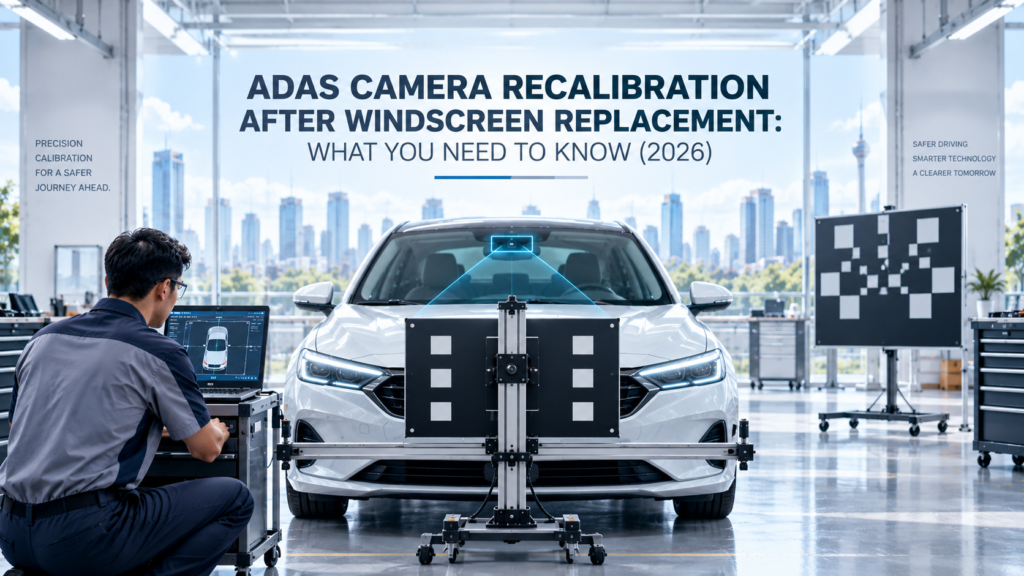
This guide explains exactly why ADAS camera recalibration matters after a windscreen replacement, what the process actually involves, how much it costs, and why this has become a near-universal requirement on modern vehicles.
What Is ADAS Camera Recalibration?
Most vehicles with Advanced Driver Assistance Systems (ADAS) — lane departure warning, automatic emergency braking, adaptive cruise control, and traffic sign recognition — rely on a forward-facing camera mounted directly behind the windscreen to “see” the road ahead. During a windscreen replacement, even with a perfect new piece of glass, the mounting position of that camera can shift slightly from where it was originally calibrated. ADAS camera recalibration is the precise process of fine-tuning the camera’s angle and reference points back to the exact specifications your vehicle’s systems depend on to function accurately.
Why This Step Is Non-Negotiable, Not Optional
Automakers and safety authorities are unambiguous on this point: recalibration after windscreen replacement isn’t a suggestion, it’s treated as a requirement for maintaining the vehicle’s safety integrity. The US National Highway Traffic Safety Administration has emphasized that ADAS cameras must be properly recalibrated after windscreen work, and nearly every major manufacturer requires forward-facing camera recalibration whenever the windscreen is replaced. Skipping this step means your car’s computer may continue “seeing” the road incorrectly — lane keeping assist might nudge the wheel at the wrong moment, automatic emergency braking might trigger too late or not at all, and traffic sign recognition might misread speed limits. None of these failures are visible to the driver until the exact moment the system is actually needed.
How Common Is This Requirement Now?
The scale of this shift has been dramatic. In 2016, only around 1 in 4 vehicles needed calibration after a new windscreen. By the 2023 model year, that figure had climbed to nearly 9 out of 10 vehicles requiring ADAS recalibration after windscreen replacement — a jump driven entirely by how quickly driver assistance technology has become standard equipment rather than a premium option. Given how fast this adoption curve has moved, it’s reasonable to assume that most vehicles sold in Malaysia from roughly 2019-2020 onward will need this step after any windscreen replacement, not just luxury or flagship models.
Static vs Dynamic Calibration: What’s the Difference?
Recalibration generally happens through one of two methods, and some vehicles require both:
- Static calibration — performed in a controlled environment using precisely positioned calibration targets, typically inside a workshop bay with specific lighting and floor-marking requirements. This method doesn’t require driving the vehicle.
- Dynamic calibration — performed by driving the vehicle under specific conditions (often on a road with clear lane markings, at a defined speed range) while the system recalibrates itself in real time using live road data.
- Dual calibration — some vehicles require both static and dynamic calibration performed in sequence to fully restore accuracy across all ADAS functions.
Which method (or combination) your vehicle needs depends entirely on the manufacturer’s specific requirements, which is why a certified technician with access to manufacturer-specific or multi-brand calibration equipment matters more than a generalist workshop without this specialized setup.
How Much Does ADAS Recalibration Cost?
Pricing varies based on your vehicle’s make, model, and how many systems require recalibration, but general market estimates place the cost in a fairly consistent range internationally:
| Calibration Type | Typical Cost Range |
|---|---|
| Single system (e.g., forward camera only) | Lower end of the range |
| Multiple systems requiring dual calibration | Mid-to-higher end of the range |
| Average across most passenger vehicles | Broadly comparable to a meaningful fraction of the windscreen replacement cost itself |
Internationally, published estimates commonly cite figures in the range of roughly $150 to $700 USD equivalent depending on the vehicle and calibration complexity — a cost that can add meaningfully to a windscreen replacement bill, which is exactly why it’s worth confirming upfront with your installer whether recalibration is included in their quote or billed as a separate line item.
Common Myths About ADAS Camera Recalibration
“If my dashboard doesn’t show a warning light, calibration must have been done correctly.” Not necessarily. A misaligned camera doesn’t always trigger an immediate warning light — the systems can appear to function normally on the surface while still reading the road inaccurately, which is exactly why confirming calibration was performed and verified matters more than relying on the absence of a warning.
“Only luxury or high-end cars need ADAS recalibration.” This hasn’t been true for years. With nearly 9 out of 10 recent model-year vehicles requiring recalibration after windscreen replacement, this is now a mainstream requirement across most price segments, not a luxury-vehicle-only concern.
“Any windscreen installer can handle recalibration.” Not accurately. Recalibration requires specific professional-grade equipment and calibration targets that not every glass installer has invested in, which is why confirming a workshop’s specific recalibration capability matters as much as their glass replacement service.
“Recalibration is a one-time optional upgrade, not a required step.” For any ADAS-equipped vehicle, this is treated as a required part of the windscreen replacement process by manufacturers and safety authorities, not an optional add-on you can reasonably skip to save money.
Does Insurance Cover Recalibration Costs?
If your policy includes windscreen coverage, recalibration costs are often covered as part of a comprehensive claim, though this varies by insurer and specific policy terms. It’s genuinely worth confirming this detail directly with your insurer before your appointment, since some policies cover the glass replacement itself but treat recalibration as a separate service requiring explicit inclusion or an additional premium. Given how routinely this step is now required, insurers are increasingly building recalibration into standard windscreen claim processing rather than treating it as an optional extra, but confirming this for your specific policy avoids an unwelcome surprise on the final bill.
How Long Does Recalibration Take?
The process typically takes 30 minutes to two hours, depending on your vehicle’s make and model and how many systems need recalibrating. Static calibration alone can sometimes be completed relatively quickly in a properly equipped bay, while dynamic calibration adds time since it requires actually driving the vehicle under the right conditions — and if road or traffic conditions aren’t cooperative, this step can take longer than expected. It’s worth budgeting extra time beyond the windscreen replacement itself when scheduling your appointment, rather than assuming the whole process wraps up the moment the glass is installed.
Why Not Every Workshop Can Do This
Unlike straightforward glass installation, ADAS recalibration requires professional-grade scan tools and precisely positioned calibration targets — specialized equipment that can represent a significant investment for a workshop to acquire and maintain, along with training to use correctly. There’s no consumer-grade or shortcut solution for camera or radar recalibration; attempting to skip this step or use inadequate equipment leaves safety systems non-functional or misaligned, regardless of how good the new windscreen glass itself might be. This is exactly why confirming a workshop’s specific recalibration capability — not just their glass replacement service — matters before booking, particularly for vehicles with multiple ADAS systems requiring dual calibration.
Warning Signs That Recalibration Was Skipped or Done Incorrectly
If you’ve had a windscreen replaced and notice any of the following afterward, it’s worth having the calibration checked promptly:
- Persistent dashboard warning lights related to lane departure, forward collision, or other driver assistance features
- Lane keeping assist behaving erratically — nudging at unexpected moments or failing to engage at all
- Adaptive cruise control reacting inconsistently to vehicles ahead, either braking too aggressively or too late
- Traffic sign recognition displaying incorrect speed limits or failing to update as you pass signage
Any of these symptoms after a windscreen replacement is a signal to return to your installer and confirm calibration was actually completed and verified, rather than assuming the systems will “settle in” on their own over time.
Does OEM vs Aftermarket Glass Affect Calibration?
Yes, meaningfully. As covered in our OEM vs Aftermarket Windscreen Glass guide, the precise optical clarity and curvature of the glass affects how smoothly the camera recalibrates afterward. OEM or high-quality OEE glass is generally recommended specifically for ADAS-equipped vehicles, since a precise match reduces the risk of calibration complications that lower-tier aftermarket glass can occasionally introduce.
A Brief History: How We Got Here
It’s worth understanding how quickly this requirement emerged, since it explains why awareness still lags behind actual necessity. Industry bodies like Thatcham Research introduced formal codes of practice for ADAS recalibration as early as the mid-2010s, when only a small fraction of vehicles on the road carried this technology. At the time, industry insiders specifically flagged a lack of awareness among aftermarket installers, fleet operators, and even insurers about the emerging calibration requirement. That gap has narrowed considerably as ADAS adoption has become near-universal on new vehicles, but pockets of outdated assumptions — including installers or drivers who still treat recalibration as optional — persist simply because the technology moved faster than general awareness could keep pace with.
Quick Checklist Before Your Windscreen Appointment
- Ask directly whether your specific vehicle requires ADAS recalibration after replacement
- Confirm whether recalibration is included in the quoted price or billed separately
- Check with your insurer whether recalibration costs are covered under your windscreen add-on
- Ask whether static, dynamic, or dual calibration applies to your vehicle, and how long to budget for it
- Request written confirmation that calibration was completed and verified before leaving the workshop
Final Thoughts
ADAS camera recalibration after windscreen replacement has shifted from a niche requirement affecting a small minority of vehicles to something close to standard procedure for most modern cars — nearly 9 out of 10 recent model-year vehicles now require it. Skipping this step doesn’t cause an obvious, immediate problem, which is exactly what makes it dangerous: your safety systems can remain silently misaligned until the precise moment you need them to work correctly. Before your next windscreen replacement, confirm with your installer whether your vehicle requires recalibration, which method it needs, whether it’s included in the quoted price, and whether your insurance covers the cost — treating this as a standard part of the replacement process rather than an optional add-on.
Frequently Asked Questions
Do all windscreen replacements require ADAS recalibration?
Not all, but the vast majority of vehicles built from roughly 2019-2020 onward do, since this is when driver assistance camera systems became standard equipment across most manufacturers.
How much does ADAS recalibration typically cost?
Estimates commonly range from roughly $150 to $700 USD equivalent depending on the vehicle and number of systems requiring calibration, though this is often bundled into a windscreen replacement quote.
How long does ADAS recalibration take?
Generally 30 minutes to two hours, depending on whether your vehicle needs static calibration, dynamic calibration (which requires driving), or both.
What happens if ADAS recalibration is skipped?
Your car’s safety systems may continue operating with a misaligned reference point, meaning features like automatic emergency braking or lane keeping assist could behave inaccurately without any obvious warning until the system is actually needed.
Does aftermarket windscreen glass affect calibration?
It can. Lower-quality aftermarket glass can introduce optical distortion that complicates calibration, which is why OEM or high-quality equivalent glass is often recommended for ADAS-equipped vehicles specifically.