
Over a 5-year ownership period with home charging, a mainstream EV in Malaysia typically saves RM8,000-18,000 in combined fuel, maintenance, and road tax costs compared to an equivalent petrol car — though EVs still carry a higher upfront price and depreciate faster, meaning total cost of ownership (TCO) rather than sticker price is what actually determines which option saves you money. The math has shifted meaningfully since Malaysia’s new kW-based EV road tax took effect on 1 January 2026, replacing the previous full exemption but still keeping EVs considerably cheaper to tax than equivalent petrol cars.
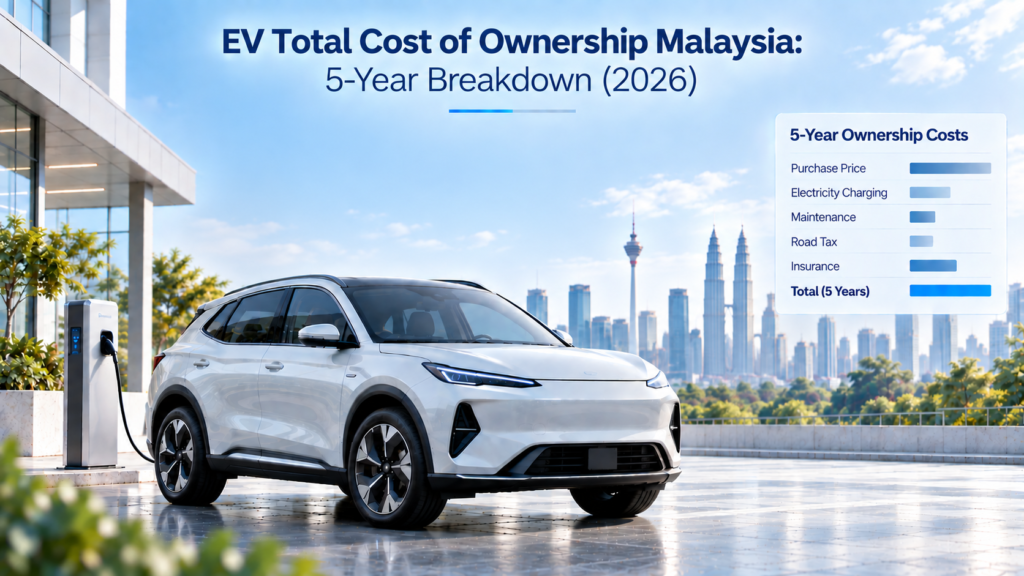
This guide breaks down every cost line — purchase price, road tax, fuel versus electricity, maintenance, insurance, and depreciation — over a 5-year ownership period, so you can build an accurate comparison for your own driving habits.
What Total Cost of Ownership Actually Includes
TCO combines six cost lines into one figure: (purchase price − expected resale value) + fuel or electricity + road tax + insurance + maintenance, measured over your actual driving distance rather than a generic estimate. Most buyers focus only on the showroom price tag, but that number tells you almost nothing about what a car will actually cost you to own for five years.
Cost Line 1: Fuel vs Electricity
This is where EVs deliver their most consistent, predictable savings. Using real 2026 figures: a petrol car averaging 12 km per litre, driven 1,500 km per month, costs roughly RM250-380 per month in fuel depending on whether you’re on subsidized RON95 (RM1.99/L) or the floating market rate (RM3.72/L). An equivalent EV consuming around 15 kWh per 100 km, charged at home at typical domestic electricity rates (roughly RM0.50/kWh), costs approximately RM110-115 per month for the same distance — a saving of roughly RM1,700 to RM3,200 per year on fuel alone, depending on which petrol price tier you’re comparing against.
Over 5 years, this fuel/electricity gap alone typically totals RM8,500-16,000 in favor of the EV, assuming consistent home charging rather than reliance on public DC fast charging, which costs meaningfully more per kWh.
Cost Line 2: Road Tax — The 2026 Policy Change
Malaysia’s EV road tax structure changed fundamentally on 1 January 2026 — the previous full exemption ended, replaced by a kW-based fee schedule, though EVs still pay dramatically less than equivalent petrol cars. Under the new bands:
| Vehicle Type | Approximate Power | Annual Road Tax (2026) |
|---|---|---|
| Compact EV (e.g., Proton e.MAS 5) | ~80 kW | ~RM80 |
| Mid-size EV (e.g., BYD Atto 3) | ~150 kW | ~RM160 |
| Compact petrol (1.5L) | N/A | RM90 |
| Mid-size petrol (2.0L) | N/A | RM380 |
| Luxury petrol sedan (2.5L, e.g., Camry) | N/A | RM800+ |
For mainstream EVs, road tax now lands roughly comparable to a small petrol car, but the gap widens dramatically at the luxury end — an electric executive sedan like the BMW i5 eDrive40 pays RM395 annually versus RM800+ for an equivalent petrol luxury sedan, and the disparity becomes extreme at the very top: a Rolls-Royce Spectre pays RM1,240 versus RM19,005 for its petrol V12 counterpart. Over 5 years, road tax savings for a mainstream EV versus a mid-size petrol car typically add up to RM1,000-1,500.
Cost Line 3: Maintenance
EVs have structurally lower maintenance costs due to having far fewer moving parts — no engine oil changes, no spark plugs, and regenerative braking that significantly reduces brake wear. Real-world 5-year comparisons show EV owners spending roughly RM8,750 combined on electricity and maintenance, versus over RM25,000 for petrol car owners across fuel, maintenance, and road tax combined in similar comparisons — though these figures vary by specific model and driving pattern. Some brands sweeten this further with free maintenance packages for the first five years, removing this cost line from the comparison almost entirely during that period.
Cost Line 4: Insurance
EV insurance premiums in Malaysia typically run 10-30% higher than equivalent petrol cars, mainly reflecting higher vehicle values and expensive battery replacement risk that insurers price into premiums. This is a genuine cost disadvantage for EVs, but the fuel and maintenance savings covered above generally more than offset this premium gap over a full ownership period. For a deeper look at what drives this cost difference, our EV Insurance Malaysia guide covers pricing factors and how to manage this cost specifically.
Cost Line 5: Depreciation
This remains the biggest cost disadvantage for EVs in Malaysia’s current market. Chinese-brand EVs currently depreciate roughly 40-50% over 3 years, compared to 25-35% for hybrids over the same period, driven by rapid year-over-year technology turnover and battery health concerns among used-car buyers. This gap is significant enough that it can offset a meaningful portion of the running-cost savings covered above, depending on how long you keep the vehicle. Our EV Depreciation in Malaysia guide breaks down exactly which brands hold value best and why this gap exists.
Common Myths About EV Total Cost of Ownership in Malaysia
“EV road tax is now expensive since the exemption ended.” This is a common misreading of the 2026 changes. While the full exemption did end, mainstream EVs still pay roughly RM80-200 annually — comparable to or cheaper than most petrol cars, and dramatically cheaper at the luxury end where the tax structure heavily favors electric motors.
“Total cost of ownership is basically the same as purchase price plus fuel.” This misses insurance, maintenance, and depreciation — all of which can shift a comparison significantly. A car with a lower purchase price but poor resale value and high maintenance costs can easily cost more over 5 years than a pricier alternative with strong resale and low upkeep.
“EVs always save money regardless of how you charge or drive.” Not true. The savings depend heavily on home charging access and monthly mileage — a driver without home charging, relying on public fast charging, or covering very low monthly distances may find the EV cost advantage shrinks substantially or disappears.
“Higher EV insurance premiums cancel out all the running-cost savings.” Generally not the case for typical driving patterns — while insurance does run 10-30% higher, this gap is usually smaller in absolute ringgit terms than the combined fuel and maintenance savings over a full ownership period.
A Real 5-Year TCO Example
Using a documented comparison of similarly-sized, cross-shoppable vehicles driven 1,500 km/month with home charging, an EV like the Proton e.MAS 5 delivered the lowest 5-year total cost of ownership — saving roughly RM18,460 compared to an equivalent petrol Vios, and RM11,305 compared to a hybrid Vios. This outcome depended heavily on two specific factors: home charging access (rather than relying on public charging) and taking advantage of a free wallbox and free maintenance package included with purchase — both of which meaningfully shift the calculation in the EV’s favor.
When Does an EV NOT Win on Total Cost of Ownership?
The EV cost advantage shrinks or disappears entirely without home charging access, or with very low annual mileage. If you’re relying primarily on public DC fast charging rather than home AC charging, electricity costs rise substantially, eroding much of the fuel-cost advantage. Similarly, for drivers covering very low monthly mileage, the higher upfront EV price relative to a comparable petrol car may not be recouped through running-cost savings within a typical 5-year ownership window — the break-even point can stretch to well over a decade in genuinely low-mileage scenarios. The clearest financial case for an EV in Malaysia is a driver with reliable home charging access and moderate-to-high monthly mileage (1,000+ km).
Building Your Own 5-Year TCO Comparison
To build an accurate comparison for your specific situation, calculate: (purchase price − expected 5-year resale value) + (fuel or electricity cost × 60 months) + (annual road tax × 5) + (annual insurance × 5) + (5-year maintenance total), using your actual monthly kilometres rather than a generic average. Use your genuine petrol price reference (subsidized quota rate or floating market rate, whichever actually applies to you) and get real insurance quotes for both vehicle types rather than relying on rough percentage estimates, since actual quotes can vary meaningfully by model and insurer.
How Financing Affects Your Total Cost of Ownership
Loan structure is another factor worth factoring into any TCO comparison, since dealers often quote longer tenures specifically to make the monthly payment look smaller. Stretching a loan from 5 to 9 years on the same financed amount can add several thousand ringgit in total interest paid, while also keeping you upside-down on the vehicle’s value for longer given how EVs currently depreciate. When comparing total interest rather than just the monthly instalment figure, it’s worth running the numbers for both a shorter and longer tenure on any EV you’re considering, since the “cheaper-looking” monthly payment on a stretched loan doesn’t actually reduce your genuine 5-year total cost of ownership — it just spreads the same or higher total cost across more months.
Final Thoughts
Total cost of ownership, not purchase price, is what actually determines whether an EV saves you money in Malaysia over a 5-year period — and for drivers with home charging access and moderate-to-high mileage, the math increasingly favors electric even after accounting for the 2026 road tax changes and steeper depreciation. The clearest savings come from the fuel/electricity gap (RM8,500-16,000 over 5 years) and reduced maintenance, while the clearest cost disadvantages are higher upfront pricing, steeper early depreciation, and somewhat higher insurance premiums. Running your own numbers with your actual driving distance and charging access — rather than relying on generic percentage comparisons — is the only way to know which option genuinely wins for your specific situation.
Frequently Asked Questions
Does an EV actually save money over 5 years in Malaysia?
Generally yes, for drivers with home charging access and moderate-to-high mileage — typical combined savings on fuel, maintenance, and road tax range from RM8,000 to RM18,000 over 5 years compared to an equivalent petrol car.
How much did Malaysia’s 2026 EV road tax change actually cost EV owners?
Mainstream EVs now pay roughly RM80-200 annually under the new kW-based structure, up from the previous full exemption, but this remains considerably cheaper than equivalent petrol car road tax, especially at the higher power/luxury end.
Is EV insurance really more expensive in Malaysia?
Yes, typically 10-30% higher than equivalent petrol cars, mainly due to higher vehicle values and battery replacement risk, though this is generally offset by fuel and maintenance savings over a full ownership period.
Does an EV still make financial sense without home charging?
The cost advantage shrinks considerably without home charging access, since relying on public DC fast charging costs meaningfully more per kWh than home AC charging.
How much faster do EVs depreciate compared to petrol cars in Malaysia?
Chinese-brand EVs currently depreciate roughly 40-50% over 3 years compared to 25-35% for hybrids over the same period, though this gap is expected to narrow as EV brands build longer local track records.