
One-pedal driving in Malaysian traffic might be the single most useful EV feature nobody explains properly before handover. Malaysia’s driving conditions — dense stop-and-go congestion on the Federal Highway, steep inclines around Genting or the Titiwangsa range, and unpredictable monsoon downpours — happen to be almost exactly the scenario one-pedal driving was designed for, yet most new EV owners discover the feature by accident rather than through any real explanation at delivery.
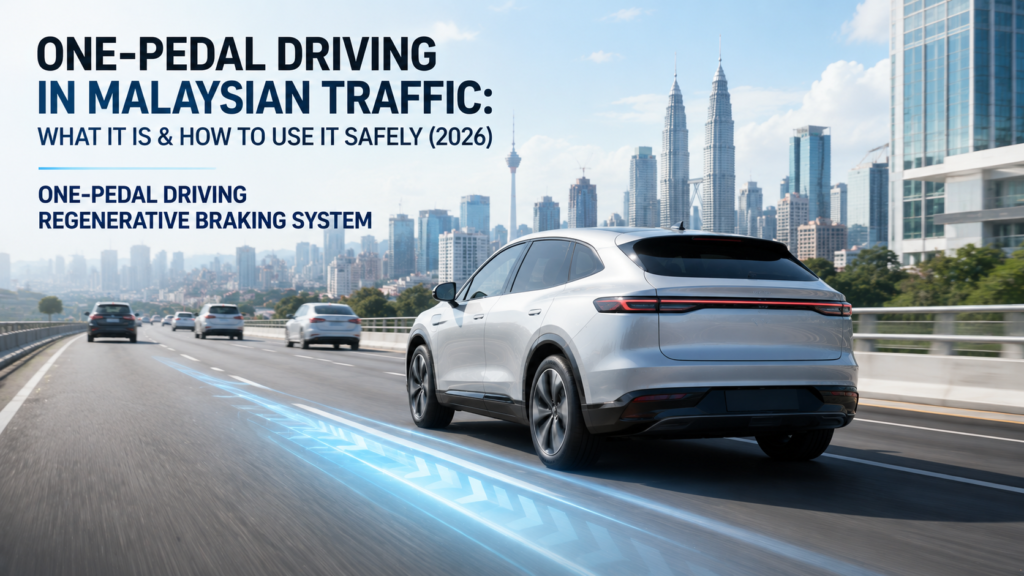
This guide covers what one-pedal driving actually is, why it suits Malaysian traffic conditions specifically, how to use it safely on local roads, and when to switch it off.
What Is One-Pedal Driving?
One-pedal driving is a mode that uses strong regenerative braking to let you control both acceleration and deceleration almost entirely through the accelerator pedal. Lift off gently and the car slows down gradually; lift off more completely and it can slow the vehicle all the way to a complete stop without ever touching the brake pedal. The electric motor, which normally draws power from the battery to move the car forward, reverses its role during deceleration — acting as a generator that both slows the vehicle and sends recovered energy back into the battery.
Not every EV implements this identically. Some brands make one-pedal driving the default, aggressive experience straight out of the factory, while others offer it as a selectable mode alongside gentler regen settings that feel closer to a conventional petrol car’s natural coasting.
Why One-Pedal Driving Suits Malaysian Traffic So Well
Stop-and-Go Congestion
Malaysia’s urban traffic — particularly around Kuala Lumpur, Penang, and Johor Bahru during peak hours — involves constant, low-speed starting and stopping. This is precisely the driving pattern where one-pedal driving delivers its clearest benefit: instead of repeatedly shuffling your foot between the accelerator and brake pedal, you modulate speed with a single continuous motion. Drivers who’ve adapted to it often describe stop-and-go traffic as noticeably less tiring, since the constant pedal-switching that makes congested driving fatiguing in a petrol car simply isn’t necessary anymore.
Hilly and Highland Routes
Malaysia’s terrain includes genuinely steep sustained inclines, particularly on routes toward Genting Highlands, Cameron Highlands, and other hill destinations. On long descents, one-pedal driving provides what’s sometimes called a “virtual engine brake” — quietly recovering energy while reducing strain on your conventional friction brakes, which is exactly the kind of driving where brake fade becomes a real concern in a traditional vehicle relying solely on friction braking down a long grade.
Real-World Validation on Malaysian Roads
This isn’t purely theoretical — a documented BMW iX road trip from Singapore to Kuala Lumpur specifically noted that as traffic built up approaching the city, the adaptive regeneration function proved particularly useful in start-stop conditions, with drivers engaging a stronger regen mode specifically to reduce brake pedal use and wear during the congested final stretch into KL. This kind of real-world account reflects exactly the pattern most Malaysian EV owners will experience on a regular commute, not just a special road trip scenario.
How Much Range Does One-Pedal Driving Actually Save?
The energy recovery numbers are meaningful without being dramatic. In real-world city driving, EVs typically reclaim roughly 10% to 25% of total driven energy through regenerative braking in stop-and-go conditions — meaning a commute that would use 12 kWh without regen might use closer to 9-10 kWh with consistent one-pedal driving. On long, steep descents specifically, the range recovery can be considerably more dramatic, with some drivers reporting 15 to 18 kilometers gained descending especially long, steep grades. In flatter, lower-speed city traffic, the gain per stop is smaller — closer to a couple of extra meters at a time — but Malaysia’s dense urban traffic means those small recoveries add up meaningfully across a full day of driving.
How to Use One-Pedal Driving Safely
- Practice in an empty parking lot first — before using it in live traffic, get comfortable with exactly how much pedal lift produces how much deceleration, since this varies by vehicle and takes a session or two to internalize
- Time your lift-off earlier than you would in a petrol car — since deceleration is gradual rather than instant, easing off the accelerator sooner lets you glide smoothly to a stop rather than needing a late correction
- Warn passengers during your adjustment period — new one-pedal drivers often lift off too abruptly at first, which can cause an uncomfortable jerking sensation for anyone riding along until smoothness becomes second nature
- Check whether your car’s brake lights activate during strong regen — most modern EVs automatically illuminate brake lights during aggressive regenerative deceleration to warn following traffic, but this isn’t universal across every model, so confirm your specific vehicle’s behavior
- Always be ready to use the actual brake pedal for emergencies — one-pedal driving is not a substitute for hard braking; if you need to stop immediately, go straight to the brake pedal rather than relying on regen alone
When to Turn Off One-Pedal Driving
Despite how well it suits Malaysian traffic generally, there are specific conditions where switching to a gentler regen setting — or turning one-pedal driving off entirely — is the safer choice:
- During heavy rain or on wet roads — several automakers specifically recommend disabling strong one-pedal modes on slippery surfaces, since aggressive regen braking on wet tarmac can behave less predictably than on dry roads, a genuinely relevant consideration during Malaysia’s frequent monsoon downpours
- On very steep descents — on the steepest grades, regenerative braking alone may not provide sufficient stopping force, meaning you’ll still need to use the conventional brake pedal even with one-pedal driving engaged
- When your battery is nearly fully charged — the battery management system automatically reduces regen strength when the battery is close to 100% state of charge, since it can’t safely accept much additional energy at that point, so don’t rely on full one-pedal stopping power immediately after a full charge
- In an automatic car wash or when being towed — several manufacturers specifically advise disabling one-pedal driving in these situations, since the system can misinterpret external movement of the vehicle
Common Myths About One-Pedal Driving in Malaysia
“One-pedal driving means I’ll never need my brakes again.” Not true. Even with one-pedal driving fully engaged, you still need the conventional brake pedal for emergency stops, very steep descents, and situations where regenerative braking alone can’t provide enough stopping force quickly.
“It’s only useful on long road trips, not daily KL traffic.” Actually the opposite tends to be true for range benefits — while descents on highland routes can recover more dramatic amounts of energy at once, the cumulative effect of one-pedal driving in daily stop-and-go city traffic adds up meaningfully over a full week of commuting.
“All EVs handle one-pedal driving the same way.” Implementation varies significantly between manufacturers. Some default to aggressive regen as the standard driving feel, while others require manually selecting a specific mode, and the strength of deceleration at each setting differs from model to model.
“One-pedal driving will damage my car’s motor over time.” There’s no basis for this concern — using the motor as a generator during braking is exactly what it’s designed to do, and if anything, relying on regen more reduces wear on your conventional brake components rather than causing extra strain elsewhere.
Adjusting to One-Pedal Driving: What to Expect in the First Week
Most drivers describe a genuine adjustment period lasting anywhere from a few days to about two weeks before one-pedal driving starts to feel natural rather than deliberate. Early on, it’s common to lift off the accelerator too abruptly, resulting in a jerkier stop than intended — something passengers notice more than the driver often does at first. By the end of the first week or two, most drivers report that timing their lift-off to glide smoothly into a stop at a red light becomes almost second nature, and many describe genuinely missing the feature when driving a petrol car afterward. If you’re new to an EV, it’s worth giving the adjustment period a fair chance before deciding one-pedal driving isn’t for you — the learning curve is real, but relatively short.
Does One-Pedal Driving Work the Same on Every EV in Malaysia?
Implementation varies meaningfully across the models available locally. Some EVs sold in Malaysia offer one-pedal driving as an adjustable “B mode” or similarly labeled setting, while others build it in as the default regenerative braking behavior without requiring the driver to select anything. If you’re comparing specific EV models available in the Malaysian market and want to understand how their regenerative braking systems differ, our Regenerative Braking Explained guide covers the underlying technology in more technical depth, and our Best EV Cars in Malaysia guide covers what’s currently available locally.
A Hidden Benefit for Used EV Buyers
If you’re shopping for a used EV in Malaysia, one-pedal driving habits from a previous owner can work in your favor. A vehicle that spent most of its life in strong regen or one-pedal mode typically has friction brake pads and rotors in noticeably better condition than a similar-mileage vehicle driven with traditional braking habits, since regen handles the bulk of routine deceleration. A proper inspection still matters, but it’s a genuinely underappreciated upside worth asking about when evaluating a used EV’s condition relative to its mileage.
Quick Reference: One-Pedal Driving Do’s and Don’ts
- Do practice in an empty area before using it in live KL or Penang traffic
- Do keep your foot ready near the brake pedal during your first few weeks
- Don’t rely on it alone during heavy monsoon rain — switch to a gentler setting
- Don’t assume it will fully stop the car on the steepest highland descents
- Do check your specific EV’s brake light behavior during regen braking
Final Thoughts
One-pedal driving in Malaysian traffic isn’t just a novelty feature to experiment with occasionally — given the country’s combination of dense stop-and-go congestion, genuinely steep highland routes, and frequent heavy rain, it’s a feature that aligns unusually well with how Malaysians actually drive day to day. The adjustment period is real, and it’s worth practicing in a low-stakes setting before relying on it in traffic, but most drivers who stick with it find that after a week or two, modulating speed with a single pedal stops feeling like a gimmick and starts feeling like the more natural way to drive. Just remember its limits: switch to a gentler setting in heavy rain, keep the brake pedal ready for emergencies, and don’t expect full stopping power immediately after a full charge.
Frequently Asked Questions
Is one-pedal driving safe to use in Malaysia’s heavy rain?
It’s generally recommended to switch to a gentler regen setting or turn off aggressive one-pedal driving during heavy rain, since strong regenerative braking can behave less predictably on wet roads than on dry surfaces
Does one-pedal driving work on steep hills like the route to Genting Highlands?
On long, steady descents, one-pedal driving works well and reduces strain on conventional brakes, but on very steep grades, regen alone may not provide enough stopping force, so you may still need to use the brake pedal.
How much range can I actually save using one-pedal driving in KL traffic?
Real-world estimates suggest 10% to 25% of driven energy can be recovered in stop-and-go city conditions, meaning a noticeable but not dramatic improvement in daily driving efficiency.
Can I turn off one-pedal driving if I don’t like it?
Yes, virtually every EV that offers one-pedal driving allows you to select a gentler regen setting or disable it entirely for a coasting feel closer to a conventional petrol car.
Will one-pedal driving wear down my tires faster?
Not meaningfully — one-pedal driving primarily reduces wear on conventional friction brakes rather than tires, since the deceleration force is distributed differently than hard braking.
Pingback: EV Battery Preconditioning: Does It Matter in Malaysia's Climate?