
Regenerative braking is one of those EV features that sounds technical but, once explained, turns out to be one of the more intuitive pieces of engineering in the entire vehicle. It’s the reason EVs recover range while slowing down, why their brake pads last so much longer than a gas car’s, and why one-pedal driving feels genuinely different from anything a combustion vehicle can offer.
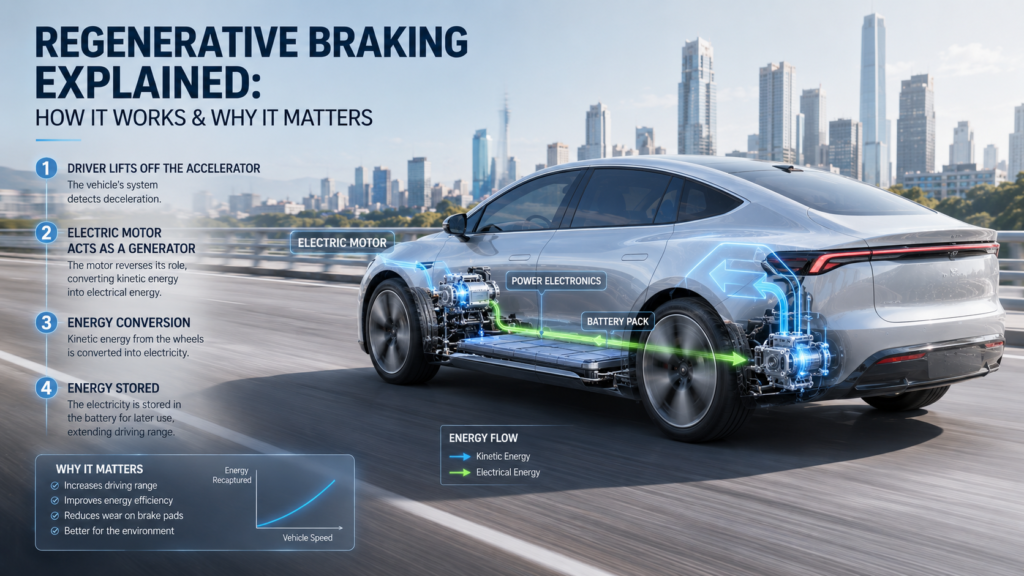
This guide breaks down exactly how regenerative braking works, how much energy it actually recovers, its real limitations, and how to use it to get the most out of your EV.
What Is Regenerative Braking?
In a conventional gas car, hitting the brakes means metal pads clamp down on a rotor, converting your car’s kinetic energy (motion) into heat through friction. Once that heat dissipates into the air, the energy is simply gone — wasted every single time you slow down. Regenerative braking flips this equation. Instead of drawing power from the battery to spin the wheels, the wheels spin the electric motor, which now behaves like a generator. That generator produces electricity, which flows back into the battery, while the resistance created inside the motor simultaneously provides the braking force that slows the car down.
Think of it like a bicycle dynamo: when you pedal, the motion generates electricity to power a headlight. Regenerative braking works on a similar principle, just running in reverse and at a much larger scale — every time you slow down, your EV recovers a portion of the energy it spent accelerating in the first place.
How Regenerative Braking Actually Recovers Energy
The process happens in a specific sequence: the driver lifts off the accelerator or presses the brake pedal, the electric motor reverses its normal function, the wheels’ momentum spins the motor, and that spinning motor generates electricity that flows back into the high-voltage battery pack. At the same time, a brake controller determines when regenerative braking should engage and how intensely, often working alongside the vehicle’s ABS and traction control systems to maintain stability throughout the process.
Top-tier regenerative braking systems can achieve energy recapture rates of roughly 60% to 70% of the kinetic energy that would otherwise be lost as heat in a conventional friction brake. In real-world terms, this typically translates into a 10% to 20% improvement in range, particularly in city driving with frequent stops — exactly the kind of driving where regenerative braking gets the most opportunities to do its work.
Why Regenerative Braking Matters Beyond Just Range
While extended range is the headline benefit, two other effects matter just as much for everyday ownership.
Significantly Reduced Brake Wear
Because regenerative braking handles the majority of routine deceleration, the vehicle’s traditional friction brakes — pads and rotors — get used far less often than on a comparable gas car. This translates directly into brake components that typically last two to three times longer, meaning fewer trips to a service center and real savings on maintenance costs that compound over the life of the vehicle.
A Smoother, More Controlled Driving Feel
Regenerative braking often delivers smoother, more linear deceleration than friction-only braking, without the slightly grabby feel some drivers notice with conventional brakes. Owners frequently describe less nose-dive during deceleration and reduced noise overall — small details, but ones that add up to a noticeably different driving experience once you get used to it.
One-Pedal Driving: Regenerative Braking’s Signature Feature
Strong regenerative braking settings enable what’s commonly called one-pedal driving — lifting off the accelerator alone is enough to slow the car significantly, sometimes all the way down to a complete stop without ever touching the brake pedal. Not every automaker implements this the same way: some, like Tesla and several other EV-first manufacturers, offer aggressive regenerative braking as the default experience, while others, including Toyota’s bZ lineup, take a more conservative approach — offering strong regen without forcing full one-pedal behavior, letting drivers still rely on the brake pedal to come to a complete stop. This gives drivers more familiar control, particularly useful for those transitioning from a traditional gas car or driving in wet conditions and downhill grades where predictable stopping matters more.
If you’re new to an EV with adjustable regen settings, most experienced owners suggest starting with a medium setting and working up to the strongest option once the feel becomes familiar — within a few days, modulating speed with the accelerator alone typically stops feeling like a gimmick and becomes second nature.
The Real Limitations of Regenerative Braking
Regenerative braking is genuinely impressive engineering, but it isn’t a complete replacement for conventional brakes, and understanding its limits matters for safe driving.
Reduced Effectiveness When the Battery Is Nearly Full
If the high-voltage battery is close to 100% state of charge, it physically can’t safely accept much additional energy. In this situation, the car automatically reduces regenerative braking strength and leans more heavily on friction brakes instead — a detail worth knowing if you notice weaker regen right after a full charge.
Extreme Temperatures Affect Performance
Very cold or very hot battery temperatures can also reduce how much energy regenerative braking is able to safely capture, since battery chemistry becomes less efficient at accepting charge outside its optimal temperature range.
Not as Reliable for Emergency Stops
Friction braking remains a mature, extremely reliable technology for situations requiring the vehicle to stop promptly and predictably. Regenerative braking alone isn’t calibrated for emergency stopping scenarios, which is exactly why every EV and hybrid on the market pairs regenerative braking with conventional hydraulic friction brakes rather than relying on regen exclusively.
Limited Benefit at Low Speeds
In slow-speed, stop-and-go city driving, regenerative braking doesn’t generate enough energy at each deceleration to make a particularly meaningful range difference — the benefit scales up considerably in situations with more sustained speed and more significant deceleration events, like highway driving with periodic slowdowns.
Regenerative Braking Settings: What You’ll Typically Find
Most modern EVs offer adjustable regenerative braking intensity, generally falling into a few common categories:
| Setting | Feel | Best For |
|---|---|---|
| Low/Off | Coasts like a gas car when you lift off | Drivers who prefer traditional brake-pedal control |
| Medium | Noticeable but gentle deceleration | Transitioning EV owners, mixed driving |
| High/Strong | Can bring the car to a full stop without braking | Experienced one-pedal driving, stop-and-go traffic |
Some vehicles also offer an “auto” or adaptive regen mode, which adjusts intensity based on traffic conditions, following distance, or even upcoming road topography detected through navigation data — a feature increasingly common on 2026 model-year EVs.
Does Regenerative Braking Work the Same on Every EV?
Not exactly. While the underlying physics are identical across manufacturers, implementation varies meaningfully — some automakers tune regenerative braking to be nearly imperceptible unless manually adjusted, while others make it the default, more aggressive experience straight from the factory. This is genuinely worth testing during a test drive, since the feel of regenerative braking is one of the more subjective aspects of EV ownership, and what feels natural to one driver can feel jarring to another until they adjust.
Final Thoughts
Regenerative braking is one of the clearest examples of how EV engineering rethinks a basic function of driving rather than just electrifying it. By turning the electric motor into a generator during deceleration, EVs recover a meaningful portion of energy that a gas car simply throws away as heat — typically 60% to 70% of that kinetic energy, translating into a real-world range boost of 10% to 20% in everyday driving, alongside brake components that last significantly longer. It isn’t a complete replacement for conventional brakes, and its effectiveness varies with battery temperature, charge level, and driving speed, but understanding how it works — and how to adjust it to your preference — is one of the more rewarding parts of adapting to EV ownership.
Frequently Asked Questions
Does regenerative braking wear out over time like normal brakes?
The motor and generator components involved in regenerative braking don’t wear the way friction brake pads do, and because regen handles most routine braking, your conventional brake pads and rotors typically last significantly longer as a result.
Can I turn off regenerative braking completely?
Many EVs allow you to reduce regen to a low or minimal setting for a coasting feel closer to a gas car, though most retain at least some baseline regenerative braking for efficiency even at the lowest setting.
Does regenerative braking work when the battery is fully charged?
It’s reduced, not eliminated — when the battery is nearly full, it can’t safely accept much more energy, so the car automatically relies more on friction brakes until the battery has some room to accept charge again.
Is one-pedal driving safe?
Yes, once you’re familiar with it. It simply requires adjusting your driving habits, since lifting off the accelerator now does more of the work traditionally handled by the brake pedal.
How much extra range does regenerative braking actually add?
Real-world estimates generally range from 10% to 20% improvement, with the biggest benefit showing up in city driving with frequent stops rather than steady highway cruising.
Related Guides
- EV Range Anxiety: Myths vs Reality (2026)
- EV Safety Features Explained: ADAS, Autopilot & Crash Protection (2026)
- How Long Do EV Batteries Last in Malaysia? EV Battery Lifespan Guide (2026)
- Electric SUV vs Sedan: Which Fits Your Lifestyle? (2026)