
EV safety features have evolved dramatically over the past few years, moving from optional extras on luxury trims to standard equipment expected on nearly every new electric vehicle sold in 2026. But the terminology alone — ADAS, Autopilot, Level 2, Level 3 — can be genuinely confusing for buyers trying to understand what they’re actually getting, and more importantly, what these systems can’t yet do.
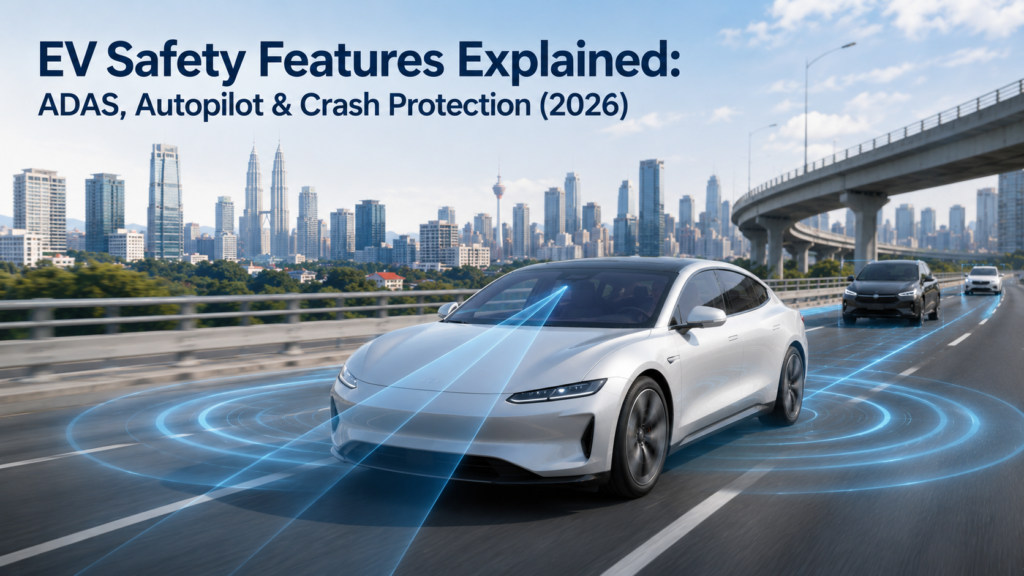
This guide breaks down exactly what EV safety features exist today, how ADAS actually works, why naming conventions like “Autopilot” can be misleading, and what post-crash protections EVs specifically need that gas cars don’t.
What Does ADAS Actually Mean?
ADAS stands for Advanced Driver Assistance Systems — a broad category of technologies that use cameras, radar, and sometimes LiDAR to monitor the road and either warn drivers of danger or take limited automatic action to prevent a crash. ADAS is now standard across roughly a third of vehicles sold in the US, Europe, Japan, and China, and among EV safety features specifically, it’s become close to a baseline expectation rather than a premium add-on by 2026.
Critically, ADAS provides assistance, not automation. Every current system on the market, regardless of branding, still requires the driver to remain attentive and ready to take control — none of today’s consumer EVs are legally or technically capable of true hands-off, eyes-off driving on public roads.
Core EV Safety Features You’ll Actually Encounter
Automatic Emergency Braking (AEB)
AEB uses forward-facing sensors to detect an imminent collision and applies the brakes automatically if the driver doesn’t react in time. This is widely considered one of the most impactful EV safety features available today, since it directly addresses the split-second reaction gap that causes many rear-end collisions.
Lane Keeping Assist (LKA) and Lane Centering
Using cameras to track lane markings, LKA gently steers the vehicle back if it drifts out of its lane without signaling — addressing one of the most common causes of highway accidents. Lane centering goes a step further, continuously making small steering adjustments to keep the car centered rather than just correcting drift after the fact.
Adaptive Cruise Control (ACC)
ACC automatically maintains a set following distance from the car ahead, adjusting speed in response to traffic. Increasingly, 2026 models pair this with stop-and-go functionality, extending the feature’s usefulness into congested city and highway traffic rather than just open-road cruising.
Blind Spot Monitoring and Rear Cross-Traffic Alert
These systems use radar or ultrasonic sensors to detect vehicles in blind spots or crossing behind the car while reversing, addressing situations where mirrors alone leave dangerous gaps in visibility.
Driver Attention Monitoring
An increasingly common addition among 2026 EV safety features, driver monitoring systems use interior cameras or steering pattern analysis to detect signs of drowsiness or distraction, prompting the driver to refocus. Updated 2026 testing protocols from organizations like Euro NCAP are pushing this further, now assessing systems for their ability to detect distraction, drowsiness, and even signs of substance impairment through behavioral analysis.
Why “Autopilot” and Similar Names Can Be Misleading
Naming is one of the more contentious issues surrounding EV safety features today. Tesla’s Autopilot, for instance, is a Level 2 system — meaning it handles steering and acceleration/braking simultaneously under driver supervision, but is not a self-driving system. Independent testing by Euro NCAP found that while Tesla’s system scored well on Safety Backup (94%), it performed poorly on Assistance Competence, and testers specifically flagged that the name “Autopilot” and its marketing suggest a level of automation the system doesn’t actually deliver. This gap between branding and actual capability is exactly why understanding EV safety features by what they technically do — not what they’re called — matters for safe use.
By contrast, Mercedes-Benz’s Drive Pilot is a genuine Level 3 system, certified for hands-off, eyes-off use at speeds up to 59 mph in Germany (currently limited to 37 mph in the US pending regulatory approval), using more than 35 sensors to maintain safety at that higher level of automation. The distinction matters enormously — Level 3 systems take on legal responsibility for driving within their approved conditions, while Level 2 systems, regardless of how capable they feel, still put full responsibility on the driver at all times.
The Sensor Technology Behind EV Safety Features
Most ADAS relies on a combination of cameras, radar, and increasingly LiDAR, fused together to build a real-time picture of the surrounding environment. Tesla notably uses a vision-only approach, relying entirely on cameras rather than radar or LiDAR — a strategy that works across a wider range of road types but has drawn scrutiny given the system’s crash history. Other automakers, including Mercedes-Benz and most legacy manufacturers, favor sensor fusion approaches combining multiple technologies, which generally offer more redundancy but a narrower range of conditions where the most advanced features are certified for use.
Weather remains a genuine limitation across the board: heavy rain, fog, or snow can temporarily degrade camera and even radar performance, which is why every current system — regardless of sensor approach — still requires driver readiness to take over immediately.
Crash Protection: What Happens When Prevention Fails
EV safety features aren’t only about crash avoidance. When a collision does happen, a second layer of protection takes over. Modern vehicles increasingly pair active safety systems with advanced restraint technology — multi-stage airbags, occupant-presence detection, and improved seatbelt pretensioners — designed to work together when prevention isn’t possible. 2026 crash testing standards have also expanded focus to rear-seat passengers specifically, now placing test dummies in rear positions to evaluate whether vehicles prevent the head from striking the front seatback and prevent “submarining,” where a passenger slides under the lap belt during a collision.
EV-Specific Post-Crash Safety: Thermal Runaway Detection
This is where EV safety features diverge meaningfully from gas car safety technology. Euro NCAP’s 2026 protocols specifically introduce new post-crash requirements for EVs, including thermal runaway detection systems designed to identify and mitigate battery-related fire hazards following a collision. Unlike a gas car, where post-crash fire risk stems from fuel leakage, an EV’s battery pack carries a distinct risk profile — a damaged battery can potentially enter thermal runaway, a chain reaction of overheating cells, sometimes hours after an initial impact. Thermal runaway detection systems monitor battery temperature and cell health after a crash, aiming to alert occupants and first responders before a dangerous escalation occurs, making this one of the more important EV-specific safety developments heading into 2026 testing cycles.
Regulatory Testing Catching Up in 2026
Testing standards are evolving quickly to keep pace with these systems. In the US, NHTSA added ADAS-specific pass/fail criteria to its New Car Assessment Program in 2026, evaluating forward collision warning, crash imminent braking, dynamic brake support, and lane departure warning as a standardized benchmark rather than relying purely on manufacturer claims. Euro NCAP’s parallel 2026 update expands driver monitoring requirements and introduces the EV-specific post-crash thermal runaway assessment described above. Together, these updates mean EV safety features are increasingly being independently verified rather than taken at face value from marketing material — a meaningful shift for buyers trying to compare systems objectively.
Limitations Every Driver Should Understand
- These are assistance systems, not autonomy — regardless of branding, every current consumer EV requires the driver to stay alert and ready to intervene at all times
- Weather can degrade performance — heavy rain, fog, or snow can temporarily reduce sensor accuracy across camera, radar, and LiDAR-based systems alike
- Software updates can change behavior — because many of these systems update over the air, how a feature behaves can shift without the driver necessarily realizing it changed
- Repair costs run higher — vehicles equipped with extensive ADAS hardware typically cost more to repair after a collision, since sensor recalibration is often required even for minor bodywork
- Overreliance is a real risk — safety researchers consistently note that some drivers become overly dependent on these systems, assuming more capability than the technology actually provides
What to Look for When Comparing EV Safety Features
When shopping for an EV in 2026, a few practical checks help separate genuinely useful safety technology from marketing gloss:
- Check independent test scores, not just manufacturer claims — Euro NCAP and NHTSA’s updated 2026 protocols now score ADAS performance directly, giving a more reliable picture than brochure language alone
- Understand the automation level, not just the feature name — ask specifically whether a system is Level 2 (assistance, driver always responsible) or something closer to Level 3, since the practical difference is significant
- Ask whether features are standard or trim-dependent — some automakers, like Chevrolet’s 2026 lineup, have moved toward standardizing core EV safety features across trims rather than reserving them for top-tier models, while others still gate advanced features behind expensive option packages
- Confirm how sensor recalibration works after repairs — since this affects long-term ownership cost, it’s worth asking your dealer or insurer how ADAS-equipped panels are handled after a collision
- Look specifically for EV post-crash protections — thermal runaway detection and similar battery-specific safety systems aren’t universal yet, so it’s worth confirming a specific model includes them rather than assuming all EVs do
Does This Apply the Same Way in Malaysia?
EV safety feature adoption in Malaysia generally follows global trends, though the mix of specific systems available depends heavily on which models and trims are sold locally, and testing standards like Euro NCAP’s protocols aren’t always directly applied to the Malaysian market in the same way. If you’re comparing EV models available in Malaysia and want to understand what fits local driving conditions, our Best EV Cars in Malaysia guide covers locally available models, and our Tesla Model 3 review discusses driver assistance features specifically in the context of Malaysian roads.
Final Thoughts
EV safety features in 2026 span a genuinely wide spectrum — from well-established basics like automatic emergency braking and lane keeping assist, to newer additions like driver attention monitoring and EV-specific thermal runaway detection. The single most important thing to understand across all of them is the gap between marketing names and actual capability: a system called “Autopilot” or “Full Self-Driving” is still, in every consumer vehicle on sale today, a driver assistance system requiring full attention, not genuine autonomy. As testing standards from NHTSA and Euro NCAP catch up to the technology in 2026, buyers are gaining better tools to evaluate these systems on verified performance rather than marketing claims alone — which is exactly the right direction for a category of features this consequential to get right.
Frequently Asked Questions
Is Tesla Autopilot the same as self-driving?
No. Autopilot is a Level 2 driver assistance system requiring full driver attention at all times — it is not a self-driving system, despite the name suggesting otherwise.
What is thermal runaway detection and why does it matter for EVs?
It’s a post-crash safety system that monitors EV battery temperature and cell health after a collision, aiming to detect and alert occupants to potential battery fire risk before it escalates — a risk profile unique to EVs compared to gas vehicles.
Do EV safety features work in bad weather?
Performance can be temporarily degraded by heavy rain, fog, or snow, since these conditions affect camera and radar sensor accuracy, which is why driver attentiveness remains essential regardless of weather.
Why do EVs with lots of ADAS features cost more to repair after an accident?
Many of these systems require sensor recalibration after even minor bodywork or windshield replacement, adding cost and complexity compared to repairing a vehicle without extensive ADAS hardware.
Is Level 3 automation available to consumers yet?
Very limited availability — Mercedes-Benz’s Drive Pilot is a genuine Level 3 system but is currently restricted to specific speeds and regions, such as Germany, with more limited approval still pending in markets like the US.
Pingback: Regenerative Braking Explained: How It Works & Why It Matter
Pingback: Over-the-Air (OTA) Updates: How Your EV Keeps Improving
Pingback: One-Pedal Driving in Malaysian Traffic: How to Use It Safely
Pingback: Windscreen Coverage in Malaysia: Is It Worth Adding? (2026)
Pingback: How to Prevent Windscreen Chips and Cracks While Driving
Pingback: OEM vs Aftermarket Windscreen Glass: What's the Difference?