
AC Charging vs DC Fast Charging: What’s the Difference?
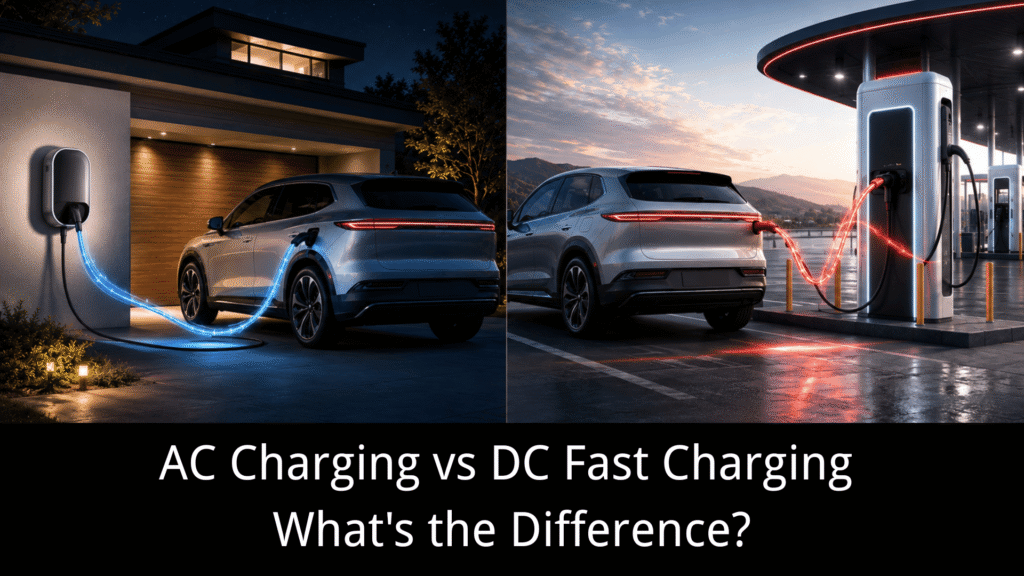
EV charging is one of the most important topics for electric vehicle owners.
Understanding the differences between AC charging and DC fast charging can help drivers save money, protect battery health and improve charging efficiency.
What Is AC Charging?
AC charging stands for Alternating Current charging.
Electricity from homes and most public charging stations is supplied as alternating current (AC). However, EV batteries can only store direct current (DC).
As a result, electricity must first be converted from AC to DC before it can be stored in the battery.
This conversion is performed by the vehicle’s onboard charger.
Common places to find AC chargers include:
- Homes
- Apartments
- Shopping malls
- Office buildings
- Public parking lots
For most EV owners, AC charging is the primary charging method for daily use.
How Does AC Charging Work?
The charging process is relatively simple:
- Electricity comes from the power grid as AC.
- The charging cable transfers power to the vehicle.
- The onboard charger converts AC into DC.
- The battery stores the electricity.
Because the conversion takes place inside the car, charging speed is limited by the onboard charger.
Common AC Charging Speeds
| Charger Power | Charging Time |
|---|---|
| 3.5 kW | 12–16 hours |
| 7 kW | 6–10 hours |
| 11 kW | 4–7 hours |
| 22 kW | 2–4 hours |
Actual charging times depend on:
- Battery capacity
- Vehicle model
- Battery temperature
- State of charge
For daily commuting, overnight charging is usually sufficient.
What Is DC Fast Charging?
DC fast charging delivers direct current directly to the battery.
Unlike AC charging, electricity conversion takes place inside the charging station rather than inside the vehicle.
Because DC chargers bypass the onboard charger, charging speeds are significantly faster.
DC charging stations are commonly found at:
- Highway service areas
- EV charging hubs
- Petrol stations
- Commercial centers
- Rest stops
How Does DC Fast Charging Work?
The charging process works as follows:
- Electricity comes from the power grid.
- The charging station converts AC into DC.
- DC electricity flows directly into the battery.
- The battery charges at a much higher speed.
This allows some chargers to deliver more than 250 kW of power.
Common DC Charging Speeds
| Charger Power | Charging Time (20%–80%) |
|---|---|
| 50 kW | 45–60 minutes |
| 120 kW | 30–40 minutes |
| 250 kW | 15–25 minutes |
| 350 kW | 10–20 minutes |
Charging speed depends on:
- Battery size
- Vehicle compatibility
- Battery temperature
- Charger output
Not all electric vehicles support ultra-fast charging.
AC Charging vs DC Fast Charging: Key Differences
| Feature | AC Charging | DC Fast Charging |
|---|---|---|
| Speed | Slow | Fast |
| Charging Power | 3–22 kW | 50–350 kW |
| Charging Time | 4–12 hours | 15–60 minutes |
| Cost | Lower | Higher |
| Conversion | Inside the car | Inside the charger |
| Location | Home and office | Highways and charging hubs |
Why Does Charging Slow Down After 80%?
Many EV owners notice that charging speed decreases significantly once the battery reaches around 80%.
This happens because the Battery Management System (BMS) protects the battery from:
- Overheating
- Overcharging
- Excessive voltage
- Battery degradation
Reducing charging speed helps improve battery lifespan.
Is DC Fast Charging Bad for EV Batteries?
Occasional DC fast charging is generally safe.
However, frequent fast charging can increase battery temperatures and place additional stress on battery cells.
Potential effects include:
- Increased heat
- Faster battery aging
- Reduced long-term efficiency
For everyday use, AC charging is usually recommended.
Which Charging Method Is Cheaper?
AC charging is usually cheaper because residential electricity rates are lower than public fast-charging stations.
Advantages of AC charging:
- Lower cost
- Better battery health
- Convenient overnight charging
Advantages of DC charging:
- Faster charging speed
- Ideal for road trips
- Useful in emergencies
Most EV owners use both charging methods.
When Should You Use AC Charging?
AC charging is ideal for:
- Overnight charging
- Daily commuting
- Office parking
- Apartment charging
- Shopping malls
If you drive less than 100 km per day, AC charging is usually enough.
When Should You Use DC Fast Charging?
DC fast charging is ideal for:
- Long-distance travel
- Highway driving
- Emergency charging
- Weekend trips
- Drivers with limited time
Most people do not need DC fast charging every day.
Final Verdict
Both AC charging and DC fast charging play important roles in the EV ecosystem.
AC charging is affordable, convenient and better for daily use, while DC fast charging provides speed and flexibility during long journeys.
The best strategy is simple:
- Use AC charging at home whenever possible.
- Use DC fast charging when speed matters.
Understanding the differences between these charging methods will help you save money, protect your battery and enjoy a better EV ownership experience.
Charging Connectors Around the World
Different countries and manufacturers use different charging connectors.
The most common EV charging standards include:
- Type 1 (SAE J1772)
- Type 2 (Mennekes)
- CCS1
- CCS2
- CHAdeMO
- Tesla NACS
Different charging standards support different charging speeds and power outputs.
Type 1
Commonly used in:
- United States
- Japan
Maximum charging speed:
- Up to 19.2 kW
Type 2
Commonly used in:
- Europe
- Malaysia
- Singapore
- Australia
Maximum charging speed:
- Up to 22 kW AC
CCS2
Commonly used in:
- Europe
- Malaysia
- China
Maximum charging speed:
- Up to 350 kW
CCS2 is currently the most popular DC fast-charging standard in Malaysia.
How Much Does EV Charging Cost?
Charging costs depend on:
- Electricity price
- Charger type
- Battery size
- Charging provider
Example:
60 kWh battery
Home charging price:
RM 0.50 / kWh
Total cost:
60 × RM 0.50 = RM 30
DC fast charging:
RM 1.20 / kWh
Total cost:
60 × RM 1.20 = RM 72
Home charging is generally much cheaper than public DC fast charging.
Can You Install an EV Charger at Home?
Yes.
Most EV owners install a wallbox charger at home.
Before installation, consider:
- Electrical capacity
- Parking location
- Safety regulations
- Installation cost
Typical installation costs:
- Basic installation: RM 1,500–RM 3,000
- Premium installation: RM 3,000–RM 6,000
What Is the 20%–80% Charging Rule?
Many EV manufacturers recommend keeping the battery between 20% and 80%.
Benefits include:
- Reduced battery stress
- Lower operating temperatures
- Longer battery lifespan
- Better charging efficiency
For long-distance travel, charging to 100% may still be necessary.
Can Rain Affect EV Charging?
No.
Modern charging systems are designed to operate safely in rainy conditions.
Charging connectors are protected against:
- Water splashes
- Dust
- Humidity
However, drivers should avoid:
- Damaged charging cables
- Flooded charging stations
- Broken connectors
AC vs DC Charging Pros and Cons Table
| Feature | AC Charging | DC Fast Charging |
|---|---|---|
| Charging Speed | Slow | Fast |
| Cost | Lower | Higher |
| Battery Health | Better | Slightly Worse |
| Convenience | High | Medium |
| Installation | Easy | Difficult |
| Best For | Daily Use | Road Trips |
Expert Recommendation
For most EV owners, the ideal charging strategy is:
- Use AC charging at home for daily driving.
- Use DC fast charging during road trips.
- Avoid relying on fast charging every day.
- Keep the battery between 20% and 80%.
Using both charging methods correctly can maximize battery life and reduce charging costs.
Final Conclusion
AC charging and DC fast charging each serve different purposes.
AC charging is affordable, convenient and ideal for everyday use, while DC fast charging offers speed and flexibility when traveling long distances.
The best solution is to combine both charging methods according to your driving habits.
Understanding how each charging method works will help you save money, improve battery health and get the most out of your electric vehicle.
Frequently Asked Questions
What is the difference between AC charging and DC fast charging?
AC charging converts electricity inside the vehicle, while DC fast charging converts electricity inside the charging station.
Which charging method is faster?
DC fast charging is significantly faster than AC charging and can charge an EV from 20% to 80% in as little as 20 minutes.
Is AC charging better for battery health?
Yes. AC charging generates less heat and is generally considered better for long-term battery health.
Can I use DC fast charging every day?
Yes, but frequent fast charging may increase battery wear over time.
Why does charging slow down after 80%?
The Battery Management System (BMS) reduces charging speed to protect the battery from overheating and overcharging.
Is home charging cheaper than public charging?
Yes. Home charging is usually much cheaper than public DC fast charging stations.
Can I charge my EV in the rain?
Yes. Modern EV charging systems are designed to operate safely in wet conditions.
How long does AC charging take?
Depending on the charger and battery size, AC charging can take anywhere from 4 to 16 hours.
How long does DC fast charging take?
Most DC fast chargers can charge an EV from 20% to 80% in 20 to 60 minutes.
Can all EVs use DC fast charging?
No. Not all electric vehicles support DC fast charging, and charging speeds vary by model.
What is AC charging?
AC charging uses alternating current from the power grid, which is converted into direct current by the vehicle’s onboard charger before being stored in the battery.
What is DC fast charging?
DC fast charging converts electricity inside the charging station and delivers direct current directly to the battery, allowing much faster charging speeds.
Is DC charging bad for EV batteries?
Occasional DC fast charging is safe, but frequent use may increase battery degradation due to higher temperatures.
Which is cheaper: AC charging or DC fast charging?
AC charging is generally cheaper because residential electricity rates are lower than public fast-charging prices.
Which charging method is best?
AC charging is best for daily use, while DC fast charging is ideal for road trips and emergency charging.
AC Charging Pros
- Lower charging costs
- Better battery health
- Convenient for overnight charging
- Easier home installation
- Widely available
AC Charging Cons
- Slower charging speeds
- Longer waiting times
DC Fast Charging Pros
- Extremely fast charging
- Ideal for long-distance travel
- Convenient during emergencies
- Expands driving flexibility
DC Fast Charging Cons
- More expensive
- May accelerate battery degradation
- Limited availability in some areas
Common EV Charging Mistakes
- Relying on DC fast charging every day
- Frequently charging to 100%
- Letting the battery drop to 0%
- Using damaged charging cables
- Ignoring software updates
- Charging in flooded areas
- Parking with a fully charged battery for long periods
Avoiding these mistakes can help extend battery life and improve charging efficiency.
Key Takeaways
- AC charging is slower but cheaper.
- DC fast charging is faster but more expensive.
- AC charging is generally better for battery health.
- DC fast charging is ideal for long-distance travel.
- Most EV owners use both charging methods.
- Keeping the battery between 20% and 80% may help extend battery life.
- Home charging is usually the most cost-effective option.
Conclusion
AC charging and DC fast charging each play an important role in the electric vehicle ecosystem.
AC charging is affordable, convenient and ideal for everyday use, while DC fast charging offers speed and flexibility for long-distance travel.
The best charging strategy is to use AC charging at home whenever possible and rely on DC fast charging only when necessary.
By understanding the differences between these charging methods, EV owners can save money, protect their batteries and enjoy a better driving experience.
Pingback: Home EV Charger Installation Guide (2026)