
EVs in Malaysia depreciate faster than petrol cars in the first 3-5 years, with typical 5-year resale value retention of 50-60% for mainstream Chinese-brand EVs versus 65-75% for Tesla — but this steep early curve tends to flatten out once a vehicle passes the halfway point of its battery warranty period. Battery health, brand trust, and charging infrastructure access are the three biggest factors separating an EV that holds its value from one that doesn’t.
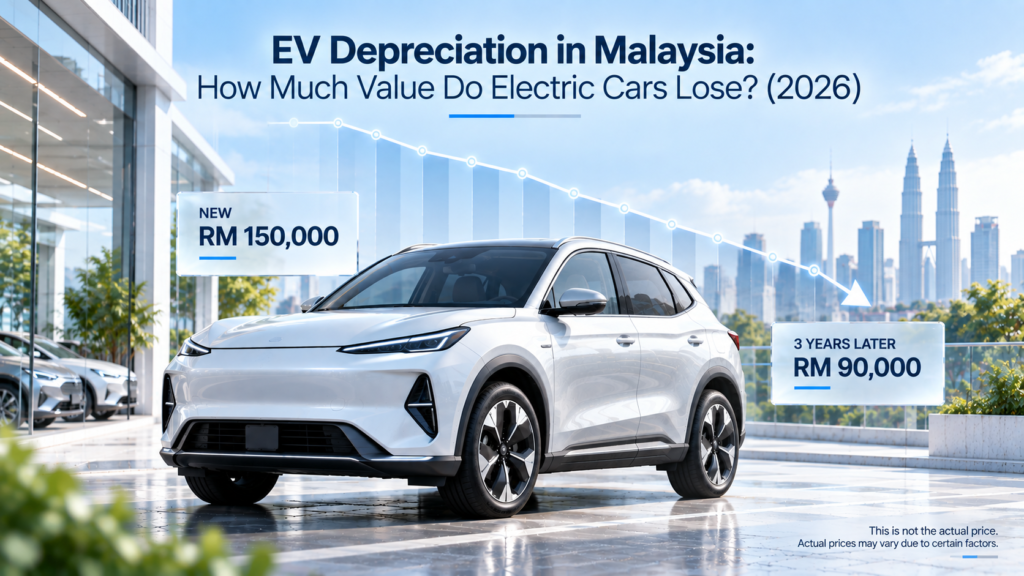
This guide breaks down exactly how much value EVs lose in Malaysia, why the depreciation curve looks different from a petrol car’s, which brands hold value best, and what actually drives the difference.
Why EVs Depreciate Faster Than Petrol Cars in Malaysia
EVs tend to depreciate faster than internal combustion engine (ICE) vehicles in Malaysia, especially within the first five years, primarily due to three compounding factors: battery degradation concerns, limited charging infrastructure in some areas, and rapid year-over-year technology advancement making older EVs feel outdated faster than an equivalent-age petrol car. Unlike a petrol car, where mechanical wear is the main resale concern, an EV’s value is disproportionately tied to a single number — its battery’s remaining capacity — giving buyers and sellers alike a much sharper reference point for negotiating price than petrol resale ever had.
Malaysia’s 5-Year Resale Value Retention by Brand
Resale value retention varies significantly by brand in Malaysia, and the gap is wider than most buyers expect:
| Brand Positioning | 5-Year Resale Retention | Key Driver |
|---|---|---|
| Tesla | 65-75% | Strong brand trust, established Supercharger network, proven battery longevity |
| Chinese brands (BYD, etc.) | 50-60% | Rapid model turnover, newer generations with better specs launching frequently |
Chinese EV brands have been depreciating faster than initially expected in the Malaysian market, largely because new-generation models with longer range and better specs at competitive prices keep arriving, making the previous generation feel dated more quickly than buyers anticipated when purchasing new.
How Malaysia’s Road Tax Changes Affect Resale Value
The free road tax era for EVs in Malaysia ended on 31 December 2025 — starting 1 January 2026, EVs pay road tax under a new kW-based structure, though this remains roughly 85% cheaper than the equivalent ICE-engine-based road tax. This policy shift matters for resale value specifically because it removes one incentive that previously made new EV purchases more attractive relative to used ones. Buyers evaluating used EVs should factor in current road tax obligations under the new structure rather than assuming the old free road tax benefit still applies, since this changes the ongoing cost comparison against a used petrol alternative.
Battery Health: The Single Biggest Factor in Resale Value
Battery State of Health (SoH) has become the single biggest factor in used EV pricing — a car at 90%+ SoH commands a clear resale premium over an otherwise identical car at 75% SoH. This represents a genuine structural shift from how petrol car resale has always worked: petrol resale never had one dominant mechanical metric the way EVs now have battery SoH. Real-world data from Malaysian EV owner communities shows liquid-cooled lithium-ion battery packs (used by Tesla, BYD, MG, Volvo, Polestar, Mercedes-EQ, and BMW-i) losing roughly 10-15% of usable capacity over 5 years in Malaysian tropical conditions — a genuine but manageable degradation rate rather than the dramatic capacity collapse some buyers fear. If you’re evaluating a specific used EV’s battery condition, our Used EV Buying Guide Malaysia covers exactly how to check this before purchasing.
Does Depreciation Stabilize Over Time?
Yes — EV resale value in Malaysia tends to be steepest in the early years and stabilizes noticeably after the vehicle passes the halfway point of its battery warranty period. Most EVs sold in Malaysia carry an industry-standard 8-year or 160,000 km battery warranty (whichever comes first), covering capacity dropping below 70-75% of new. Once a vehicle passes roughly the 4-year mark within that warranty window, buyers gain more confidence that the remaining battery life is well-documented and covered, which reduces the steep uncertainty discount applied to newer used EVs still within their first few years.
Factors That Influence How Well a Specific EV Holds Value
Beyond brand and battery health broadly, several specific factors influence resale value for any individual EV:
- Charging network access — a wider public charging network improves practical usability, which in turn boosts resale interest; EVs that are harder to charge conveniently in a given area tend to see softer demand
- Remaining battery warranty coverage — buyers actively look for good battery condition backed by long remaining warranty coverage, since this directly reduces their own risk in the purchase
- Brand trust and service network maturity — premium and well-established brands like Tesla or BYD tend to retain value better specifically because of accumulated brand trust and proven battery quality over multiple years of local ownership data
- Original incentive exposure — tax breaks or road tax exemptions that boosted a model’s original demand don’t always translate into long-term resale strength, since these government incentives affected the new-car market at time of purchase, not necessarily what a buyer values years later
Does Faster Depreciation Mean EVs Are a Bad Financial Choice?
Not necessarily — resale value is only one part of total ownership cost, and it needs to be weighed against fuel savings, reduced maintenance costs, and any incentives received at purchase. With home charging, EV running costs in Malaysia can drop to roughly RM80-150 per month, compared to RM380-580 for an equivalent petrol car covering similar mileage. Even with steeper depreciation in the first five years, the combined savings from lower running costs and reduced maintenance can offset a meaningful portion of the resale value gap, particularly for owners who keep the vehicle well past the steepest depreciation window rather than trading in early.
Common Myths About EV Depreciation in Malaysia
“All EVs depreciate at the same rate regardless of brand.” Not true. The gap between Tesla’s 65-75% five-year retention and mainstream Chinese brands’ 50-60% is substantial, driven by differences in brand trust, battery track record, and how frequently newer generations of a given model arrive on the market.
“Steep depreciation means EVs are always a worse financial choice than petrol cars.” This overlooks total ownership cost. Lower running costs (RM80-150/month with home charging versus RM380-580 for petrol) and reduced maintenance can offset a meaningful portion of the resale gap, particularly for owners who keep the vehicle for several years rather than trading in early.
“A battery warranty means degradation doesn’t matter for resale.” Warranty coverage protects against catastrophic failure, but SoH still varies meaningfully within the warranty’s acceptable range (down to 70-75%), and buyers price this variation into what they’re willing to pay even for a vehicle still under warranty.
“Government incentives always help resale value.” Not necessarily — tax breaks or road tax exemptions that boosted a model’s original demand affected the new-car buying decision at the time, but they don’t automatically translate into stronger resale value years later once those specific incentives have changed or expired.
How to Minimize EV Depreciation as an Owner
- Charge to 80% as your daily ceiling, reserving 100% charges specifically for longer trips — this habit measurably slows battery degradation and preserves resale-relevant SoH longer
- Avoid frequent DC fast charging above 100kW when AC charging is available — fast charging accelerates calendar aging of the battery pack compared to routine home charging
- Park in shade or covered parking when possible — sustained cell temperatures above 40°C during idle periods accelerate capacity loss, a genuinely relevant consideration in Malaysia’s climate
- Keep documented service and charging history — buyers increasingly value transparency, and a well-documented ownership history supports a stronger resale price when the time comes
- Choose brands with established local service networks — this reduces a future buyer’s perceived risk, which translates into a measurably stronger resale position compared to less-established brands with thinner local support
The Global Context Behind Malaysia’s EV Depreciation Trend
Malaysia isn’t alone in seeing steeper EV depreciation — this reflects a broader global pattern the industry is still adjusting to. China’s used EV market, for instance, saw resale value retention for 3-year-old electric cars fall from around 46% in 2024 to about 42% by late 2025, compared to roughly 50-55% for the broader used car market over the same period. Rapid battery technology improvements are a major driver globally, since newer models quickly make older EVs feel outdated, accelerating depreciation on previous-generation vehicles in a way that doesn’t have a direct petrol-car equivalent. Understanding that this EV depreciation pattern is a global maturing-market phenomenon — not a Malaysia-specific problem — helps put local resale figures in proper context.
Final Thoughts
EV depreciation in Malaysia genuinely runs steeper than petrol cars in the first 3-5 years, but the gap isn’t as one-sided as headline percentages suggest once total ownership cost, battery warranty structure, and post-warranty-midpoint stabilization are factored in. Tesla currently holds value noticeably better than Chinese EV brands in the Malaysian market, reflecting stronger brand trust and a more mature charging and service ecosystem, though this gap may narrow as newer Chinese brands build up their own multi-year local track records. For buyers specifically concerned about resale value, prioritizing battery health maintenance, choosing brands with strong local support, and understanding that depreciation stabilizes after the battery warranty’s halfway point are the most actionable ways to protect an EV’s long-term value in Malaysia.
Frequently Asked Questions
Do EVs lose value faster than petrol cars in Malaysia?
Yes, generally, especially within the first 3-5 years, driven mainly by battery degradation concerns, charging infrastructure variability, and rapid technology turnover among newer EV models.
Which EV brand holds its value best in Malaysia?
Tesla currently retains value best, with roughly 65-75% resale retention at 5 years, compared to 50-60% for mainstream Chinese EV brands.
Does battery health really affect an EV’s resale value that much?
Yes — battery State of Health has become the single biggest factor in used EV pricing, with a car at 90%+ SoH commanding a clear premium over an otherwise identical car at 75% SoH.
Does EV depreciation stabilize over time?
Yes, typically after a vehicle passes the halfway point of its battery warranty period (often around the 4-year mark on an 8-year warranty), as remaining battery life becomes more predictable and better documented.
How did Malaysia’s 2026 road tax changes affect EV resale value?
The free road tax era ended on 31 December 2025, with EVs now paying under a new kW-based structure from 1 January 2026 — still roughly 85% cheaper than equivalent ICE road tax, but a factor buyers should account for when comparing used EV total ownership costs.